Catholic or Christian means a question about the relationship between Catholicism and Christianity, and if Catholics are considered Christians.
Many people search for this phrase because they are unsure if “Catholic” and “Christian” describe two different religions or if one is part of the other.
The confusion is easy to understand. In everyday conversations, people sometimes say “Catholic or Christian” as if they are two separate choices.
However, the terms have different meanings. Christian is the broader term for a person who follows Jesus Christ, while Catholic refers to a specific Christian tradition and membership in the Catholic Church.
Understanding this difference can help you use both words correctly in conversations, emails, articles, and online content. It also helps explain why someone can be both Catholic and Christian at the same time.
In this guide, we will explore the meaning, origin, spelling, common mistakes, everyday examples, and usage of catholic or christian.
If you are a student, writer, or simply looking for a quick answer, this guide will make the difference clear and easy to understand.
Catholic or Christian: Quick Answer
Catholic and Christian are not normally two opposite choices. A Catholic is a Christian.
The word Christian is a broad term for a follower of Jesus Christ. The word Catholic identifies a particular Christian tradition and church.
For example:
- A Catholic Christian → Christian
- A Protestant Christian → Christian
- An Eastern Orthodox Christian → Christian
- A Catholic → specifically a member of the Catholic Church
The Catholic Church itself describes “Christian” as a name derived from Christ and used for followers of Christ.
So, if someone asks, “Are Catholics Christians?”, the straightforward answer is yes.
The confusion happens because some people use “Christian” in everyday speech to mean “Protestant.” That is a narrower use of the word, not its broad historical meaning.
The Origin of Catholic or Christian
The two words have different histories.
Origin of “Christian”
The word Christian comes from Christ, meaning a follower of Christ. The New Testament says that Jesus’ disciples were first called Christians at Antioch. The Catholic Church’s Catechism also identifies this as the origin of the name.
The term therefore describes people connected with the Christian faith.
Origin of “Catholic”
The word Catholic comes from the Greek word katholikos, meaning universal or according to the whole. It passed through Latin and French before entering English. Merriam-Webster records its English history and traces it back to Greek.
Historically, “catholic” could describe the universal Christian Church. Over time, Catholic became strongly associated with the Roman Catholic Church.
The term was used by early Christians before it became the familiar denominational label used today. Historical sources record the expression “Catholic Church” in early Christian writings.
Why do people think they are different?
Modern conversations often use Catholic and Christian as if they were equal categories. This is the main source of confusion.
A more accurate structure is:
Christianity → Christian traditions → Catholic, Orthodox, Protestant, and others
Therefore, “Christian” is generally the wider category, while “Catholic” is more specific.
British English vs American English Spelling
There is no major British-versus-American spelling difference between Catholic and Christian.
Both British and American English normally spell the words the same way:
| Word | British English | American English |
| Catholic | Catholic | Catholic |
| Christian | Christian | Christian |
| Christianity | Christianity | Christianity |
| Catholicism | Catholicism | Catholicism |
The main difference is usually capitalization and context, not regional spelling.
For example:
- Catholic Church: capitalize when referring to the specific church.
- Christian faith: capitalize Christian.
- Christianity: capitalize the name of the religion.
- Catholic: lowercase can be used when the word means “universal” rather than referring to the Catholic Church.
Which Spelling Should You Use?
If your question is really about which word to use, choose based on meaning rather than British or American spelling.
For a general audience
Use Christian when you mean a follower of Jesus Christ in a broad sense.
Example:
“Christian traditions include Catholic, Orthodox, and Protestant communities.”
When referring specifically to the Catholic Church
Use Catholic.
Example:
“She attends a Catholic church.”
For US audiences
The word Christian is sometimes used in everyday conversation to mean Protestant or evangelical Christian. If you need to be precise, use the specific term Catholic, Protestant, or another denomination.
For UK and Commonwealth audiences
The same basic distinction applies. Use Christian for the broad category and Catholic when referring specifically to Catholic identity or the Catholic Church.
For global content
The safest approach is to explain the relationship clearly:
“Catholics are Christians, but not all Christians are Catholic.”
This sentence removes most confusion.
Common Mistakes with Catholic or Christian
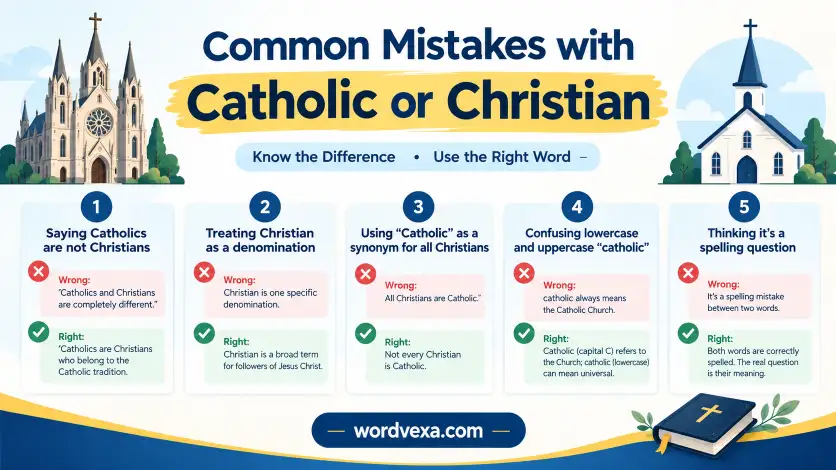
Mistake 1: Saying Catholics are not Christians
Incorrect:
“Catholics and Christians are completely different.”
Better:
“Catholics are Christians who belong to the Catholic tradition.”
Mistake 2: Treating Christian as a denomination
Christian is usually a broad religious identity, not one single denomination.
Better:
“Catholicism is a Christian tradition.”
Mistake 3: Using “Catholic” as a synonym for every Christian
Not every Christian is Catholic.
Example:
A Protestant can be Christian without being Catholic.
Mistake 4: Confusing lowercase and uppercase “catholic”
Catholic with a capital C usually refers to Catholic identity or the Catholic Church.
catholic with a lowercase c can mean universal or broad.
Mistake 5: Assuming the question is about spelling
The phrase “catholic or christian” is usually not a spelling question. Both words have standard spellings in British and American English. The real issue is their meaning and relationship.
Everyday Examples
In an Email
“I am writing to confirm the Catholic community event scheduled for Sunday.”
Here, Catholic is specific.
In News Writing
“Christian communities around the world celebrated the event.”
Here, Christian is broad.
On Social Media
“I am Catholic, and my faith is an important part of my life.”
The speaker uses Catholic to give a more specific identity.
In Formal Writing
“Catholicism is one of the major traditions within Christianity.”
This is clear and precise.
In General Conversation
“Are you Christian?”
A Catholic may reasonably answer:
“Yes, I am Catholic.”
This gives both the broad identity and the specific tradition.
Catholic or Christian: Google Trends & Usage Data
People search this mainly because they want to understand the relationship between the two terms. Related searches often focus on questions such as if Catholics are Christians, how Catholicism differs from Protestant Christianity, and what the word Catholic means.
Google Trends does not provide raw search counts. Instead, it uses a normalized scale from 0 to 100, where 100 represents the highest relative search interest for the selected time and place. Google also allows interest to be compared by country, region, and city.
This means a Trends score should not be read as an exact number of searches.
Search interest also changes by location and context. Searches using Catholic are especially relevant in places with large Catholic populations, while Christian is a much broader term used across many countries and Christian traditions.
- Are Catholics Christians?
- Catholic vs Christian
- What is the difference between Catholic and Christian?
- Is Catholicism Christianity?
- Catholic meaning
- Christian meaning
- Catholic Church vs Protestant Church
Google states that Trends can compare search terms and examine interest by location, but the results are relative rather than absolute search-volume figures.
Catholic or Christian: Comparison Table
| Term | Meaning | Scope | Example |
| Christian | Follower of Jesus Christ | Broad | “She is Christian.” |
| Catholic | Member of the Catholic Church | Specific | “She is Catholic.” |
| Christianity | Religion centered on Christ | Broad | “Christianity is practiced worldwide.” |
| Catholicism | Catholic tradition and faith | Specific | “Catholicism has a long history.” |
| Protestant | A major Christian tradition | Specific | “He is Protestant.” |
| Orthodox Christian | Another historic Christian tradition | Specific | “She belongs to an Orthodox Church.” |
The key point is simple: Catholic is more specific, while Christian is broader.
FAQs
1. Are Catholics Christians?
Yes. Catholics are Christians. The Catholic Church identifies Christians as followers of Christ, and Catholic teaching describes the Church as part of the Christian faith.
2. Is Catholic the same as Christian?
Not exactly. Catholic is a specific Christian identity, while Christian is the broader term.
3. Can you be Catholic and Christian at the same time?
Yes. A person can accurately describe themselves as both Catholic and Christian.
4. What is the difference between Catholic and Christian?
The main difference is that Christian is a broad term, while Catholic identifies a particular Christian tradition and church
5. Is Christianity bigger than Catholicism?
Yes. Christianity includes multiple traditions. Catholicism is one major tradition within Christianity.
6. Should I say Catholic or Christian?
Use Christian when speaking generally about followers of Christ. Use Catholic when you specifically mean the Catholic tradition or Catholic Church.
7. Is “Catholic” a spelling difference in British English?
No. Catholic is normally spelled the same in British and American English. The same is true for Christian.
Conclusion
The phrase “catholic or christian” can be confusing because people often use the two words in everyday speech as if they describe separate religions. The key fact is simple: Catholics are Christians, but not all Christians are Catholic.
Christian is the broader term. It describes people who follow Jesus Christ and includes several Christian traditions. Catholic is more specific and normally refers to people who belong to the Catholic Church.
There is also no important British-versus-American spelling difference between Catholic and Christian. The bigger issue is choosing the word that matches your meaning. Use Christian for a broad reference and Catholic for a specific reference to Catholic identity or the Catholic Church.
For websites, articles, emails, and everyday conversation, clear wording is best. If your audience may be confused, simply explain the relationship: Catholicism is a Christian tradition, and Catholics are Christians. This gives readers the quick answer while avoiding a common misunderstandings.
Explore More Articles:

I’m Sloane Mercer, a U.S.-based English language writer focused on grammar, spelling, vocabulary, and everyday English usage. Through Wordvexa, I provide clear and practical explanations to help readers choose the right words and communicate with confidence.








5 thoughts on “Catholic or Christian: What Is the Difference?”