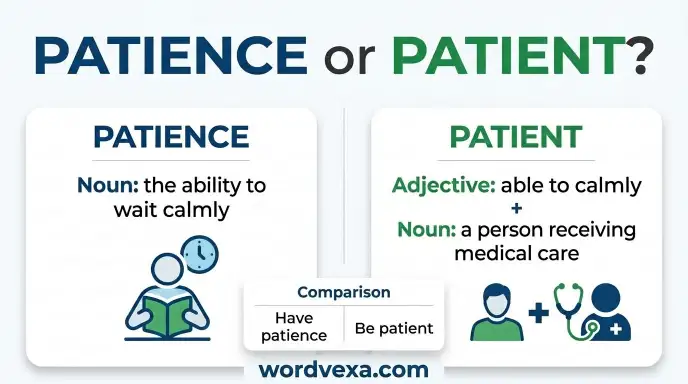
Patience or patient refers to two closely related English words: patience is the ability to remain calm while waiting or dealing with difficulties, while patient describes someone who has this quality.
Although they look and sound similar, they have different grammatical uses.Many English learners and writers confuse these words because both are connected to the idea of staying calm and enduring difficult situations.
For example, we say “She has great patience,” but “She is very patient.” Using the wrong form can make a sentence grammatically incorrect or change its meaning.
Understanding the difference is simple once you know their parts of speech. In this guide, you will learn the meanings of patience and patient, how to use them correctly, common mistakes to avoid, and practical examples for everyday, academic, and professional English.
Patience or Patient: Quick Answer
The easiest way to remember the difference is:
- Patience = a quality or ability
- Patient = describing a person
- Patient = also a person receiving medical treatment
Examples
- She has a lot of patience with children.
- She is very patient with children.
- The doctor examined the patient.
Notice the grammar:
have + patience
be + patient
So, if you are describing someone’s behavior, use patient.
If you are naming the quality itself, use patience.
What Does Patience Mean?
Patience is a noun. It describes the ability to wait calmly, deal with problems without becoming angry, or continue doing something despite difficulty. Cambridge Dictionary defines it as the ability to wait or continue despite difficulties without becoming annoyed.
Examples of patience
- Learning a new language takes patience.
- You need patience when teaching young children.
- Thank you for your patience.
- His patience finally ran out.
Common expressions include:
- have patience
- show patience
- need patience
- lose patience
- test someone’s patience
- run out of patience
- have the patience to do something
Part of speech
Patience = noun
It normally refers to the quality itself.
Example:
Her patience helped her complete the difficult project.
Here, patience is the thing she has.
What Does Patient Mean?
Patient has two major uses.
1. Patient as an adjective
As an adjective, patient describes someone who can wait calmly or deal with problems without becoming angry.
Examples:
- She is patient with her students.
- Please be patient.
- He is a patient teacher.
- You need to be patient while learning.
2. Patient as a noun
As a noun, patient means a person who is receiving medical care from a doctor, dentist, hospital, or other healthcare professional.
Examples:
- The doctor examined the patient.
- The hospital treated 50 patients.
- The patient is recovering well.
This medical meaning is completely different from the adjective meaning, even though the spelling is identical.
Part of speech
Patient = adjective or noun
| Word | Part of Speech | Meaning |
| patience | Noun | The ability to wait calmly |
| patient | Adjective | Able to wait calmly |
| patient | Noun | A person receiving medical care |
The Origin of Patience and Patient
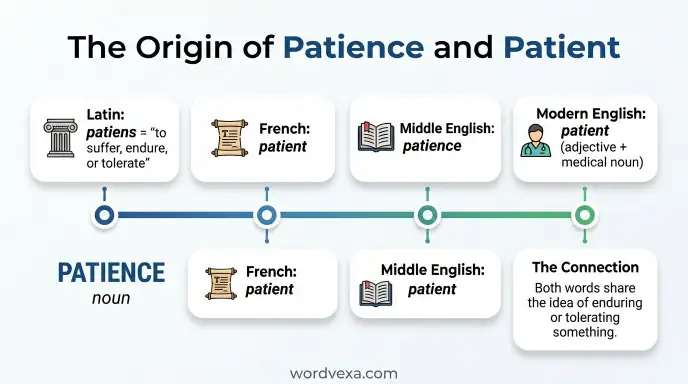
The two words are closely related. Their history goes back through French to Latin.
Patience entered English around the Middle English period. Merriam-Webster records its first known use in the 13th century and traces its etymology through patient.
The related adjective patient dates from the 14th century in English. Merriam-Webster traces it to Middle English pacient, Anglo-French, and Latin patient- / patiens, from pati, meaning to suffer or endure.
The historical connection makes sense because both words developed around the idea of enduring, bearing, or tolerating something.
Over time, their grammatical roles became clearer:
- patient became the adjective describing someone who can endure or wait calmly.
- patience became the noun naming that quality.
- patient also developed its medical noun meaning, referring to someone receiving treatment.
So these are not unrelated words. They are part of the same word family.
British English vs American English
There is no major British-American spelling difference between patience and patient. Both forms are standard in British and American English.
The main regional difference worth noting is another meaning of patience. In British English, patience can also refer to a card game that Americans commonly call solitaire.
| British English | American English | Example |
| patience | patience | Patience is important when teaching. |
| patient | patient | She is patient with children. |
| patient | patient | The patient is waiting for the doctor. |
| patience, as a card game | solitaire | She enjoys playing patience/solitaire. |
Regional usage
For normal writing about behavior, waiting, or medical care, patience and patient work the same way in both varieties of English.
Style guides generally do not require you to change these words based on if you are writing for a British or American audience.
The main thing is to use the correct part of speech and meaning.
Which Version Should You Use?
Use the word that matches the grammar and meaning of your sentence.
United States
Use patience for the quality:
Thank you for your patience.
Use patient as an adjective:
Please be patient.
Use patient as a medical noun:
The patient needs additional tests.
United Kingdom
The same rules apply:
You need patience.
You need to be patient.
In British English, patience can additionally refer to the card game known as solitaire in American English.
Canada
Canadian English generally follows the same distinction:
Her patience was impressive.
She was patient with the children.
Australia
Australian English also uses the same standard distinction:
Patience is important.
He is very patient.
International English
For international readers, especially ESL learners, the safest rule is simple:
Patience is the quality. Patient describes a person or means a medical patient.
Academic writing
Use the noun when discussing the quality as a concept:
Patience is an important quality in effective teaching.
Use the adjective when describing a person:
Effective teachers are patient with learners.
Business writing
A common professional phrase is:
Thank you for your patience and understanding.
This is especially useful when an organization is responding to delays or service problems.
Common Mistakes With Patience or Patient
Mistake 1: Using patient as a noun for the quality
❌ She has a lot of patient.
✅ She has a lot of patience.
Why?
You are talking about a quality, so you need the noun patience.
Memory tip:
If you can say a lot of, think of patience.
Mistake 2: Using patience after “be”
❌ You need to be patience.
✅ You need to be patient.
Why?
After be, you need an adjective when describing someone.
Memory tip:
Be patient.
Have patience.
Mistake 3: Confusing “patient” with “patience” in medical writing
❌ The patience was taken to the hospital.
✅ The patient was taken to the hospital.
Why?
A person receiving medical care is a patient.
Mistake 4: Using “patient” when you mean the quality
❌ Thank you for your patient.
✅ Thank you for your patience.
The phrase “Thank you for your patience” is standard because you are thanking someone for the quality they showed while waiting.
A simple memory trick
Remember this:
Patient = person or personality
Patience = quality
You can be patient, but you have patience.
Everyday Examples
Emails
Thank you for your patience while we resolve this issue.
Business writing
We appreciate your patience during the service update.
News headlines
Officials Ask Residents for Patience During Repairs
Blogs
Learning to cook well requires patience and practice.
Social media
Good things take time. Stay patient!
Academic writing
Patience can help learners continue working through challenging tasks.
Daily conversation
“How long will it take?”
“I’m not sure. You’ll have to be patient.”
Medical context
The patient was asked to wait for the test results.
These examples show why context matters. The same word family can appear in education, business, healthcare, social media, and everyday speech.
Google Trends & Modern Usage
People commonly search “patience or patient” because the words look and sound similar and belong to the same word family. The confusion is especially common among English learners who are deciding which form fits a sentence.
There is no major British-versus-American spelling issue with these two words. Both patience and patient are standard in modern English.
Modern usage also keeps both words highly practical:
- patience appears in phrases about waiting, tolerance, and perseverance.
- patient often describes someone’s behavior.
- patient is also common in healthcare contexts.
- patiently is the related adverb.
Exact Google Trends numbers can change over time and by location, so specific popularity figures should not be claimed without checking the current Google Trends data for a defined region and time period.
The important search-intent pattern is clear: people usually want to know if they should say “be patient” or “have patience.”
Quick Comparison Table
| Version | Meaning | Correct? | Region | Example |
| patience | Ability to wait calmly | Yes | All major English varieties | She has great patience. |
| patient | Able to wait calmly | Yes | All major English varieties | She is very patient. |
| patient | Person receiving medical care | Yes | All major English varieties | The patient saw the doctor. |
| patience | Card game | Yes | Mainly British English | They played patience. |
| patient | Medical person | Yes | American English | The patient is recovering. |
Grammar shortcut
| Sentence Pattern | Correct Word | Example |
| have + | patience | I have patience. |
| show + | patience | Show some patience. |
| lose + | patience | He lost his patience. |
| be + | patient | Please be patient. |
| very + | patient | She is very patient. |
| the + in healthcare | patient | The patient is resting. |
Key Takeaways
- Patience is a noun.
- Patient is usually an adjective.
- Patient can also be a noun for someone receiving medical care.
- Say “Be patient”, not “be patience.”
- Say “Have patience”, not “have patient.”
- “Thank you for your patience” is the correct expression.
- British and American English use the same standard forms.
- In British English, patience can also mean the card game called solitaire in the US.
- Both words come from the same historical word family related to enduring or suffering.
FAQs About Patience or Patient
Is it patience or patient?
It depends on the sentence. Patience is a noun meaning the ability to wait calmly or deal with difficulty. Patient is an adjective meaning able to wait calmly.
Patient is also a noun meaning someone receiving medical care. For example, “She has patience” and “She is patient” are both correct.
What is the difference between patient and patience?
The main difference is grammar. Patient is normally an adjective that describes a person, while patience is a noun that names the quality of staying calm.
Compare “He is patient” with “He has patience.” The two words are closely related but cannot always replace each other.
Is it “be patient” or “be patience”?
The correct phrase is “be patient.” Patient is an adjective, so it can describe someone’s behavior after the verb be.
For example, “Please be patient while we check your order.” Patience is a noun, so you would say, “Please have patience.”
Is it “thank you for your patience” or “patient”?
The correct expression is “Thank you for your patience.” Patience is the quality someone shows while waiting or dealing with a delay.
This phrase is common in professional emails, customer service messages, business notices, and other formal communication.
Is patient a noun or an adjective?
Patient can be both. As an adjective, it describes someone who can wait calmly, as in “She is patient.” As a noun, it means someone receiving medical care, as in “The patient is waiting for the doctor.” Context tells you which meaning is intended.
What is the noun form of patient?
The noun related to the adjective patient is patience. For example, “She is patient” uses the adjective, while “She has patience” uses the noun.
The word patient itself can also function as a noun, but in that case it has the separate medical meaning of a person receiving treatment.
What is the adjective form of patience?
The adjective form is patient. For example, “He has patience” can be changed to “He is patient.” Another related form is patiently, which is an adverb: “She waited patiently for her turn.”
Is “patience” a noun?
Yes. Patience is a noun, and it usually refers to the ability to remain calm while waiting, facing difficulty, or dealing with annoyance. It is generally an uncountable noun, so we say “a lot of patience” rather than “a lot of patiences.”
Is “patient” related to medical treatment?
Yes. Patient is commonly used as a noun for a person receiving medical care. For example, “The doctor examined the patient.” This medical sense is separate from the adjective patient, although both meanings have the same historical word family.
How can I remember patience vs patient?
Use this simple rule: patient describes a person, while patience names the quality. Think of the phrases “be patient” and “have patience.” If you remember those two patterns, you can avoid most common mistakes.
Conclusion
Understanding patience or patient becomes easy once you focus on grammar. Patience is a noun that names the ability to wait calmly, tolerate difficulties, or remain composed.
Patient is usually an adjective that describes someone with this quality. It can also be a noun referring to someone receiving medical treatment.
The most useful patterns are “have patience” and “be patient.” For example, “Thank you for your patience” is correct, while “Please be patient” is also correct.
There is no major British-American spelling difference between these words. The important difference is their meaning and grammatical function.
If you are writing an email, completing an English assignment, preparing an academic paper, or speaking in everyday English, choosing the right form depends on what you mean.
Remember: You have patience, but you are patient.
Keep this simple rule in mind, and you will rarely confuse these two words again.
You May Also Like:

I’m Claire Morgan, the author behind wordvexa.com, where I write about English grammar, sentence structure, punctuation, and everyday language. My goal is to make grammar simple, clear, and practical, helping readers understand the rules and apply them with confidence in real-world writing.







