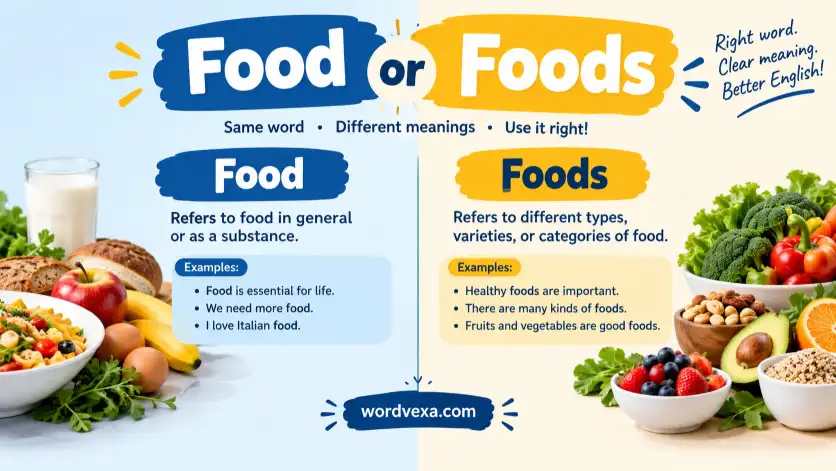
“Food” is usually correct when you mean food in general, while “foods” is used when you mean different types or kinds of food.
This small grammar difference often causes confusion because both forms are correct, but they are used in different situations.
People search for “food or foods” when they are unsure if food is countable or uncountable, if they should add -s, or which form sounds natural in formal English. The good news is that the rule is simple once you understand the meaning behind each form.
In everyday English, food normally refers to nourishment as a whole: “Food is essential for life.” However, foods can refer to separate varieties or categories:
“Healthy foods are rich in nutrients.” This distinction is useful in school writing, emails, articles, menus, websites, and professional communication. Understanding when to use each form can make your English more natural, clear, and accurate.
Food or Foods: Quick Answer
Both food and foods are correct, but they have different uses.
- Food = food in general or as a substance.
- Foods = different types, varieties, or categories of food.
Examples
Food:
- I love Italian food.
- We need more food for the party.
- Food is necessary for good health.
Foods:
- Fresh foods are available at the market.
- Some foods contain more protein than others.
- Traditional foods vary from country to country.
A simple rule is:
Use “food” for food in general and “foods” for different kinds of food.
Definition and Meaning of Food or Foods
Food
Food is a noun that means something people, animals, or other living things eat or consume for nourishment and energy.
It is usually an uncountable noun when used in a general sense.
Examples:
- We need food and water.
- The food is delicious.
- There is enough food for everyone.
You normally do not say:
- ❌ I bought three foods.
- ❌ She ate many foods. (when referring simply to an amount of food)
Instead, use a measurable or countable word:
- I bought three types of food.
- She ate several kinds of food.
Foods
Foods is the plural form used when referring to separate kinds, varieties, or categories of food.
Examples:
- Vegetables and fruits are healthy foods.
- Some foods can cause allergies.
- The store sells imported foods.
Oxford gives examples such as “a variety of foods” and “everyday foods,” showing that the plural form is standard when different types are meant.
The Meaning Changes With Context
Compare:
I like Mexican food.
Here, food means Mexican cuisine in general.
I like Mexican foods.
Here, foods emphasizes different Mexican dishes or varieties.
So, the choice depends on what you want to express.
The Origin of Food or Foods
The word food has a long history in English. It comes from the Old English word fōda, meaning “food” or “nourishment.” It developed through Middle English forms such as fode and foode before becoming the modern English word food.
The word is related to other Germanic words connected with feeding and nourishment. Oxford also identifies its origin as late Old English and notes its Germanic background.
Why Does “Foods” Exist?
The -s in foods is not a British-versus-American spelling difference. Instead, it reflects a change in grammatical meaning.
When food means nourishment in general, it is normally uncountable:
Food is important.
When food means a particular kind or variety, it can become countable:
This is a food that contains a lot of protein.
The plural then becomes:
These are foods that contain a lot of protein.
So, food → foods is mainly a difference in meaning and grammatical use, not a regional spelling rule.
British English vs American English Spelling
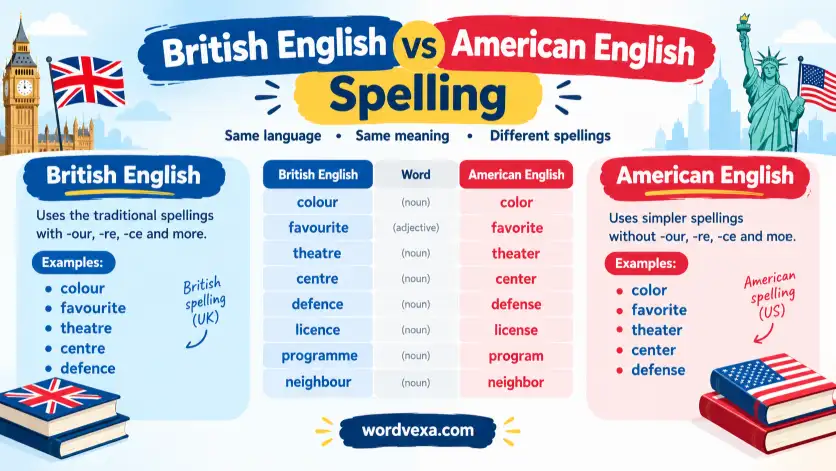
Unlike words such as colour/color or favourite/favorite, there is no standard British-versus-American spelling difference between food and foods.
Both British and American English use:
- food
- foods
The important difference is context, not spelling.
| Meaning | British English | American English |
| Food in general | food | food |
| Different types | foods | foods |
| One type of food | a food | a food |
| Several types | foods | foods |
| General nourishment | food | food |
Examples
British English:
Healthy foods are important for children.
American English:
Healthy foods are important for children.
The spelling remains exactly the same.
Which Spelling Should You Use?
You do not need to choose a British or American spelling for food or foods. Both varieties of English use the same forms.
Instead, choose the form based on your meaning.
For General Food
Use food:
We need more food.
For Different Types
Use foods:
The supermarket sells many different foods.
For US Audiences
Use the same rule:
Healthy foods can support a balanced diet.
For UK and Commonwealth Audiences
Use the same rule:
Healthy foods can support a balanced diet.
For Global or Professional Writing
The safest approach is simple:
- Use food for the general idea.
- Use foods for different types or varieties.
Common Mistakes with Food or Foods
Mistake 1: Using “foods” for food in general
❌ We need more foods.
✅ We need more food.
If you mean the overall amount of nourishment, use food.
Mistake 2: Avoiding “foods” completely
Some learners think food can never be plural.
❌ These food are rich in vitamins.
✅ These foods are rich in vitamins.
When you mean different kinds, foods is correct.
Mistake 3: Saying “many food”
❌ There are many food in the kitchen.
✅ There is a lot of food in the kitchen.
Or:
✅ There are many foods in the supermarket.
Mistake 4: Using “food are”
❌ Food are important for life.
✅ Food is important for life.
When food is used as an uncountable noun, it takes a singular verb.
Mistake 5: Confusing “foods” with individual items
If you mean apples, bananas, and oranges as individual items, it is often clearer to say:
I bought three pieces of fruit.
If you mean categories:
Fruits are healthy foods.
Food or Foods in Everyday Examples
In Emails
Food:
Please let me know if there is enough food for the meeting.
Foods:
Please include vegetarian foods in the menu.
In News Writing
Food:
Food prices have increased in many markets.
Foods:
Researchers studied foods rich in essential nutrients.
On Social Media
Food:
I love homemade food!
Foods:
What are your favorite healthy foods?
In Formal Writing
Food:
Access to safe food is important for public health.
Foods:
Certain foods may contain high levels of added sugar.
In Everyday Conversation
What kind of food do you like?
This is more natural than:
❌ What kind of foods do you like?
However, “What foods do you like?” is also correct when the focus is on specific types or choices.
Food or Foods: Comparison Table
| Form | Grammar | Main Meaning | Example |
| food | Usually uncountable | Food in general | Food is essential. |
| a food | Countable | One type of food | Rice is a staple food. |
| foods | Plural countable | Different types | Healthy foods are useful. |
| types of food | Plural phrase | Different categories | Many types of food are available. |
| kinds of food | Plural phrase | Different varieties | What kinds of food do you like? |
| pieces of food | Countable phrase | Individual pieces | Small pieces of food were left. |
Food or Foods: Google Trends & Usage Data
Search interest in food is much broader than interest in the grammar question “food or foods.” The word food is used in searches about recipes, health, restaurants, diets, nutrition, cooking, and many other topics.
Third-party trend data currently estimates millions of monthly Google searches for the broad term food, showing how common the word is in online searches.
Google Trends research also shows that food-related searches can change with seasons, events, health concerns, and local culture. For example, Google reported recurring increases in searches for certain foods around holiday periods.
Food-related search behavior is also studied across countries. Research using Google Trends has compared food-related search interest across countries and found that search patterns can vary by language, location, and current events.
For grammar purposes, however, “food or foods” is a narrower language question. People usually search it because they want to know if food should be treated as singular, plural, countable, or uncountable in a particular sentence.
Important: Google Trends uses relative search interest rather than a simple grammar score. A value of 100 represents the peak popularity within the selected comparison, not a fixed number of searches.
Frequently Asked Questions
1. Is “food” singular or plural?
Food is usually an uncountable noun. It can refer to food in general without showing a specific number.
Food is necessary for life.
When referring to different types, foods can be used.
2. Is “foods” grammatically correct?
Yes. Foods is correct when you mean different kinds, varieties, or categories of food.
Many healthy foods contain important nutrients.
3. Should I say “food” or “foods”?
Use food for the general idea and foods for different types.
I love Italian food.
Italian foods include many different dishes.
4. Can I say “many foods”?
Yes. Many foods means many types or varieties of food.
Many foods contain natural vitamins.
5. Can I say “a food”?
Yes. When food means one particular type or category, a food is possible.
An apple is a healthy food.
6. Is “food” the same in British and American English?
Yes. Both British and American English use food and foods. There is no spelling difference between the two varieties.
7. Which is correct: “healthy food” or “healthy foods”?
Both can be correct.
Healthy food means healthy food in general:
Eating healthy food is important.
Healthy foods means different healthy types:
Fruits and vegetables are healthy foods.
Final Thoughts
The difference between food or foods is simple once you focus on meaning. Food is normally an uncountable noun when you mean nourishment or food in general.
For example, “Food is important for good health” is correct. Foods is used when you mean different types, varieties, or categories, as in “Healthy foods can provide important nutrients.”
There is also no British-versus-American spelling difference here. Both British and American English use food and foods in the same way. The real difference is grammatical and contextual.
When writing, ask yourself one question: Am I talking about food in general or different kinds of food? If you mean the general substance or idea, choose food. If you mean separate varieties, choose foods.
This simple rule works in everyday conversation, academic writing, emails, news articles, and professional content. Understanding this distinction will help you write more naturally and avoid one of the common countable and uncountable noun mistakes in English.
Explore More Articles:
- Catholic or Christian: What Is the Difference?
- Patience or Patient: What’s the Difference?
- Nutritionist or Dietician? Key Differences Explained

I’m Sloane Mercer, a U.S.-based English language writer focused on grammar, spelling, vocabulary, and everyday English usage. Through Wordvexa, I provide clear and practical explanations to help readers choose the right words and communicate with confidence.







