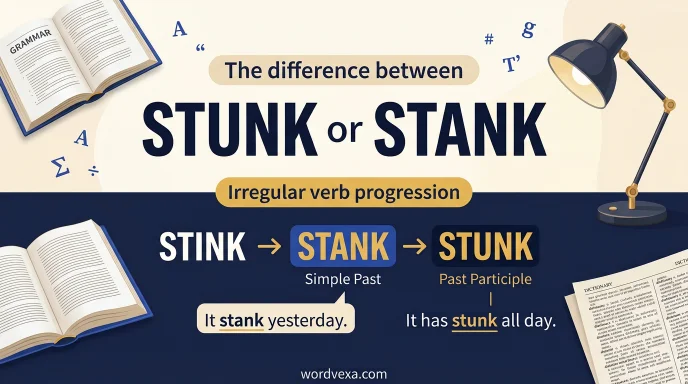
Stunk or stank are two forms of the irregular verb “stink,” meaning to have or produce a very unpleasant smell. Choosing between these two words can be confusing because both describe something that smelled bad in the past.
The key difference is their grammatical role: stank is normally the simple past form, while stunk is normally the past participle.
For example, you can say, “The garbage stank yesterday,” because the sentence describes a completed event in the past. However, you would say, “The garbage has stunk all day,” because stunk follows the auxiliary verb “has.”
This small grammatical difference causes many learners, students, writers, and even native speakers to search for “stunk or stank.”
Understanding the difference helps you avoid common grammar mistakes and choose the right form in everyday conversation, emails, academic writing, and professional content.
Once you remember stank = simple past and stunk = past participle, the choice becomes much easier.
Stunk or Stank: Quick Answer
Stank and stunk are both correct, but they have different grammatical uses.
- Stank = usually the simple past of stink
- Stunk = usually the past participle of stink
Examples
- The kitchen stank after the food was left outside.
- The kitchen has stunk all morning.
- The fish stank yesterday.
- The fish had stunk before we found it.
The basic verb forms are:
| Form | Word | Example |
| Base form | stink | The shoes stink. |
| Simple past | stank | The shoes stank yesterday. |
| Past participle | stunk | The shoes have stunk for days. |
| Present participle | stinking | The shoes are stinking. |
Quick rule: Use stank for a completed past action and stunk after auxiliary verbs such as has, have, and had.
Definition and Meaning of Stunk or Stank
What Does “Stank” Mean?
Stank is the simple past form of stink. It means that something had a very unpleasant smell at a particular time in the past.
Example:
The old refrigerator stank badly.
Here, the bad smell happened in the past.
What Does “Stunk” Mean?
Stunk is generally the past participle of stink. It is commonly used with auxiliary verbs such as has, have, and had.
Examples:
The refrigerator has stunk for weeks.
The room had stunk before the windows were opened.
Simple Meaning
The verb stink means to smell very unpleasant.
Therefore:
- Stank = smelled bad in the past
- Stunk = has/had smelled bad
Context and Usage
The choice depends mainly on the grammatical structure of the sentence.
Simple past:
The garbage stank yesterday.
Present perfect:
The garbage has stunk all week.
Past perfect:
The garbage had stunk before the cleaners arrived.
In informal English, you may sometimes hear variations in how people use irregular verb forms. For standard writing, however, following the usual grammatical pattern is safest.
The Origin of Stunk or Stank
The words stank and stunk come from the irregular English verb stink.
The verb has very old Germanic roots. It is related to words in other Germanic languages that describe producing or having an unpleasant smell.
Over time, English developed different forms of the verb:
stink → stank → stunk
This type of verb is called an irregular verb because its past forms are not created simply by adding -ed.
For example:
- walk → walked
- clean → cleaned
- stink → stank → stunk
The vowel changes in stank and stunk are part of an old pattern found in several English irregular verbs.
Similar patterns can be seen in:
- sing → sang → sung
- drink → drank → drunk
- swim → swam → swum
This helps explain why English speakers use stank and stunk instead of forms such as “stinked.”
British English vs American English Spelling
The difference between stank and stunk is not mainly a British-versus-American spelling issue.
Both forms are found in English varieties, including American and British English. The more important difference is grammar and sentence structure.
| English Variety | Simple Past | Past Participle | Example |
| American English | stank | stunk | It stank yesterday. |
| British English | stank | stunk | It has stunk all day. |
| Commonwealth English | stank | stunk | The room stank earlier. |
| International English | stank | stunk | The food has stunk since morning. |
There is therefore no general rule saying that Americans should use stank while British speakers should use stunk.
Instead, look at the grammatical structure.
Simple Past
The trash stank last night.
Present Perfect
The trash has stunk since yesterday.
Past Perfect
The trash had stunk for hours.
Which Spelling Should You Use?
Your choice should depend on the sentence, not simply on where your audience lives.
For US English
Use stank as the simple past form.
The milk stank yesterday.
Use stunk as the past participle.
The milk has stunk since Monday.
For UK and Commonwealth English
The same basic distinction applies.
The milk stank yesterday.
The milk has stunk since Monday.
For Global English
If you write for an international audience, follow standard grammar and make the sentence structure clear.
The easiest rule to remember is:
stank = simple past
stunk = past participle
Common Mistakes with Stunk or Stank
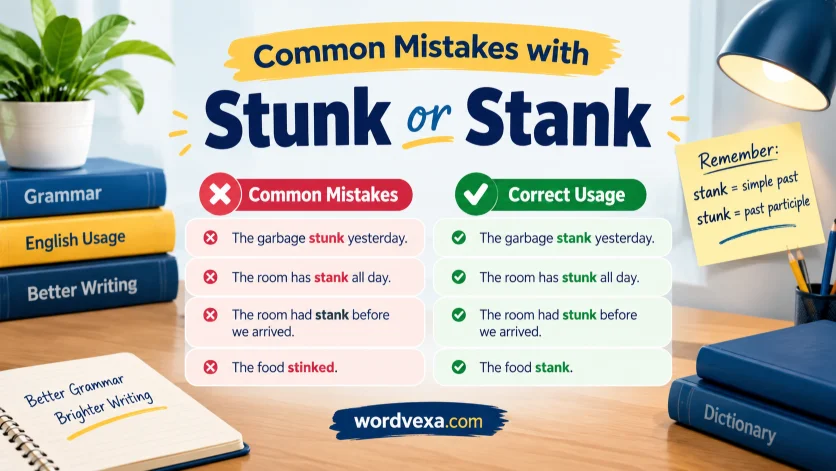
Mistake 1: Using “Stunk” as the Simple Past
❌ The garbage stunk yesterday.
For standard English, use:
✅ The garbage stank yesterday.
Mistake 2: Using “Stank” After “Has”
❌ The garbage has stank all day.
Correct:
✅ The garbage has stunk all day.
Mistake 3: Using “Stank” After “Had”
❌ The room had stank before we arrived.
Correct:
✅ The room had stunk before we arrived.
Mistake 4: Writing “Stinked”
Because many English verbs form the past with -ed, learners may write:
❌ The food stinked.
Standard English uses:
✅ The food stank.
Mistake 5: Confusing “Stunk” With “Stank”
Remember the helper-verb test:
No auxiliary verb + completed past event → stank
It stank yesterday.
Has/have/had + verb → stunk
It has stunk all day.
Stunk or Stank in Everyday Examples
In Emails
Simple past:
The food stank after being left in the office overnight.
Past participle:
The refrigerator has stunk since yesterday.
In News Writing
Residents reported that the building stank after the water system failed.
On Social Media
My gym shoes stank after the workout!
Or:
These shoes have stunk up my entire room.
In Formal Writing
The waste container stank after remaining outside for several days.
Or:
The waste container had stunk before it was removed.
In Everyday Conversation
Something stank in the kitchen.
That bag has stunk since yesterday.
The word is common in informal speech, but formal writing may use alternatives such as smelled unpleasant, gave off a bad odor, or had an unpleasant smell, depending on the context.
Stunk or Stank: Comparison Table
| Feature | Stank | Stunk |
| Base verb | Stink | Stink |
| Main grammatical role | Simple past | Past participle |
| Typical structure | Subject + stank | Subject + has/have/had + stunk |
| Time reference | Completed past event | Perfect constructions |
| Example | The room stank. | The room has stunk. |
| Correct? | Yes | Yes |
| Common mistake | Using after “has” | Using alone as simple past |
Easy Memory Trick
Think about another irregular verb:
drink → drank → drunk
The same pattern helps:
stink → stank → stunk
So:
Yesterday, he drank coffee.
He has drunk coffee.
Likewise:
Yesterday, the room stank.
The room has stunk for hours.
Stunk or Stank: Google Trends & Usage Data
Search interest in “stunk or stank” generally reflects a grammar and word-choice question rather than a difference in spelling between countries.
People may search for the phrase when they encounter both forms in books, conversations, social media, or educational material. The question is especially relevant to learners who are studying irregular English verbs.
Usage also depends heavily on context. Stank commonly appears in sentences describing a completed event in the past, while stunk appears with perfect constructions such as has stunk, have stunk, and had stunk.
Search trends can change over time and may vary by country, season, and search behavior. Google Trends measures search interest rather than actual spoken or written frequency, so it should not be treated as a complete measure of English usage.
For practical writing, grammatical structure is more useful than search popularity.
FAQs About Stunk or Stank
Q1. Is “stank” a correct word?
Yes. Stank is the standard simple past form of stink.
The garbage stank yesterday.
Q2. Is “stunk” a correct word?
Yes. Stunk is generally used as the past participle of stink.
The garbage has stunk for days.
Q3. Which is correct: “It stank” or “It stunk”?
Both words are correct, but “It stank” is the standard simple-past construction.
It stank yesterday.
With a perfect auxiliary verb:
It has stunk all day.
Q4. Can I say “has stank”?
In standard English, use “has stunk”, not “has stank.”
The room has stunk since morning.
Q5. Is “stank” past tense or past participle?
Stank is the simple past form of stink. The past participle is generally stunk.
Q6. Is “stinked” correct?
For the standard irregular verb stink, stinked is not the usual standard past form. Use stank for simple past and stunk as the past participle.
Q7. What is the easiest way to remember stank and stunk?
Remember:
stank = simple past
stunk = has/have/had + past participle
For example:
It stank yesterday.
It has stunk all week.
Conclusion
The difference between stunk or stank becomes simple once you understand their grammatical roles. Both words come from the irregular verb stink, which means to have an unpleasant smell. Stank is normally used as the simple past form, while stunk is normally used as the past participle.
Use stank when describing a completed event in the past: “The garbage stank yesterday.” Use stunk with perfect constructions: “The garbage has stunk all week” or “The garbage had stunk before it was removed.”
This distinction applies across standard American, British, and Commonwealth English. It is therefore not mainly a regional spelling issue. Instead, the surrounding grammar determines which form you need.
For students, ESL learners, writers, and editors, the easiest memory rule is stink → stank → stunk. Once you connect stank with simple past and stunk with has, have, or had, choosing the correct form becomes much easier.
Read More Articles:

I’m Claire Morgan, the author behind wordvexa.com, where I write about English grammar, sentence structure, punctuation, and everyday language. My goal is to make grammar simple, clear, and practical, helping readers understand the rules and apply them with confidence in real-world writing.







