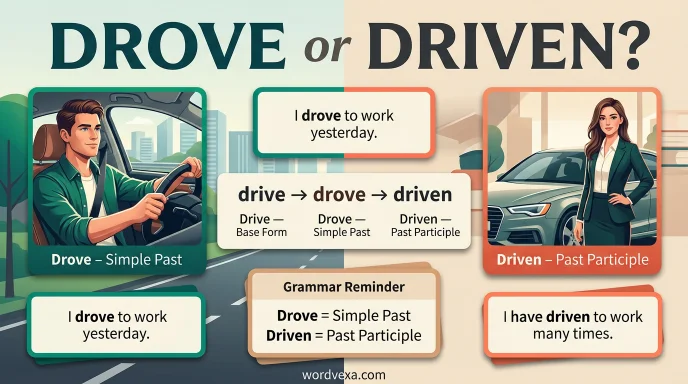
Drove or driven refers to two different forms of the verb “drive”: drove is the simple past form, while driven is the past participle.
Understanding this difference is important because both words describe driving in the past but cannot always be used in the same sentence.
Many English learners search for “drove or driven” when they are unsure which form to use in everyday conversations, emails, essays, or professional writing.
The confusion usually comes from the fact that English irregular verbs do not follow the usual “-ed” pattern.
For example, we say “I drove to work yesterday,” but “I have driven to work many times.” The first sentence uses the simple past, while the second uses the past participle with “have.” Once you understand this basic difference, choosing between drove and driven becomes much easier.
This guide explains their meanings, grammatical roles, common mistakes, and everyday usage so you can use both forms correctly and confidently.
Drove or Driven: Quick Answer
Drove and driven are both correct forms of the verb drive, but they are used differently.
- Drive = present/base form
- Drove = simple past
- Driven = past participle
Examples
- I drive to work every day.
- I drove to work yesterday.
- I have driven to work many times.
The easiest rule is:
Use “drove” for a completed past action. Use “driven” after a helping verb such as have, has, or had.
Quick Comparison
| Word | Verb Form | Example |
| Drive | Base form | I drive every morning. |
| Drove | Simple past | I drove yesterday. |
| Driven | Past participle | I have driven before. |
Definition and Meaning of Drove or Driven
What Does “Drove” Mean?
Drove is the simple past form of drive.
It describes an action that happened and finished in the past.
Examples:
- She drove to school yesterday.
- They drove across the country last summer.
- He drove the car carefully.
What Does “Driven” Mean?
Driven is the past participle of drive.
It normally needs a helping verb in perfect or passive constructions.
Examples:
- I have driven this car before.
- She had driven for three hours.
- The car was driven by my brother.
Using driven alone in a standard past-tense sentence is usually incorrect.
❌ I driven to work yesterday.
✅ I drove to work yesterday.
Context and Usage
The choice depends on the grammatical structure of the sentence.
Simple past:
He drove home.
Present perfect:
He has driven home.
Past perfect:
He had driven home before the rain started.
Passive voice:
The vehicle was driven by an experienced driver.
Other Meanings of “Drive”
The verb drive can have meanings beyond operating a vehicle.
It can mean to force or cause something to happen:
High costs drove the company to reduce spending.
It can also describe motivation:
Her ambition has driven her to succeed.
So, the forms drove and driven can appear in both literal and figurative contexts.
The Origin of Drove or Driven
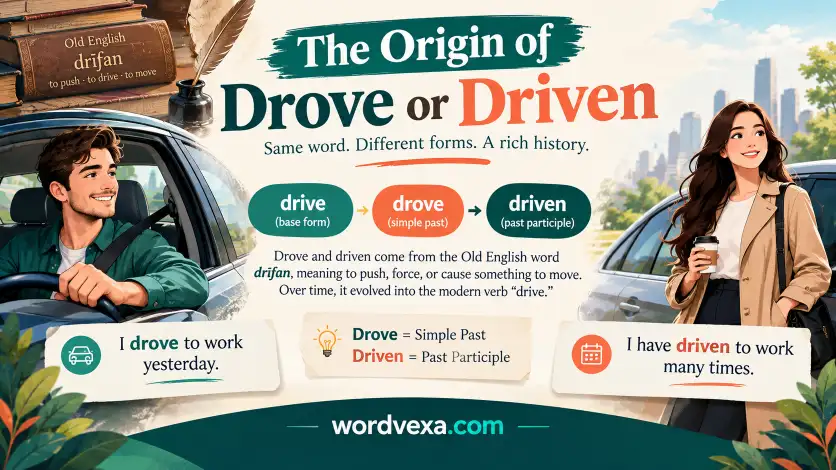
The words drove and driven come from the verb drive, which has a long history in English.
Drive comes from Old English drīfan, meaning to push, force, or cause something to move. The word has Germanic roots and is related to similar words in other Germanic languages.
Over time, drive developed its modern connection with controlling or operating vehicles. However, its older meanings remain in English expressions such as:
- drive someone to action
- drive a project forward
- drive economic growth
The three principal forms developed as an irregular verb:
drive → drove → driven
The spelling differences exist because English has many irregular verbs whose past forms did not develop by simply adding -ed.
For example:
- write → wrote → written
- speak → spoke → spoken
- break → broke → broken
- drive → drove → driven
Therefore, drove and driven are not spelling variations. They are different grammatical forms of the same verb.
British English vs American English Spelling
There is no major spelling difference between British and American English for drove and driven.
Both varieties use:
- drive
- drove
- driven
The difference between British and American English usually appears in other vocabulary or spelling areas, such as colour/color or centre/center. The verb forms of drive remain the same.
Comparison Table
| Feature | British English | American English |
| Present | drive | drive |
| Simple past | drove | drove |
| Past participle | driven | driven |
| Example | She drove home. | She drove home. |
| Perfect form | She has driven home. | She has driven home. |
| Spelling difference | None | None |
Examples in Both Varieties
British English:
I drove to London yesterday.
American English:
I drove to Chicago yesterday.
The verb form does not change based on the variety of English.
Which Spelling Should You Use?
You do not need to choose between British and American spelling for drove and driven. Both forms are standard in both varieties.
Instead, choose the form according to the tense and sentence structure.
For a Completed Past Action
Use drove.
She drove to the office yesterday.
With Have, Has, or Had
Use driven.
She has driven to the office.
She had driven there before.
For International English
Use whichever form grammar requires. The same rules apply internationally.
If you are writing for an international audience, focus on making the tense clear rather than treating drove and driven as regional spellings.
Common Mistakes with Drove or Driven
Mistake 1: Using “Driven” as Simple Past
❌ I driven to the store yesterday.
✅ I drove to the store yesterday.
Why?
“Yesterday” describes a completed past action, so the simple past drove is required.
Mistake 2: Using “Drove” After “Have”
❌ I have drove this car before.
✅ I have driven this car before.
Why?
After have, use the past participle driven.
Mistake 3: Using “Drove” After “Had”
❌ She had drove for five hours.
✅ She had driven for five hours.
Why?
Had requires the past participle.
Mistake 4: Confusing “Was Driven” and “Drove”
❌ The car was drove by John.
✅ The car was driven by John.
The sentence uses passive voice, so driven is required.
Mistake 5: Adding “-ed”
❌ He drived home.
✅ He drove home.
❌ She has drived the car.
✅ She has driven the car.
Drive is an irregular verb, so neither drived nor driveed is correct.
Drove or Driven in Everyday Examples
Understanding these words becomes easier when you see them in everyday writing.
In Emails
I drove to the client’s office yesterday.
I have driven there several times.
In News Writing
The suspect drove away from the scene.
Police said the vehicle had been driven by another person.
In Social Media
I drove six hours to see the concert!
I have never driven such a long distance alone.
In Formal Writing
The researcher drove to the field site during the first phase of the study.
The vehicle was driven under controlled conditions.
In Conversation
“Who drove you home?”
“My brother did.”
“Have you ever driven a truck?”
These examples show that the correct form depends on the grammatical structure, not the level of formality.
Drove or Driven: Google Trends & Usage Data
Search interest for “drove or driven” generally reflects a grammar question rather than a regional spelling dispute. People search for the pair when they are unsure which verb form fits a sentence.
The words themselves are widely used in English-speaking countries because drive is a common everyday verb. However, their frequency depends strongly on context.
For example:
- Drove is common in narratives about completed past events.
- Driven is common with has, have, and had.
- Driven is also common in passive constructions.
- Drove frequently appears in news reports describing past events.
Search trends can change over time and can vary by country, so search volume should not be treated as a grammar rule. The grammatical function of each form provides the reliable answer.
Drove vs Driven: Comparison Table
| Word | Form | When to Use | Example |
| Drive | Base form | Present/simple forms | I drive every day. |
| Drove | Simple past | Completed past action | I drove yesterday. |
| Driven | Past participle | Perfect/passive constructions | I have driven before. |
| Drived | Incorrect | Not a standard form | ❌ I drived home. |
Simple Formula
Present:
Subject + drive
Past:
Subject + drove
Perfect:
Subject + have/has/had + driven
Passive:
Subject + be + driven
FAQs About Drove or Driven
Q1. Is “drove” the past tense of drive?
Yes. Drove is the simple past tense of drive.
I drove home yesterday.
Q2. Is “driven” the past tense of drive?
No. Driven is the past participle of drive. It normally appears with a helping verb.
I have driven home.
Q3. Is “I drove” or “I driven” correct?
I drove is correct when you are describing a simple past action.
I drove to work yesterday.
Q4. Should I say “have drove” or “have driven”?
Use have driven.
I have driven this car before.
Q5. Is “drived” a correct word?
No. Drived is not the standard past form of drive. The correct forms are drove and driven.
Q6. Is “driven” used in passive sentences?
Yes. Driven is commonly used in passive constructions.
The car was driven by Sarah.
Q7. Are “drove” and “driven” different in British and American English?
No. Both British and American English use drove as the simple past and driven as the past participle.
Conclusion
The choice between drove or driven depends on grammar, not British versus American spelling. Drove is the simple past form of drive, while driven is the past participle. The basic verb pattern is drive → drove → driven.
Use drove when describing a completed action in the simple past: “I drove to work yesterday.” Use driven after helping verbs such as have, has, and had, or in passive constructions: “I have driven to work” and “The car was driven by John.”
Remember that drived is not the standard form. Learning these three forms together makes the difference much easier to remember. If you write for a British, American, or international audience, the same grammatical rules apply.
When you are unsure, look at the words around the verb. If the sentence describes a straightforward completed past action, drove is usually the answer. If a perfect or passive construction requires a past participle, choose driven.
You May Also Like:

I’m Claire Morgan, the author behind wordvexa.com, where I write about English grammar, sentence structure, punctuation, and everyday language. My goal is to make grammar simple, clear, and practical, helping readers understand the rules and apply them with confidence in real-world writing.







