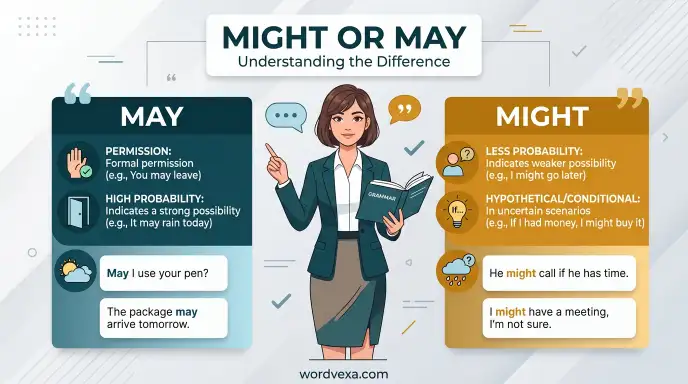
Might or may are both modal verbs used to talk about possibility, but may is often used for permission and possibility, while might often suggests a less certain possibility or works as the past form of may in reported speech.
People often search for “might or may” because the two words can look interchangeable in sentences such as “It may rain” and “It might rain.” The confusion becomes stronger when writers want to show how likely something is, ask for permission, or report what someone said earlier.
The good news is that both forms are correct; the right choice depends mainly on meaning, context, and tone. In modern English, may and might often overlap when expressing possibility, so the difference is not always a strict rule.
This guide explains might or may in simple terms. You will learn their meanings, history, differences, common mistakes, everyday uses, and how to choose the right form in formal and informal writing.
Might or May: Quick Answer
May and might can both express possibility.
- May = something is possible.
- Might = something is possible, often with a weaker or more uncertain tone.
- May is also commonly used to ask for or give formal permission.
- Might can be used as the past form of may in reported speech.
Examples
| Sentence | Meaning |
| It may rain tonight. | Rain is possible. |
| It might rain tonight. | Rain is possible, with more uncertainty. |
| May I come in? | Formal request for permission. |
| She said she might come. | Reported speech about a possibility. |
| You may leave now. | Formal permission. |
| You might want to check your email. | A polite suggestion. |
British Council explains that may and might are both used for present and future possibility, while may is also used for formal permission.
Definition and Meaning of Might or May
What Does May Mean?
May is a modal verb used to express possibility, permission, and sometimes uncertainty.
For example:
She may arrive late.
This means that her late arrival is possible.
May can also express formal permission:
May I ask a question?
Here, may is not about possibility. It is a polite request for permission.
Another example:
You may leave after the test.
This gives formal permission.
What Does Might Mean?
Might is also a modal verb. It commonly expresses possibility, especially when the speaker is less certain.
We might visit them tomorrow.
The speaker is not sure that the visit will happen.
Might can also be used in reported speech:
“I may go home early.”
becomes:
She said she might go home early.
Cambridge Dictionary notes that might is frequently used for weak possibility and can also function as the past form of may in reported speech.
May and Might After the Subject
Both verbs are followed by the base form of another verb:
- She may come.
- She might come.
- They may leave.
- They might leave.
Do not add -s, -ed, or -ing directly to may or might.
Incorrect: She mays come.
Correct: She may come.
Incorrect: He mights leave.
Correct: He might leave.
The Origin of Might or May
The words may and might are very old English modal verbs. Their modern forms developed from earlier Germanic forms used to express ideas such as ability, possibility, and permission.
Historically, might developed as the past form of may. This relationship can still be seen in reported speech:
He said, “I may come.”
Reported:
He said he might come.
Oxford also identifies might as the past form of may when reporting what someone has said.
Over time, however, might developed uses beyond simple past-time meaning. Modern speakers often use it for present or future possibilities:
I might go tomorrow.
So, although may and might are historically connected, modern English uses them for several different purposes.
British English vs American English Spelling
There is no spelling difference between British and American English for may or might.
Both varieties use:
- may
- might
- may not
- might not
The main differences are related to usage, style, and frequency, not spelling.
| Feature | British English | American English |
| May | may | may |
| Might | might | might |
| Formal permission | Common | Common |
| Possibility | Common | Common |
| Might for weaker possibility | Common | Common |
| Mightn’t | Possible in British English | Rare |
| Mayn’t | Extremely uncommon | Extremely uncommon |
British English can use the contraction mightn’t, although it is not especially common. American English generally prefers might not.
Example
British English:
It mightn’t be ready.
American English:
It might not be ready.
The meaning is essentially the same.
Which Spelling Should You Use?
There is no spelling choice to make because may and might are both correctly spelled in both British and American English.
Instead, choose the word based on meaning.
For American English
Use may for:
- possibility
- formal permission
- formal writing
Use might for:
- uncertain possibilities
- polite suggestions
- reported speech
- hypothetical situations
For British English
The same basic rules apply. Both forms are standard.
For Global English
If you write for an international audience, focus on clarity rather than trying to force a strict difference in probability.
For example:
The meeting may start late.
and
The meeting might start late.
Both are natural English.
Cambridge notes that many native speakers do not agree on an exact level of certainty for may versus might.
Common Mistakes with Might or May
1. Thinking May Is Always More Certain
A common rule says:
May = more likely
Might = less likely
This can be useful as a general guide, but it is not an absolute rule.
Both can describe uncertain possibilities.
It may snow tomorrow.
It might snow tomorrow.
The second can sound more tentative, but context and tone also affect the meaning. Cambridge specifically notes that native speakers may disagree about which modal expresses more or less certainty.
2. Using May for Every Permission Request
In formal English:
May I leave early?
is correct.
But may is not required in every informal request.
Can I leave early?
is also normal in everyday conversation.
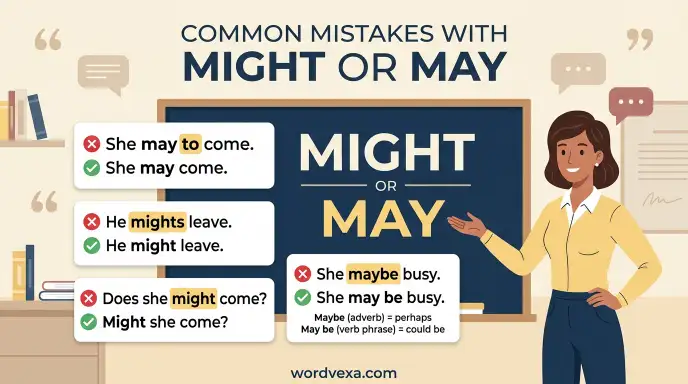
3. Adding “To” After May or Might
Modal verbs are followed by the base verb without to.
Incorrect: She may to come.
Correct: She may come.
Incorrect: He might to leave.
Correct: He might leave.
4. Using “Do” with Might
Do not use do, does, or did to form questions with might.
Incorrect: Does she might come?
Correct: Might she come?
Cambridge confirms that modal questions are formed without do/does/did.
5. Confusing “Maybe” and “May Be”
These forms are different.
Maybe = perhaps.
Maybe she will call.
May be = modal verb + verb.
She may be busy.
This is a very common grammar mistake.
Might or May in Everyday Examples
Understanding real situations makes the difference easier to remember.
In Emails
May:
We may need additional documents before processing your request.
This sounds professional and neutral.
Might:
We might need to move the meeting to Friday.
This suggests that the change is possible but not certain.
In News Writing
Heavy rain may cause delays across the region.
News writing often uses may to describe a possible event without presenting it as certain.
On Social Media
I might post the photos later.
Might works naturally in casual writing because it expresses uncertainty.
In Formal Writing
The results may indicate a change in consumer behavior.
This is appropriate when the writer wants to avoid presenting an interpretation as a certainty.
For Permission
May I enter the room?
This is a formal request.
For Suggestions
You might want to review the document again.
Here, might makes the suggestion softer.
Might or May: Google Trends & Usage Data
Search interest for grammar comparisons such as “might or may” reflects a common learner question because both words are modal verbs and frequently overlap in meaning.
The important point is that may and might are both established, common English words, not regional spellings. They are used in British English, American English, and other varieties of standard English. British Council grammar guidance lists both among the core modal verbs and explains their roles in possibility, permission, and reported speech.
Usage also depends strongly on context:
- May appears often in formal statements about possibility.
- May is especially important in formal permission.
- Might is common for uncertain possibilities.
- Might is used in reported speech.
- Might is also common in polite suggestions.
For example, official or formal writing may say:
The service may be delayed.
In everyday conversation, a speaker may say:
I might be late.
Modern grammar references also show that the distinction between may and might is not always a strict probability scale.
Might vs May: Comparison Table
| Feature | May | Might |
| Part of speech | Modal verb | Modal verb |
| Possibility | Yes | Yes |
| Present possibility | Yes | Yes |
| Future possibility | Yes | Yes |
| Formal permission | Yes | Rare/formal |
| Reported speech | Can remain may in some contexts | Common past form |
| Polite suggestion | Less common | Common |
| Strong certainty difference | Not fixed | Not fixed |
| Followed by base verb | Yes | Yes |
| Example | It may rain. | It might rain. |
The British Council confirms that both verbs can express present and future possibility, while may has a major role in formal permission and might can function as its past form.
FAQs About Might or May
Q1. Is “may” or “might” more correct?
Both are correct. The choice depends on the meaning and context of the sentence.
Q2. Is “might” the past tense of “may”?
Yes, might can be the past form of may, especially in reported speech.
She said, “I may come.”
She said she might come.
But might is also commonly used for present and future possibilities.
Q3. Is “may” more likely than “might”?
Often, may can sound more open or less tentative, while might can sound more uncertain. However, this is not a strict rule. Context and speaker intention matter.
Q4. Can I use “may” for permission?
Yes. May is commonly used for formal permission.
May I use your phone?
Q5. Can “might” be used for permission?
Yes, but it is very formal and uncommon in ordinary conversation.
Might I ask a question?
Cambridge describes this use as very formal.
Q6. Which is better: “It may rain” or “It might rain”?
Both are correct.
It may rain.
It might rain.
Might can sound slightly more tentative, but there is no universal rule that one is always better.
Q7. What is the difference between “maybe” and “may be”?
Maybe means perhaps:
Maybe he is busy.
May be contains the modal verb may:
He may be busy.
The two forms have different grammar and sentence structures.
Conclusion
Might or may are both correct modal verbs, but they are used for slightly different purposes. May commonly expresses possibility and formal permission, while might often expresses a more tentative possibility, works as the past form of may in reported speech, and can make suggestions sound softer.
However, you should not treat the difference as a fixed scale of probability. In many sentences, both forms are natural.
For formal permission, “May I…?” is the standard choice. For uncertain possibilities, either may or might can work depending on the intended tone. In reported speech, might is often used when may changes into a past form.
Remember that neither verb takes to before the next verb: say “may go” and “might go,” not “may to go” or “might to go.”
The best way to choose between them is to consider meaning, context, formality, and certainty rather than relying on one simple rule.
Explore More Articles:
- Read or Reed: Meaning, Spelling, and Usage
- NIV or NLT: Which Bible Translation Should You Choose?
- Sewed or Sewn: Which Is Correct? Meaning, Grammar & Examples

I’m Claire Morgan, the author behind wordvexa.com, where I write about English grammar, sentence structure, punctuation, and everyday language. My goal is to make grammar simple, clear, and practical, helping readers understand the rules and apply them with confidence in real-world writing.








1 thought on “Might or May: How to Choose the Right Word Every Time ”