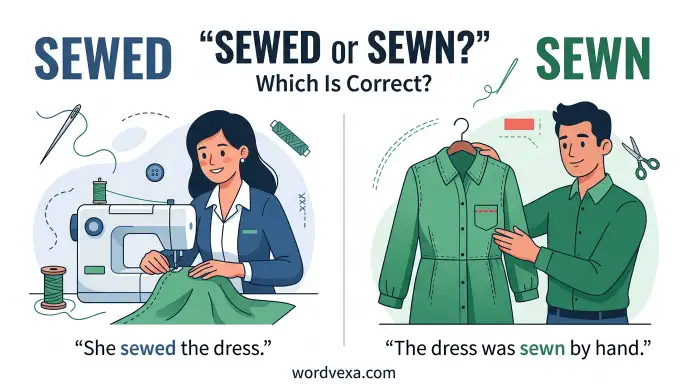
Sewed or sewn can be confusing because both forms come from the verb sew, which means to join fabric or other material with a needle and thread.
The key difference is grammatical: sewed is the simple past form, while sewn is commonly used as the past participle. However, sewed can also function as a past participle in some contexts.
For example, you can say, “She sewed the dress yesterday,” because the action happened in the past. You can also say, “She has sewn the dress,” where sewn follows the helping verb has.
People often search for sewed or sewn because English has several irregular verb patterns, and sew does not follow the same pattern as regular verbs such as walk or work.
This guide explains the difference, shows when to use each form, and provides practical examples for everyday and formal writing.
Sewed or Sewn: Quick Answer
The easiest way to remember the difference is to look at the grammatical role of the word.
- Sew = present or base form
- Sewed = simple past form
- Sewn = commonly used past participle
- Sewed = also accepted as a past participle
- Sewing = present participle or gerund
Examples
Simple past:
Maria sewed a new dress yesterday.
Present perfect:
Maria has sewn a new dress.
Past perfect:
Maria had sewn the dress before the ceremony.
Passive voice:
The buttons were sewn onto the jacket.
A useful learner-friendly rule is to use sewed when the sentence is in the simple past and sewn when a past participle is needed.
What Does Sewed or Sewn Mean?
Both sewed and sewn come from the verb sew.
Sewed is the simple past form of sew, as in “She sewed the button onto my shirt.” Sewn is commonly used as the past participle, especially after has, have, had, or in passive constructions, as in “The button has been sewn on.” However, sewed can also be used as a past participle, so both forms can be correct depending on the sentence.
What Does “Sew” Mean?
Sew means to join pieces of cloth or another material by passing thread through them with a needle.
For example:
I know how to sew.
She sews her own clothes.
He is sewing a button onto his shirt.
The verb can describe hand sewing, machine sewing, repairing clothes, making garments, attaching decorations, or joining pieces of material.
What Does “Sewed” Mean?
Sewed is primarily the simple past form of sew.
Examples:
She sewed the torn sleeve yesterday.
He sewed a patch onto his jeans.
My grandmother sewed this dress by hand.
In these sentences, the sewing action happened in the past.
What Does “Sewn” Mean?
Sewn is commonly used as the past participle of sew.
It often appears with helping verbs such as:
- has
- have
- had
- is
- was
- were
- been
Examples:
The dress has been sewn by hand.
The pieces were sewn together.
She had sewn the costume before the performance.
Can “Sewed” Also Be a Past Participle?
Yes. This is an important detail.
Sewed can also function as a past participle. Therefore, a sentence such as:
She has sewed the pieces together.
can be found in standard English.
However, has sewn is a very familiar and widely used construction. For learners and general writing, using sewn as the past participle is often the clearest choice.
The Origin of Sewed or Sewn
The verb sew has a very old history in English. It comes from Old English siwian, meaning to sew or stitch.
The word is related to older Germanic forms and ultimately to an ancient Indo-European root associated with sewing.
Over time, English developed different forms of the verb. Modern English retains sewed and sewn, which can serve different grammatical functions.
This makes sew different from regular verbs.
Compare these patterns:
| Verb | Simple Past | Past Participle |
| walk | walked | walked |
| work | worked | worked |
| play | played | played |
| sew | sewed | sewn/sewed |
The pronunciation can add another layer of confusion. Sew is pronounced like “so”, while sewed and sewn have different pronunciations.
British English vs American English
There is no major British-American spelling difference between sewed and sewn. Both forms are used in British and American English.
| British English | American English | Example |
| sewed | sewed | She sewed the dress yesterday. |
| sewn | sewn | The dress has been sewn by hand. |
| sewed | sewed | She has sewed the pieces together. |
| sewing | sewing | She enjoys sewing. |
The main distinction is grammatical rather than regional.
You should not think of sewed as an American form and sewn as a British form. Both varieties use these forms.
Regional Usage
British English commonly uses sewn as the past participle:
The buttons have been sewn onto the shirt.
American English uses the same construction:
The buttons have been sewn onto the shirt.
Therefore, writers should focus on the tense and grammatical structure instead of trying to choose between the words based on nationality.
Which Version Should You Use?
United States
Use sewed for the simple past:
She sewed the dress yesterday.
For the past participle, sewn is a common choice:
She has sewn the dress.
United Kingdom
The same basic pattern applies:
He sewed the shirt yesterday.
The shirt has been sewn by hand.
Canada
Canadian English generally follows the same standard pattern:
She sewed the fabric together.
The fabric has been sewn together.
Australia
Australian English also uses sewed as the simple past and commonly uses sewn as the past participle.
International English
For international audiences, the easiest pattern to understand is:
sew → sewed → sewn
This makes the grammatical difference clear to English learners.
Academic Writing
Academic writing should use the form that fits the grammatical construction.
For example:
The samples were sewn together before testing.
Here, sewn works naturally in the passive construction.
Business Writing
Business writing follows the same rule:
The supplier sewed the labels onto the uniforms yesterday.
The labels were sewn securely onto the uniforms.
Common Mistakes with Sewed or Sewn
Mistake 1: Using “sewn” as the simple past
Incorrect:
She sewn the dress yesterday.
Correct:
She sewed the dress yesterday.
Why?
The sentence uses the simple past. It does not have a helping verb before the main verb.
Memory tip:
If you are describing what someone did yesterday, sewed is usually the form you need.
Mistake 2: Using “sewn” without a helping verb
Incorrect:
She sewn the dress already.
Correct:
She has sewn the dress already.
Why?
In this construction, sewn is functioning as a past participle and needs a suitable helping verb.
Mistake 3: Thinking “sewed” is always wrong after “has”
Some learners are taught that sewn is the only past participle.
That is not completely accurate.
Sewed can also be used as a past participle. However, has sewn is a familiar and useful standard pattern for learners.
Mistake 4: Confusing “sew” and “sow”
Sew and sow can sound alike, but their meanings are different.
- Sew = join material with thread
- Sow = plant or scatter seeds
Examples:
She will sew the button onto the coat.
Farmers sow seeds in the spring.
Everyday Examples of Sewed or Sewn
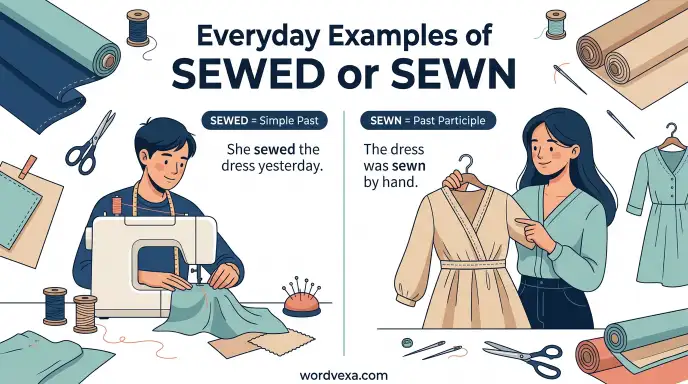
Emails
I sewed the missing button back onto the uniform.
The labels have been sewn onto the products.
Business Writing
The manufacturer sewed the pieces together before packaging.
Each label is sewn securely into the garment.
News Headlines
Local volunteers sewed hundreds of blankets for families.
Traditional designs sewn into handmade clothing attract visitors.
Blogs
I sewed this simple bag in one afternoon.
The pockets are sewn directly onto the front panel.
Social Media
Finally finished the dress I sewed last weekend!
I love this handmade jacket with its beautifully sewn details.
Academic Writing
The fabric samples were sewn together before the experiment.
The researcher sewed the material along the marked line.
Daily Conversation
I sewed a patch onto my jeans.
Who sewed this button on?
The pieces have already been sewn together.
Google Trends & Modern Usage
People search for sewed or sewn because both forms appear in real English, but they serve different grammatical roles.
The confusion is especially common among English learners who know that sew has an unusual verb pattern but are unsure which form belongs in a particular sentence.
Search interest alone does not determine if a word is grammatically correct. A search query can be popular simply because people are unsure about the difference.
For modern English, the most useful pattern for learners is:
- Sew = base form
- Sewed = simple past
- Sewn = common past participle
- Sewing = -ing form
Remember that sewed is also recognized as a past participle. The choice should therefore depend on the sentence structure rather than on a claim that one form is always correct and the other is always wrong.
Quick Comparison Table
| Version | Meaning | Correct? | Region | Example |
| sew | Base/present form | Yes | All major varieties | I sew clothes. |
| sewed | Simple past | Yes | US, UK, Canada, Australia | She sewed a dress. |
| sewn | Past participle | Yes | US, UK, Canada, Australia | The dress was sewn by hand. |
| sewed | Alternative past participle | Yes | Standard English | She has sewed the pieces together. |
| sewing | -ing form | Yes | All major varieties | She is sewing a shirt. |
Key Takeaways
- Sewed is the simple past form of sew.
- Sewn is commonly used as the past participle.
- Sewed can also function as a past participle.
- Say “She sewed the dress yesterday.”
- Say “She has sewn the dress.”
- Say “The dress was sewn by hand.”
- British and American English use both forms.
- Do not confuse sew with sow.
FAQs
Q1. Is “sewed” or “sewn” correct?
Both can be correct, but they usually appear in different grammatical roles. Sewed is the simple past form, as in “She sewed the dress.” Sewn is commonly used as a past participle, as in “She has sewn the dress.” Sewed can also function as a past participle.
Q2. Is “sewed” the past tense of sew?
Yes. Sewed is the simple past tense of sew. For example, “I sewed a button onto my shirt yesterday.” When the sentence describes a completed action in the simple past, sewed is the standard form to use.
Q3. Is “sewn” the past tense of sew?
Sewn is generally the past participle rather than the simple past. The simple past is sewed. For example, say “She sewed the dress yesterday,” but “She has sewn the dress.” This distinction helps you choose the correct form based on sentence structure.
Q4. Can I say “I have sewed”?
Yes. Sewed can function as a past participle, so “I have sewed” is possible. However, I have sewn is a very familiar construction and is often the easier choice for learners and general writing. The important point is that sewed is not automatically incorrect after have.
Q5. Should I say “has sewed” or “has sewn”?
Both forms can occur, but has sewn is a common and straightforward choice. For example, “She has sewn the button onto the coat.” If you are learning English or writing for a broad audience, using sewn as the past participle provides a simple pattern to follow.
Q6. Is “sewed” grammatically correct?
Yes. Sewed is the standard simple past form of sew. For example, “He sewed a patch onto his jacket.” It can also be used as a past participle. The key is to look at the grammatical construction rather than assuming that sewed is always a past-tense-only form.
Q7. Is “sewn” grammatically correct?
Yes. Sewn is a standard past participle of sew. It commonly appears in perfect and passive constructions, such as “has sewn,” “had sewn,” and “was sewn.” It is especially common when describing something that has been completed or something made by sewing.
Q8. What is the difference between “sewed” and “sewn”?
The main difference is grammatical. Sewed is the simple past: “He sewed the shirt.” Sewn is commonly used as a past participle: “The shirt was sewn by hand.” Remembering this pattern will solve most questions about sewed or sewn.
Q9. Is “sewn” British English?
No. Sewn is not exclusively British English. It is used in both British and American English. Likewise, sewed is used in both varieties. The distinction between these forms is mainly grammatical rather than a British-versus-American spelling difference.
Q10. How can I remember sewed vs sewn?
Use this simple memory rule: “Yesterday = sewed; has, have, had, or passive = usually sewn.” For example, “She sewed it yesterday” and “She has sewn it.” This is a useful learner rule, although sewed can also be a past participle.
Conclusion
The difference between sewed or sewn becomes much easier when you focus on grammar. Sewed is the simple past form of sew, so it works naturally in sentences such as “She sewed the dress yesterday.” Sewn is commonly used as the past participle in sentences such as “She has sewn the dress” and “The dress was sewn by hand.”
There is no major British-American spelling difference here. Both British and American English use sewed and sewn. The important question is what grammatical form your sentence requires.
One detail is especially useful for advanced learners: sewed can also be used as a past participle. Therefore, it is not accurate to say that sewn is the only possible participle. Still, sewn is a familiar and practical choice in many perfect and passive constructions.
Remember: use “sewed” for the simple past, and “sewn” is the usual choice when you need the past participle.
Explore More Articles:

I’m Sloane Mercer, a U.S.-based English language writer focused on grammar, spelling, vocabulary, and everyday English usage. Through Wordvexa, I provide clear and practical explanations to help readers choose the right words and communicate with confidence.








2 thoughts on “Sewed or Sewn: Which Is Correct? Meaning, Grammar & Examples”