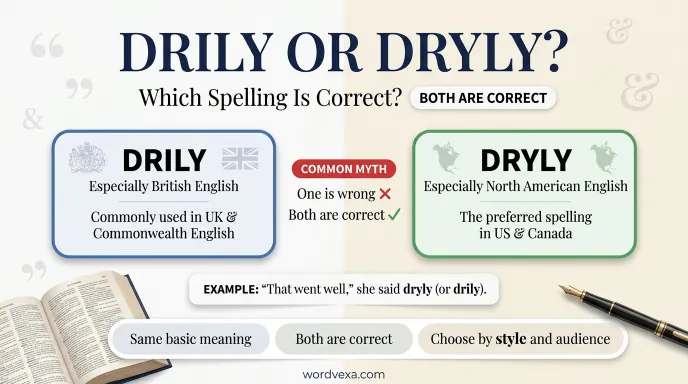
Drily or dryly means “in a dry, restrained, or subtly humorous manner,” and both spellings are correct. The two forms are alternative spellings of the same adverb, so choosing one does not normally change the meaning of a sentence.
The main difference is usage preference: drily is especially associated with British English, while dryly is also widely used in British English and is particularly common in North American English.
This spelling can confuse even confident writers because English has several ways to form adverbs ending in -ly. The word dry creates an unusual choice because both drily and dryly have become standard forms.
For example, both of these sentences are correct:
“That went well,” she said drily.
“That went well,” she said dryly.
In both sentences, the speaker is probably being understated or ironic rather than genuinely praising the situation.
This guide explains the difference between drily or dryly, their meanings, pronunciation, grammar, regional usage, common mistakes, and practical editing choices.
You will also learn when to use each spelling and why you should not automatically change drily to dryly just because the second form looks more familiar.
Drily or Dryly: Quick Answer
The easiest answer is:
- Drily is correct.
- Dryly is correct.
- Both are adverbs.
- Both usually have the same meaning.
- Both can describe understated or deadpan humor.
- Both can describe a restrained or unemotional manner.
- Both can sometimes describe a physical action involving dryness.
- Drily has a strong British English association.
- Dryly is especially familiar in North American English.
- You should follow the style of your audience or publication.
Example With Drily
“Of course I remembered,” he said drily.
Example With Dryly
“Of course I remembered,” he said dryly.
The meaning is essentially the same.
The One-Line Rule
If you are wondering “Is it drily or dryly?”, remember:
Both are correct. Choose the form that fits your regional or editorial style, and use it consistently.
What Does Dryly or Drily Mean?
Drily and dryly are both correct spellings of the same adverb. They usually describe a dry, restrained, matter-of-fact, or subtly humorous way of speaking or behaving. Drily is especially associated with British English, while dryly is particularly common in North American English. Both forms can be used in standard English.
When they describe speech, writing, or behavior, they often mean that something is expressed in a restrained, understated, unemotional, or subtly humorous way.
Simple Definition
Drily or dryly means in a dry, restrained, matter-of-fact, or not obviously humorous manner.
For example:
“I suppose that was a brilliant idea,” she said dryly.
The speaker may actually mean the opposite. The humor comes from the contrast between the words and the speaker’s tone.
Dry Humor
One of the most common uses of drily and dryly is to describe dry humor.
Dry humor is usually understated. The speaker may say something funny without changing their facial expression or using an obviously playful tone.
For example:
“Excellent. Another three-hour meeting,” he said drily.
The sentence is funny because the speaker presents an undesirable situation as if it were wonderful.
A Restrained Manner
The words can also describe a lack of emotion.
She smiled dryly and walked away.
Here, dryly does not necessarily mean that she made a joke. It can suggest a controlled or restrained reaction.
A Literal Sense
The words can also have a more physical meaning.
He swallowed dryly before answering.
In this sentence, the word can relate to physical dryness rather than humor.
This distinction is important because not every use of drily or dryly involves sarcasm or comedy.
Drily vs Dryly: Meaning by Context
A useful way to understand these words is to look at what they are describing.
| Context | Meaning | Example |
| Humor | Understated or deadpan humor | She replied dryly. |
| Conversation | Restrained manner of speaking | He answered drily. |
| Writing | Matter-of-fact presentation | The report dryly noted the error. |
| Emotion | Little visible emotion | She smiled drily. |
| Physical dryness | Without moisture | He swallowed dryly. |
This shows why the words should not automatically be defined as “sarcastically.”
Sometimes they describe humor. Sometimes they describe emotional restraint. Sometimes they describe literal dryness.
The Origin of Drily and Dryly
Both drily and dryly come from the adjective dry.
The word dry has a long history in English and originally referred to a lack of moisture. Over time, English speakers extended the word into figurative meanings.
For example, dry can describe:
- A dry surface
- Dry weather
- Dry writing
- Dry humor
- A dry personality
- A dry response
The figurative sense of dry humor refers to humor that is understated rather than openly playful.
From this adjective, English developed the adverbial forms drily and dryly.
Why Are There Two Spellings?
The spelling difference comes from the way English handles words ending in y when forming adverbs.
Writers may encounter the traditional-looking form:
dry → drily
They may also encounter:
dry → dryly
Both forms became established in standard English.
This is why it is inaccurate to say that dryly is simply a modern mistake or that drily is merely a misspelling.
Why Does Drily Look Strange?
Many readers expect the spelling of the original adjective to remain visible.
Compare:
dry → dryly
The relationship is immediately obvious.
With:
dry → drily
the original y disappears.
That can make drily look unusual to readers who have mainly encountered dryly. However, unfamiliar spelling does not make the word incorrect.
Drily or Dryly: Pronunciation
Both drily and dryly are normally pronounced the same way.
The pronunciation is approximately:
DRY-lee
The spelling changes, but the pronunciation does not normally create a meaningful distinction between the two forms.
This is another reason the words are best understood as alternative spellings rather than two completely different words.
Pronunciation Example
She answered drily.
She answered dryly.
Both are pronounced essentially the same way.
British English vs American English
The biggest practical difference between drily and dryly is regional preference.
| Feature | British English | American English |
| Drily | Especially associated with British English | Also used |
| Dryly | Also accepted | Particularly common |
| Meaning | Same | Same |
| Pronunciation | Generally the same | Generally the same |
| Best approach | Follow house style | Follow house style |
It is important not to turn this into an absolute rule.
British writers can use dryly, and American writers can encounter or use drily. The regional labels describe tendencies and preferences rather than strict grammar laws.
British English
If you are writing specifically for a British audience, drily can be a natural choice.
“I suppose that makes everything easier,” she said drily.
American English
For an American audience, dryly is a very familiar choice.
“I suppose that makes everything easier,” she said dryly.
International English
For international writing, either form is acceptable.
The more important question is if the rest of your article consistently follows a particular regional style.
Which Version Should You Use?
The best choice depends on your audience and publication.
United States
Dryly is a practical choice for American-focused content.
Example:
The manager dryly explained that the deadline had already passed.
United Kingdom
Drily is a natural choice for British-focused writing.
Example:
The manager drily explained that the deadline had already passed.
Canada
Both forms can be encountered. Follow your organization’s preferred English style if one exists.
Australia
Both forms are understandable. For professional writing, consistency with the publication’s established style is the safest approach.
International Writing
Either spelling works.
If you are writing for a broad international audience and want the spelling that many readers immediately recognize, dryly can be a practical choice.
Academic Writing
Academic writers should prioritize the style guide used by their institution, journal, or publisher.
The important point is not to change the spelling simply because you think one form is grammatically superior.
Business Writing
Choose the form that matches your organization’s English style.
For example, if your company consistently uses British English, drily may fit better. If your company uses American English, dryly may be the more natural choice.
Dryly vs Drily: Tone Test
One of the best ways to understand these words is to imagine the speaker’s tone.
Consider:
“Great. Another problem.”
Without context, this could sound genuinely positive.
Now add the adverb:
“Great. Another problem,” she said dryly.
The adverb tells the reader that the statement is probably understated or ironic.
Tone Test
Ask yourself:
Is the speaker saying something in a restrained, deadpan, or understated way?
If yes, drily or dryly may be appropriate.
Important Difference From Sarcasm
Dry humor and sarcasm can overlap, but they are not identical.
Dryly describes the manner or tone.
Sarcastically specifically suggests that the speaker is saying something that often contrasts with their intended meaning, frequently to mock or criticize.
Compare:
“Wonderful,” she said dryly.
This tells us about her manner.
“Wonderful,” she said sarcastically.
This more directly identifies the remark as sarcasm.
Therefore, do not automatically replace dryly with sarcastically.
Literal vs Figurative Uses
Another useful distinction is if drily or dryly refers to humor or physical dryness.
Figurative Use
He dryly commented that the plan had a few problems.
Here, the word describes his manner of speaking.
Literal Use
She coughed dryly.
Here, the word can describe a cough without moisture.
Why This Matters
If you teach English learners, this distinction is especially useful.
The same adverb can describe:
- How someone speaks
- How someone reacts
- How something is written
- How someone behaves
- A physical action associated with dryness
The context determines the intended meaning.
Common Mistakes With Drily or Dryly
Mistake 1: Saying Drily Is Wrong
Incorrect belief:
“Drily is a spelling mistake.”
Correct understanding:
Drily is a standard spelling.
If your grammar checker prefers dryly, that does not automatically make drily incorrect.
Mistake 2: Saying Dryly Is Wrong
Incorrect belief:
“Only drily is grammatically correct.”
Correct understanding:
Dryly is also standard.
Both forms are recognized.
Mistake 3: Assuming the Two Words Have Different Meanings
Incorrect:
“Drily means one thing, while dryly means something else.”
Correct:
They generally have the same meaning and grammatical function.
Mistake 4: Confusing Dryly With Drier
These are different forms.
The towel is drier now.
He answered dryly.
Drier is a comparative adjective.
Dryly is an adverb.
Mistake 5: Assuming Dryly Always Means Sarcastically
A dry response can be humorous, restrained, unemotional, or ironic.
It does not always have to be sarcastic.
Mistake 6: Changing the Spelling Repeatedly
Avoid unnecessary variation:
She replied drily. Later, he responded dryly.
If both forms are being used simply as spelling alternatives, consistency is usually better.
Choose one style and keep it throughout the article.
Everyday Examples of Drily or Dryly
Emails
“Thanks for reminding me about the deadline that passed yesterday,” she wrote dryly.
Business Writing
The report dryly noted that the original estimate had been too optimistic.
News Writing
The official drily observed that the announcement had arrived rather late.
Blogs
Apparently, waking up at 5 a.m. is “fun,” or so I am told dryly.
Social Media
“Another software update. Exactly what I needed,” he posted dryly.
Academic Writing
The author dryly points out that the original assumption was unsupported.
Fiction
“Of course I brought an umbrella,” he said drily, looking at the clear sky.
Daily Conversation
“Well, that went perfectly,” she said dryly.
In each example, the surrounding context helps establish the intended tone.
Dryly and Drily in Different Writing Styles
Casual Writing
Either spelling works.
Creative Writing
Choose the spelling that fits the narrator’s or publisher’s style.
Journalism
Follow the publication’s style guide.
Academic Writing
Follow the relevant academic style guide.
Professional Writing
Follow the organization’s established English variety.
Do not repeat drily or dryly unnaturally just to target the keyword.
Editor’s Decision Guide: Drily or Dryly?
When editing a sentence, use this simple process.
Step 1: Check the Meaning
Does the word describe a dry, restrained, understated, or subtly humorous manner?
If yes, drily or dryly may be correct.
Step 2: Check the Audience
Are you writing for:
- American readers?
- British readers?
- International readers?
Choose the spelling that fits your audience.
Step 3: Check the Style Guide
If your publication has a style guide, follow it.
Step 4: Check Consistency
Look through the document.
If you already use dryly, do not switch to drily without a reason.
Step 5: Do Not “Correct” a Valid Form
If an author uses drily, do not automatically replace it with dryly.
First determine if the publication has a preferred spelling.
This is an important editing principle:
A less familiar spelling is not necessarily an incorrect spelling.
When Should You NOT Change Drily to Dryly?
There are several situations where changing drily to dryly is unnecessary.
When the Style Guide Uses Drily
If your publisher prefers British English and uses drily, keep it.
When the Author’s Style Is Consistent
If the writer consistently uses drily, changing a single instance may create inconsistency.
When Editing Historical or Literary Text
If you are preserving an author’s original spelling or a particular edition’s style, do not modernize it without a reason.
When the Meaning Is Already Clear
If readers understand the sentence, there is no need to replace a valid spelling simply because another spelling looks more familiar.
Grammar-Checker Confusion
Digital writing tools do not always handle regional spelling in the same way.
A grammar checker may underline drily even though it is a recognized English word.
This can happen when:
- The software is set to a particular regional variety.
- Its dictionary prefers one form.
- The application has limited vocabulary data.
- The selected language is not the variety you intended.
Therefore, do not rely on a red underline alone.
When a spelling seems questionable, check a reputable dictionary and the style guide for your publication.
Drily or Dryly: Quick Usage Test
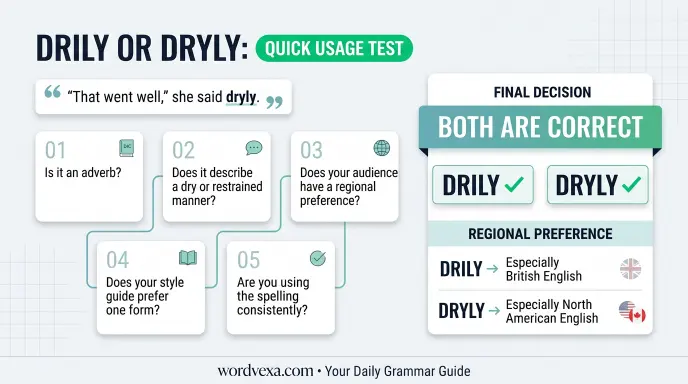
Test your sentence with these questions:
1. Is it an adverb?
She answered dryly.
Yes.
2. Does it describe a restrained or subtly humorous manner?
He commented drily.
Yes.
3. Are you using the same spelling consistently?
If yes, that is good.
4. Does your publication have a regional preference?
If yes, follow it.
5. Are you treating one spelling as automatically wrong?
If yes, reconsider.
This five-step test can solve most drily or dryly questions quickly.
Google Trends & Modern Usage
People search for drily or dryly because the two forms look like they should follow different spelling rules.
The question is especially common among:
- Students
- ESL learners
- Writers
- Editors
- Proofreaders
- Bloggers
- Teachers
- Professional communicators
Modern dictionary evidence supports both forms. The main usage distinction is not correctness but regional and editorial preference.
Exact search-volume percentages should not be claimed without current, verifiable data. Some online articles publish precise percentages for searches or regional usage without showing a reliable methodology. Such numbers should not be treated as established facts.
A better conclusion is supported by dictionary usage:
- Drily is especially associated with British English.
- Dryly is especially associated with North American English.
- Both forms are recognized.
- Both can describe understated humor.
- Both can describe an unemotional manner.
- Both can occur in literal contexts involving dryness.
Quick Comparison Table
| Version | Meaning | Correct? | Regional Preference | Example |
| Drily | In a dry, restrained, or subtly humorous way | Yes | Especially British English | She replied drily. |
| Dryly | In a dry, restrained, or subtly humorous way | Yes | Especially North American English | She replied dryly. |
| Drier | More dry | Yes | Standard English | The towel is drier. |
| Dry | Not wet; also restrained or understated | Yes | Standard English | His humor is dry. |
| Sarcastically | In a sarcastic manner | Yes | Standard English | She replied sarcastically. |
Drily vs Dryly: At-a-Glance Decision Chart
| If you are… | Recommended approach |
| Writing for US readers | Dryly is a natural choice |
| Writing for UK readers | Drily is a natural choice |
| Writing internationally | Either is acceptable |
| Following a house style | Follow the house style |
| Editing an academic paper | Follow the institution or publisher |
| Writing fiction | Choose based on style and consistency |
| Unsure if drily is valid | Yes, it is valid |
| Unsure if dryly is valid | Yes, it is valid |
| Correcting a grammar-checker warning | Verify with a reputable dictionary |
| Switching between both forms | Avoid unnecessary switching |
Key Takeaways
- Drily and dryly are both correct.
- They are alternative spellings of the same adverb.
- Both can describe understated or deadpan humor.
- Both can describe a restrained or unemotional manner.
- Both can have literal uses connected with dryness.
- Drily is especially associated with British English.
- Dryly is particularly common in North American English.
- Neither spelling should automatically be marked wrong.
- Follow your audience, publication, or style guide.
- Most importantly, remain consistent.
FAQs
Q1. Is drily or dryly correct?
Both drily and dryly are correct spellings. They are alternative forms of the same adverb and generally have the same meaning. Both can describe a dry, restrained, matter-of-fact, or subtly humorous manner. The choice usually depends on regional preference, audience, and editorial style rather than grammar.
Q2. Is drily the British spelling?
Drily is especially associated with British English, but it is not exclusively British. Dryly is also used in British English. Therefore, it is better to describe drily as a British preference rather than claim that British English requires it.
Q3. Is dryly the American spelling?
Dryly is particularly common in North American English, so it is a natural choice for many US-focused publications. However, drily can also be found in American English. The important point is that dryly is not simply the American-only version of the word.
Q4. Do drily and dryly have the same meaning?
Yes. In most contexts, drily and dryly have the same meaning. They commonly describe understated humor, a restrained manner, or an unemotional response. They can also be used in contexts involving physical dryness. The spelling itself does not normally change the meaning.
Q5. Why are there two spellings of dryly?
English has developed more than one accepted way of forming this adverb. One form changes the final y to i, producing drily, while the other retains the y, producing dryly. Both forms became established in standard English, so modern writers can encounter either spelling.
Q6. Does drily mean sarcastically?
Not necessarily. Drily can describe sarcasm, but it more broadly refers to an understated, restrained, or subtly humorous manner. Someone can speak dryly without being openly sarcastic. The exact meaning depends on context, tone, and what the speaker is trying to communicate.
Q7. Is “she said drily” grammatically correct?
Yes. “She said drily” is grammatically correct. Drily is an adverb modifying the verb said, and it explains the manner in which she spoke. You could also write “She said dryly,” and the sentence would remain grammatically correct with essentially the same meaning.
Q8. Is “dryly” a misspelling?
No. Dryly is a standard and accepted spelling. It should not be treated as a mistake simply because drily also exists. Both spellings appear in reputable dictionaries. Your choice should depend on regional preference and the style of the publication you are writing for.
Conclusion
The answer to drily or dryly is straightforward: both spellings are correct. They are alternative forms of the same adverb and generally describe a dry, restrained, matter-of-fact, or subtly humorous manner.
The real difference is usage preference. Drily is especially associated with British English, while dryly is particularly common in North American English. However, these are tendencies rather than strict rules. You can encounter both forms across different varieties of English.
For US-focused content, dryly is a practical and familiar choice. For British-focused content, drily can be a natural choice. For international writing, either spelling is acceptable as long as it fits the style of the publication.
Remember that drily is not a typo, and dryly is not an incorrect alternative. If a grammar checker flags one of them, verify the word with a reputable dictionary before changing it.
When editing, think about audience, regional style, consistency, and context rather than simply choosing the spelling that looks more familiar.
The easiest rule to remember is this: Drily and dryly are both correct, so choose your style and stay consistent.
Explore More Articles:
- Dining or Dinning: Which Spelling Is Correct?
- 13rd or 13th? Learn the Easy Rule for Using 13th
- Is It Piller or Pillar? Avoid This Common Spelling Mistake

I’m Claire Morgan, the author behind wordvexa.com, where I write about English grammar, sentence structure, punctuation, and everyday language. My goal is to make grammar simple, clear, and practical, helping readers understand the rules and apply them with confidence in real-world writing.







