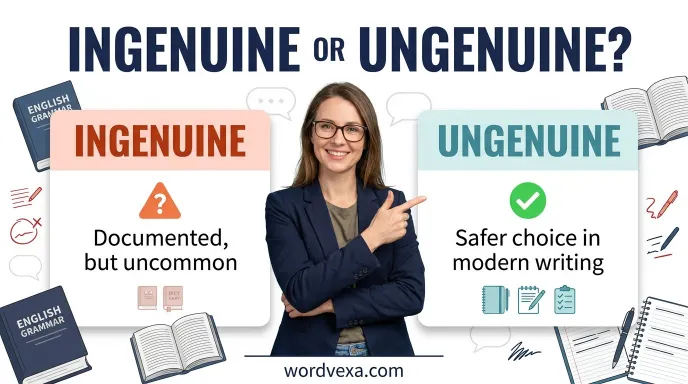
Ingenuine or ungenuine means “not genuine,” but ungenuine is the safer and more commonly recognized choice in modern English.
Both forms are documented, yet they are not equally common, which is why many writers wonder which one they should use. I
f you are writing an email, school assignment, blog post, business document, or academic paper, choosing the more familiar form can make your writing clearer.
The confusion comes from English negative prefixes such as in- and un-. Since both can mean “not,” it may seem logical to form the opposite of genuine as ingenuine.
However, ungenuine is generally the better choice when you simply mean something is not genuine, authentic, or sincere.
In this guide, you will learn the meaning of ingenuine or ungenuine, how the two forms differ, where they are used, common mistakes to avoid, and which word works best in British, American, and international English. You will also see practical examples that make the difference easy to remember.
Ingenuine or Ungenuine: Quick Answer
If you need a simple answer, choose ungenuine in most situations.
- Ungenuine = not genuine, false, artificial, or lacking authenticity.
- Ingenuine = also documented as meaning not genuine or unauthentic, but much less common.
- Genuine = real, authentic, sincere, or true.
- Inauthentic = not authentic, often a clearer formal alternative.
- Insincere = not honest or heartfelt in feelings, words, or intentions.
- Fake = not real or an imitation.
Examples
His apology sounded ungenuine.
The product appeared ungenuine.
Her enthusiasm seemed ungenuine.
The less common form ingenuine can also be found in English:
The critic described the performance as ingenuine.
This does not mean that ingenuine has no history. It is a documented adjective meaning “false, not genuine or authentic.”
The main practical issue is recognition and naturalness. Because ungenuine is the more familiar form, it is usually the better choice when you want your writing to sound clear and standard.
What Does Ingenuine or Ungenuine Mean?
Both words are intended to describe something that is not genuine.
Ungenuine is the safer and more established choice when you mean “not genuine,” “not authentic,” or “false.” Ingenuine is also documented with the same basic meaning, but it is uncommon and may sound unusual to many readers.
For clear modern writing, use ungenuine, or choose a more precise word such as inauthentic, insincere, or fake.
The adjective genuine can describe something real, authentic, natural, or sincere. Adding a negative prefix changes the meaning.
Ungenuine Meaning
Ungenuine generally means:
- not genuine
- not authentic
- false
- artificial
- fake
- insincere
- not natural
Collins gives ungenuine the definition “false” and lists related words such as artificial, false, forged, and fake.
The exact meaning depends on the context.
For example:
An ungenuine product
This suggests that the product is not authentic.
An ungenuine apology
This suggests that the apology does not seem sincere.
An ungenuine smile
This suggests that the smile appears forced or unnatural.
Ingenuine Meaning
Ingenuine is also recorded as an adjective meaning “false, not genuine or authentic.”
For example:
The reviewer considered the response ingenuine.
However, many readers may find ingenuine unusual. If clarity is your main goal, ungenuine, inauthentic, or another precise alternative is generally better.
A Useful Distinction
Do not confuse ingenuine with ingenious or ingenuous.
- Ingenuine = not genuine.
- Ingenious = clever or inventive.
- Ingenuous = innocent, frank, or candid.
These words look similar but have different meanings.
The Origin of Ingenuine or Ungenuine
The word genuine has a long history in English and is related to Latin genuinus, meaning genuine, natural, or native.
English commonly uses prefixes to express negative meanings. Two important examples are un- and in-.
The prefix un- often means “not,” as in:
- unhappy
- unfair
- unclear
- unnatural
- untrue
The prefix in- can also express negation in words such as:
- incorrect
- incomplete
- inaccurate
- inactive
- insincere
This helps explain why ingenuine may look reasonable to English speakers.
Historical evidence also shows that ungenuine is not a newly invented internet word. The World English Historical Dictionary records examples going back to the 1600s, including an example from 1665.
At the same time, ingenuine is documented in English and has been used with the meaning “false” or “not genuine.” Wiktionary records examples from published works and lists ungenuine as a synonym.
So the issue is not simply that one form exists and the other does not. Both are documented, but they do not have equal levels of modern familiarity and acceptance.
For contemporary general writing, ungenuine is the more practical choice.
British English vs American English
There is an important point to understand here: ingenuine vs ungenuine is not a straightforward British English vs American English spelling difference.
Unlike pairs such as colour/color or organise/organize, these two forms are not standard regional spellings of the same word.
| Feature | British English | American English | Example |
| Genuine | Standard | Standard | The signature is genuine. |
| Ungenuine | Used and documented | Used and understood | His apology sounded ungenuine. |
| Ingenuine | Rare/uncommon | Rare/uncommon | The response seemed ingenuine. |
| Inauthentic | Standard | Standard | The story felt inauthentic. |
| Insincere | Standard | Standard | His apology seemed insincere. |
| Fake | Standard | Standard | The product was fake. |
Collins specifically lists ungenuine in British English, while general English sources also document its meaning and use.
Therefore, writers should not assume that Americans must use one form and British writers must use the other.
Style Matters More Than Geography
If you are writing for an international audience, ungenuine is generally easier to understand than ingenuine.
For highly formal writing, however, you may want to choose a more precise word.
For example:
The statement was inauthentic.
or:
His response appeared insincere.
These may communicate your intended meaning more directly.
Which Version Should You Use?
United States
Use ungenuine if you specifically want an adjective meaning “not genuine.”
However, American readers may find inauthentic, insincere, or fake more natural depending on the context.
United Kingdom
Ungenuine is a documented British English word.
Use it when it accurately describes something that lacks genuineness.
Canada
For Canadian English, ungenuine is the safer general choice. If the meaning is specifically about honesty or emotion, insincere may be clearer.
Australia
Use ungenuine when you need the broad meaning “not genuine.” As elsewhere, a more specific synonym may be preferable when the context allows it.
International Writing
For international readers, prioritize clarity.
Use:
- ungenuine for a broad meaning
- inauthentic for something that is not authentic
- insincere for feelings, words, or intentions
- fake for something that is not real or genuine
Academic Writing
Academic writing usually benefits from precision.
Instead of:
The argument was ungenuine.
Consider:
The argument was misleading.
or:
The claim was not supported by reliable evidence.
Choose the word that describes the exact problem.
Business Writing
In business writing, avoid unusual vocabulary when a clearer alternative is available.
Instead of:
The customer’s response seemed ingenuine.
You could write:
The customer’s response appeared insincere.
For products:
The item appeared inauthentic.
This makes the intended meaning clearer.
Common Mistakes
One of the biggest mistakes is assuming that every English word can form its opposite simply by adding in-.
Mistake 1: Treating Ingenuine as the Only Correct Form
Incorrect assumption:
Genuine → ingenuine
Although ingenuine is documented, it is uncommon.
Better:
Genuine → ungenuine
Memory tip:
When you mean “not genuine,” remember un + genuine = ungenuine.
Mistake 2: Using Ungenuine When Insincere Is More Precise
His apology was ungenuine.
This is understandable.
But:
His apology was insincere.
is often more direct because the problem concerns honesty or sincerity.
Mistake 3: Using Fake in Every Context
Fake is useful, but it can sound informal.
The watch was fake.
In formal writing:
The watch appeared inauthentic.
may be more appropriate.
Mistake 4: Confusing Ingenuine With Ingenuous
These words are especially easy to mix up.
Ingenuine means not genuine.
Ingenuous means innocent, frank, or candid.
They are not interchangeable.
Mistake 5: Assuming This Is a US/UK Spelling Pair
It is not comparable to:
colour / color
or:
organise / organize
The choice between ingenuine and ungenuine is mainly about usage, familiarity, and precision, not a simple British-versus-American spelling rule.
Everyday Examples
Emails
Thank you for your message, but the apology sounded ungenuine.
For professional email, a more neutral option may be:
The apology did not appear sincere.
Business Writing
The company investigated if the documents were genuine or ungenuine.
A more precise formal version might be:
The company investigated if the documents were authentic.
News Headlines
News writing usually favors short and familiar words.
Instead of:
Official Questions Ungenuine Documents
a publication might choose:
Official Questions Authenticity of Documents
The second headline is more precise.
Blogs
The influencer’s enthusiasm felt ungenuine to many readers.
This works because blogs often use conversational language.
Social Media
That apology feels so ungenuine.
This is understandable and natural enough in casual online writing.
Academic Writing
Academic writers should usually choose a word that identifies the exact issue.
Instead of:
The author’s argument is ungenuine.
consider:
The author’s argument appears unsupported.
or:
The author’s claim appears misleading.
Daily Conversation
I don’t know why, but his friendliness seemed ungenuine.
This is understandable, although fake, forced, or insincere may sound more natural in everyday speech.
Google Trends & Modern Usage
Searches for ingenuine or ungenuine are likely driven by a simple language question: people know the word genuine and want to form its opposite correctly.
The confusion is understandable because English uses both un- and in- as negative prefixes. This does not mean that either prefix can be attached freely to every adjective.
Current dictionary evidence supports ungenuine as an established word. Collins defines it as “false” and provides examples of modern usage.
At the same time, ingenuine is documented with the meaning “false, not genuine or authentic.”
There is no need to invent a precise percentage or search-volume figure to answer the question. The useful takeaway from the available evidence is that ungenuine is the safer modern choice, while ingenuine is comparatively uncommon.
For natural writing, related searches may include:
- ungenuine meaning
- ingenuine meaning
- is ingenuine a word
- is ungenuine correct
- ingenuine vs ungenuine
- another word for not genuine
- ungenuine synonym
- inauthentic vs ungenuine
- insincere vs ungenuine
- genuine opposite
Quick Comparison Table
| Version | Meaning | Correct? | Region | Example |
| genuine | Real, authentic, sincere | Yes | All major varieties | The signature is genuine. |
| ungenuine | Not genuine, false, artificial | Yes | International English | His apology seemed ungenuine. |
| ingenuine | Not genuine or authentic | Documented, but uncommon | International, rare usage | The response appeared ingenuine. |
| inauthentic | Not authentic or genuine | Yes | International English | The product was inauthentic. |
| insincere | Not sincere or heartfelt | Yes | International English | Her apology sounded insincere. |
| fake | Not real or authentic | Yes | International English | The watch was fake. |
| disingenuous | Not candid or straightforward | Yes, but different | International English | His answer was disingenuous. |
The distinction between ungenuine and disingenuous is especially important. Disingenuous does not simply mean “not genuine.” It commonly describes someone or something that is not candid or straightforward.
Key Takeaways
- Ungenuine is the safer choice for most modern writing.
- Ingenuine is documented, but it is much less common.
- Neither form should be treated as a simple British-versus-American spelling difference.
- Ungenuine can mean false, artificial, not authentic, or insincere depending on context.
- Use inauthentic when authenticity is the main issue.
- Use insincere when feelings, words, or intentions are not genuine.
- Use fake when you want a simple and often informal term.
- Do not confuse ingenuine with ingenuous.
- In formal writing, choose the most precise word rather than simply choosing a negative form of genuine.
FAQs
Q1. Is ungenuine a correct word?
Yes. Ungenuine is a documented English adjective meaning false or not genuine. Collins Dictionary lists it and provides examples of its use. It can describe something that is not authentic, sincere, natural, or real, depending on context.
Q2. Is ingenuine a real word?
Yes, ingenuine is documented as an English adjective meaning “false, not genuine or authentic.” However, it is uncommon compared with ungenuine. For general, academic, or professional writing, ungenuine is usually the safer choice.
Q3. Which is correct, ingenuine or ungenuine?
Ungenuine is generally the better choice in modern English. Ingenuine is also documented, so calling it completely nonexistent would be inaccurate. If your goal is clear and familiar wording, use ungenuine or choose a more precise synonym.
Q4. Is ingenuine a standard English word?
Ingenuine is a documented English word, but it is relatively uncommon. Some readers may find it unusual or may confuse it with ingenuous. If you are writing for a broad audience, ungenuine, inauthentic, or insincere will often communicate your meaning more clearly.
Q5. What does ungenuine mean?
Ungenuine means not genuine. Depending on context, it can mean false, fake, artificial, inauthentic, or insincere. An ungenuine product may not be authentic, while an ungenuine apology may not sound sincere.
Q6. Is ungenuine British or American English?
Ungenuine is not limited to one major variety of English. Collins lists it in British English, and the word is understood more broadly. The pair ingenuine/ungenuine should not be treated like a typical British-versus-American spelling difference such as colour/color.
Q7. What is a better word than ungenuine?
The best alternative depends on your meaning. Use inauthentic for something that is not authentic, insincere for feelings or words that are not heartfelt, fake for something not real, and disingenuous for behavior that is not candid or straightforward.
Q8. Is ingenuine the opposite of genuine?
It is used with the meaning “not genuine,” so it can function as an opposite of genuine. However, ungenuine is the more familiar choice for this purpose. In formal writing, inauthentic may be even clearer when you are discussing authenticity.
Conclusion
When choosing between ingenuine or ungenuine, ungenuine is the safer option for most modern English writing. It is a documented adjective meaning not genuine, false, artificial, or lacking authenticity. Collins Dictionary recognizes the word and provides examples of its use.
That does not mean ingenuine is simply an invented or impossible word. It is also documented with the meaning “false, not genuine or authentic.” The practical difference is that ingenuine is much less familiar, so it may make readers pause or wonder if you intended to write something else.
For the clearest writing, choose the word that matches your exact meaning. Use ungenuine for a broad sense of “not genuine,” inauthentic for something that is not authentic, insincere for feelings or words that are not heartfelt, and fake for a simple everyday expression.
The easiest rule to remember is: when you mean “not genuine,” choose “ungenuine” unless a more precise synonym fits better.
For more clear explanations of commonly confused English words, explore related grammar and usage guides on Wordvexa.
You May Also Like:

I’m Claire Morgan, the author behind wordvexa.com, where I write about English grammar, sentence structure, punctuation, and everyday language. My goal is to make grammar simple, clear, and practical, helping readers understand the rules and apply them with confidence in real-world writing.







