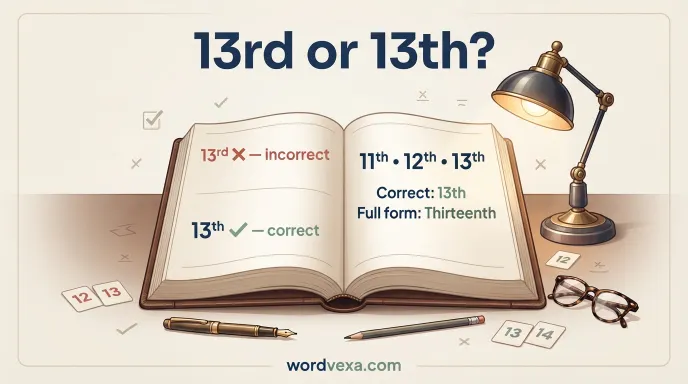
13rd or 13th: 13th is the correct ordinal form of the number 13, while 13rd is incorrect. The correct written form is 13th, and its full word form is thirteenth.
If you are unsure if to write 13rd or 13th, you are not alone. Ordinal numbers can be confusing because many numbers use endings such as -st, -nd, -rd, or -th. However, 13 follows a special pattern. Although the number ends in 3, it takes -th, not -rd.
In this guide, you will learn why 13th is correct, why 13rd is a common mistake, how to use 13th in dates and sentences, and how the rule changes with numbers such as 23rd and 113th. You will also see clear examples that make the rule easy to remember.
13rd or 13th: The Quick Answer
13th is the correct form. 13rd is not standard English.
The full ordinal word is thirteenth, so the abbreviated form is 13th.
- ✅ 13th
- ❌ 13rd
- ✅ thirteenth
- ❌ thirdteen
- ❌ thirteen-third
For example:
My 13th birthday is next week.
She finished in 13th place.
The meeting is on the 13th of May.
The easiest rule to remember is:
11th → 12th → 13th → 14th
The number 13 belongs to the group of teen numbers that take -th.
Why Is 13th Correct and 13rd Wrong?
The mistake becomes easier to understand when you compare the spoken forms.
3rd means third.
13th means thirteenth.
These are different ordinal words. The fact that 13 contains the digit 3 does not mean it should borrow the ending from third.
Compare:
| Number | Ordinal word | Correct form |
| 3 | third | 3rd |
| 13 | thirteenth | 13th |
| 23 | twenty-third | 23rd |
| 33 | thirty-third | 33rd |
| 103 | one hundred third | 103rd |
| 113 | one hundred thirteenth | 113th |
This reveals the real rule: look at the final two digits when deciding the ordinal ending.
So:
- 3 → 3rd
- 13 → 13th
- 23 → 23rd
- 33 → 33rd
- 113 → 113th
- 123 → 123rd
The final digit alone is not enough.
The Simple Rule for Ordinal Number Endings
Ordinal numbers show position or order rather than quantity.
For example:
- 1st = first
- 2nd = second
- 3rd = third
- 4th = fourth
- 5th = fifth
- 13th = thirteenth
A useful general pattern is:
| Ending | Common suffix | Examples |
| 1 | -st | 1st, 21st, 31st |
| 2 | -nd | 2nd, 22nd, 32nd |
| 3 | -rd | 3rd, 23rd, 33rd |
| Other endings | -th | 4th, 5th, 6th, 10th |
But there is one important exception to the shortcut:
11, 12, and 13 always use -th.
Therefore:
- 11th, not 11st
- 12th, not 12nd
- 13th, not 13rd
After 20, the familiar pattern returns:
- 21st
- 22nd
- 23rd
- 24th
This is why 13th may feel unusual at first. It is an exception to the simple last-digit shortcut.
Why Do People Write 13rd?
The mistake is easy to explain.
Many people first learn:
1st, 2nd, 3rd
Then they see 13 and focus on its final digit:
13 → ends in 3 → 3rd → 13rd
That reasoning looks logical, but it ignores the fact that 13 is a teen number.
The same problem appears with 11 and 12:
- ❌ 11st
- ✅ 11th
- ❌ 12nd
- ✅ 12th
- ❌ 13rd
- ✅ 13th
So the problem is not really about the number 13 alone. It comes from applying the last-digit rule too early.
A Better Way to Think About It
Instead of asking:
“What digit does the number end with?”
Ask:
“What are the final two digits?”
If the final two digits are 11, 12, or 13, use -th.
Otherwise, the final digit can determine the usual suffix.
This simple check prevents many ordinal-number mistakes.
13th vs 23rd vs 113th
This is one of the most useful comparisons for understanding the rule.
| Number | Final two digits | Correct form | Why? |
| 13 | 13 | 13th | Special teen ending |
| 23 | 23 | 23rd | Ends in 23 |
| 33 | 33 | 33rd | Ends in 33 |
| 113 | 13 | 113th | Ends in 13 |
| 123 | 23 | 123rd | Ends in 23 |
| 213 | 13 | 213th | Ends in 13 |
| 223 | 23 | 223rd | Ends in 23 |
This gives you a powerful shortcut:
If a number ends in 11, 12, or 13, use -th.
That rule works even when the number is much larger.
For example:
113th
213th
313th
But:
123rd
223rd
323rd
This is more accurate than simply looking at the last digit.
What Does 13th Mean?
13th is the ordinal form of the number 13.
An ordinal number tells us where something appears in a sequence.
For example:
She came in 13th place.
This means she was number thirteen in the ranking.
By contrast, 13 is a cardinal number:
She bought 13 books.
Here, 13 tells us the quantity, not the position.
13 vs 13th
| Form | Type | Meaning | Example |
| 13 | Cardinal | Quantity | I have 13 books. |
| 13th | Ordinal | Position/order | This is my 13th book. |
| thirteen | Cardinal word | Quantity | She has thirteen books. |
| thirteenth | Ordinal word | Position/order | She finished thirteenth. |
Understanding this difference helps you use 13th correctly beyond spelling questions.
The Origin of the 13th Form

The full ordinal word is thirteenth.
English has long used different forms for numbers that express order, such as:
- first
- second
- third
- fourth
- fifth
- tenth
- eleventh
- twelfth
- thirteenth
The modern abbreviation 13th reflects the ordinal form thirteenth.
The important point for modern English learners is not to invent a form by attaching the ending from third to thirteen. The correct ordinal word is thirteenth, and the numerical form follows it as 13th.
The sequence of English ordinal numbers confirms the distinction between 3rd and 13th: third is 3rd, while thirteenth is 13th.
13th in Dates
One of the most common reasons people search for 13rd or 13th is date writing.
The correct form is always 13th when an ordinal suffix is used.
Correct
- 13th March
- March 13th
- the 13th of March
- on the 13th
- 13th June
- June 13th
Incorrect
- ❌ 13rd March
- ❌ March 13rd
- ❌ the 13rd of March
For formal dates, many style systems also use dates without ordinal suffixes.
For example:
13 March 2026
or:
March 13, 2026
The preferred date format can vary by country, institution, and style guide. But whenever you specifically need the ordinal form, 13th is the correct choice.
British English vs American English
There is no British-American spelling difference between 13th and 13rd.
Both British and American English use:
13th
The difference is more likely to appear in date formatting.
| Usage | British English | American English |
| Common date style | 13 March | March 13 |
| With ordinal | 13th March | March 13th |
| Formal style | 13 March 2026 | March 13, 2026 |
| Ordinal number | 13th | 13th |
So you do not need to choose between 13th and 13rd based on your audience.
Use 13th in both varieties.
Which Version Should You Use?
For US English
Use 13th when an ordinal number is needed.
She celebrated her 13th birthday.
For formal dates, follow the relevant style guide.
For UK English
Use 13th.
The event takes place on the 13th of July.
A formal document may use:
13 July 2026
For Canada and Australia
Use 13th when the ordinal form is required.
Follow the organization’s preferred date style for formal documents.
For International Writing
Use 13th when expressing an ordinal.
For dates that may be misunderstood internationally, a month written as a word can improve clarity:
13 June 2026
For Academic Writing
Follow your institution or publication’s style guide.
A formal date may be written without the ordinal suffix:
13 June 2026
But if you are describing a position, use the correct ordinal:
The study ranked 13th among the selected studies.
For Business Writing
Use 13th whenever the sentence requires an ordinal.
The company will hold its 13th annual meeting.
For dates, use your company’s preferred format and remain consistent.
Common Mistakes With 13rd and 13th
Mistake 1: Copying the Rule From 3rd
❌ She finished 13rd.
✅ She finished 13th.
The mistake comes from treating 13 as if it were simply 3 with another digit added.
Mistake 2: Writing 13rd in a Date
❌ The appointment is on 13rd May.
✅ The appointment is on 13th May.
Mistake 3: Writing 13st
❌ The 13st chapter
✅ The 13th chapter
Both 13st and 13rd are incorrect.
Mistake 4: Using the Wrong Full Word
❌ thirdteen
❌ thirteen-third
✅ thirteenth
The full form is thirteenth, so the abbreviated form is 13th.
Mistake 5: Applying the Rule to 23
It is also important not to overcorrect.
❌ 23th
✅ 23rd
Why?
Because 23 is pronounced twenty-third, while 13 is thirteenth.
Everyday Examples of 13th
Seeing the form in different contexts makes the rule easier to remember.
Birthdays
She is celebrating her 13th birthday.
Anniversaries
The company is celebrating its 13th anniversary.
Rankings
The player finished 13th in the competition.
Chapters
Turn to the 13th chapter.
Floors
Their office is on the 13th floor.
Dates
The meeting is on the 13th of October.
Events
This is the school’s 13th annual science fair.
Emails
Please send the documents by the 13th.
Academic Writing
The results appear in the 13th section of the report.
News and Headlines
Company Marks Its 13th Anniversary
These examples show that 13th is used whenever 13 describes a position, sequence, or order.
When Should You Write “Thirteenth” Instead of “13th”?
Both forms are correct, but the context can affect which looks better.
Use 13th when:
- You need a short form.
- You are writing a date.
- You are giving a ranking.
- You are labeling a chapter or floor.
- You are using a table or list.
Use thirteenth when:
- You want the number written out.
- Your style guide requires numbers in words.
- You want a more literary or formal tone.
- The number appears in a sentence where spelling it out improves readability.
For example:
She finished 13th.
and:
She finished thirteenth.
Both communicate the same ordinal position.
A Fast Test: Is It 13th or 13rd?
When you are unsure, use this three-step test.
Step 1: Look at the final two digits
Is the number ending in:
- 11?
- 12?
- 13?
If yes, use -th.
Step 2: Say the ordinal aloud
For 13, say:
thirteenth
You can hear the th ending.
Step 3: Check the written form
Therefore:
13th ✅
Not:
13rd ❌
This method is more reliable than simply looking at the last digit.
Formal vs Informal Usage
The spelling of the ordinal does not change between formal and informal English.
You still write:
13th
in both settings.
What can change is if you use the abbreviated form or spell the number out.
Informal
Happy 13th birthday!
Professional
The company will hold its 13th annual meeting.
More formal
The company will hold its thirteenth annual meeting.
Formal date
13 June 2026
The choice depends on the style and context, but 13rd is never the preferred formal alternative to 13th.
Google Trends & Modern Search Confusion
Searches such as “13rd or 13th,” “is 13rd correct,” and “how do you write 13th” are driven by a predictable grammar problem.
People often know the common pattern:
1st, 2nd, 3rd
They then apply it to 13 because the number ends in 3.
But English ordinal numbers require special attention to the teen numbers. The same principle explains why 11th and 12th do not become 11st and 12nd.
This makes the topic especially useful for:
- ESL learners
- School students
- Teachers
- Content writers
- Editors
- Business professionals
- People writing dates
- Anyone checking a birthday or anniversary message
The strongest practical lesson is simple:
Do not look only at the last digit. Check the final two digits.
Quick Comparison Table
| Version | Meaning | Correct? | Typical Use | Example |
| 13th | Thirteenth | ✅ Yes | Position, date, ranking | 13th place |
| 13rd | Intended to mean thirteenth | ❌ No | Common spelling mistake | 13rd place |
| thirteenth | Full ordinal word | ✅ Yes | Formal or spelled-out writing | The thirteenth chapter |
| 13 | Thirteen | ✅ Yes | Quantity | 13 students |
| 3rd | Third | ✅ Yes | Position | 3rd place |
| 23rd | Twenty-third | ✅ Yes | Position | 23rd place |
13th or 13rd: The Decision Guide
| If you mean… | Use | Example |
| The number thirteen | 13 | There are 13 students. |
| The thirteenth position | 13th | She came 13th. |
| The thirteenth day | 13th | See you on the 13th. |
| The word form | thirteenth | The thirteenth item |
| The third position | 3rd | He came 3rd. |
| The twenty-third position | 23rd | She came 23rd. |
This distinction prevents the most common confusion.
Key Takeaways
- 13th is correct.
- 13rd is incorrect.
- The full word is thirteenth.
- The numbers 11, 12, and 13 use -th.
- Do not determine the suffix from the final digit alone.
- 23rd is correct because it ends in 23, not 13.
- 113th is correct because its final two digits are 13.
- British and American English both use 13th.
- Date formatting can vary by region, but the ordinal form does not.
- When in doubt, say the word aloud: thirteenth → 13th.
FAQs
Q1. Is 13rd correct or 13th?
13th is correct, and 13rd is incorrect. The full ordinal form of 13 is thirteenth, so the abbreviated form is 13th. The confusion comes from the fact that 3 is written as 3rd. However, 13 is a teen number, and 11, 12, and 13 all use the -th ending.
Q2. Why is 13th not 13rd?
The number 13 is pronounced thirteenth, not “thirteen-third.” The ending of the ordinal word is -th, so the abbreviated form is 13th. The -rd ending belongs to ordinal forms such as third, 23rd, and 33rd, where the number actually ends in the ordinal word “third.”
Q3. Is 13th correct in British English?
Yes. 13th is correct in British English. There is no British-American spelling difference for this ordinal form. British English may commonly write a date as “13th June,” while formal writing may use “13 June.” In either case, when the ordinal form is required, it is 13th.
Q4. Is 13th correct in American English?
Yes. 13th is also correct in American English. You may see “March 13th” in ordinary writing, while formal styles may prefer “March 13, 2026.” The date convention can change, but the ordinal number itself remains 13th.
Q5. What is the full spelling of 13th?
The full spelling of 13th is thirteenth. For example, “She finished 13th” can also be written as “She finished thirteenth.” The first form is shorter and common in numerical writing, while the second spells out the ordinal number.
Q6. Why does 23rd use “rd” but 13th uses “th”?
The difference comes from the final two digits. 23 is pronounced “twenty-third,” so it takes -rd. 13 is pronounced “thirteenth,” so it takes -th. This is why looking only at the final digit can cause mistakes.
Q7. Is 113th or 113rd correct?
113th is correct. Although 113 ends in the digit 3, its final two digits are 13. Numbers ending in 13 use -th. Compare 113th with 123rd: 113 ends in 13, while 123 ends in 23.
Q8. How do you write the 13th date?
You can write an ordinal date as 13th March, March 13th, or the 13th of March, depending on regional and stylistic conventions. In formal writing, you may also see 13 March or March 13, 2026. The important point is that 13rd is never correct.
Conclusion
If you are choosing between 13rd or 13th, always choose 13th. The correct full form is thirteenth, and 13rd is not a standard English ordinal form.
The main reason for the confusion is the digit 3. Since 3rd is correct, it can seem natural to apply the same ending to 13. But the teen numbers follow a different pattern. 11th, 12th, and 13th all use -th.
The same rule becomes especially useful with larger numbers. 113th is correct because it ends in 13, while 123rd is correct because it ends in 23. This is why checking the final two digits is more reliable than looking at the last digit alone.
The rule works in both British and American English. Date formatting may differ, but the correct ordinal remains 13th. So whenever you see the choice 13rd or 13th, there is no need to hesitate.
Remember: 13 is thirteenth, so the correct form is 13th, never 13rd.
If this guide helped clear up the confusion, explore more Wordvexa grammar guides for other commonly confused English forms.
You May Also Like:

I’m Sloane Mercer, a U.S.-based English language writer focused on grammar, spelling, vocabulary, and everyday English usage. Through Wordvexa, I provide clear and practical explanations to help readers choose the right words and communicate with confidence.








1 thought on “13rd or 13th? Learn the Easy Rule for Using 13th”