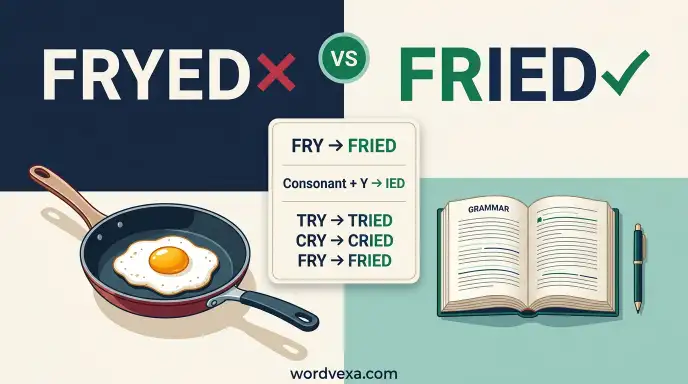
When it comes to fryed or fried, fried is the correct spelling. Fryed is a common spelling mistake, while fried is the standard past tense and past participle of the verb fry. For example, “She fried the eggs” is correct, while “She fryed the eggs” is incorrect.
This confusion is easy to understand. English learners often assume that they can form the past tense simply by adding -ed to a verb.
If that rule were applied directly to fry, it would produce fryed. However, English has a spelling rule for verbs ending in a consonant followed by y. In these cases, the y usually changes to i before -ed is added.
That gives us:
fry + ed → fried
The same pattern appears in words such as try → tried, cry → cried, and study → studied. In this guide, you will learn why fried is correct, how to use it in different sentences, and how to remember the spelling easily.
Fryed or Fried: Quick Answer
Fried is correct. Fryed is incorrect in standard English.
The verb fry changes to fried in the simple past and past participle.
- Correct: I fried an egg.
- Correct: She fried the chicken.
- Correct: We have fried the vegetables.
- Incorrect: I fryed an egg.
- Incorrect: She fryed the chicken.
The spelling follows the common rule for verbs ending in a consonant + y:
fry → fried
Other examples include:
- try → tried
- cry → cried
- reply → replied
- carry → carried
- study → studied
So, whenever you need the past form of fry, use fried.
What Does Fried Mean?
Fried is the past tense and past participle of fry. It can also be used as an adjective.
The verb fry means to cook food in hot oil or fat. The word fried therefore commonly describes food that has been cooked in this way.
Fried as a past-tense verb
Use fried when an action happened in the past.
I fried two eggs this morning.
She fried the onions before adding the sauce.
They fried the fish for dinner.
Fried as a past participle
The same form is used as a past participle.
I have fried the potatoes already.
She had fried the vegetables before we arrived.
The chicken was fried in hot oil.
Fried as an adjective
Fried can describe food.
We ordered fried chicken.
He likes fried rice.
She ate a fried egg for breakfast.
This means that fried is not limited to one grammatical role. Its function depends on how it appears in the sentence.
Why Is Fried Spelled With “I” Instead of “Y”?
The main reason is an English spelling rule.
When a verb ends in a consonant + y, the y usually changes to i before the past-tense ending -ed is added.
So:
fry + ed = fried
Not:
fry + ed = fryed
More examples of the same rule
| Base Verb | Past Form |
| fry | fried |
| try | tried |
| cry | cried |
| reply | replied |
| carry | carried |
| study | studied |
| apply | applied |
The important thing is that the letter before y is a consonant.
What happens when a vowel comes before y?
When y follows a vowel, the y usually stays in place.
| Base Verb | Past Form |
| play | played |
| stay | stayed |
| enjoy | enjoyed |
| employ | employed |
| obey | obeyed |
Compare:
fry → fried
but
play → played
This distinction explains why fryed looks reasonable at first but is not the standard spelling.
Fry, Fried, and Frying: Complete Word Forms
Understanding all the forms of the verb fry can make the spelling easier to remember.
| Verb Form | Correct Form | Example |
| Base form | fry | I fry eggs. |
| Third-person singular | fries | She fries eggs. |
| Simple past | fried | She fried eggs. |
| Past participle | fried | She has fried eggs. |
| Present participle | frying | She is frying eggs. |
Notice that the spelling changes in different forms.
fry → fries → fried → frying
Fry
Use fry for the base form.
I usually fry eggs for breakfast.
Fries
Use fries with he, she, or it in the present tense.
My mother fries vegetables in olive oil.
Fried
Use fried for the past tense and past participle.
My mother fried vegetables yesterday.
Frying
Use frying for the present participle.
My mother is frying vegetables now.
The Origin of Fry and Fried
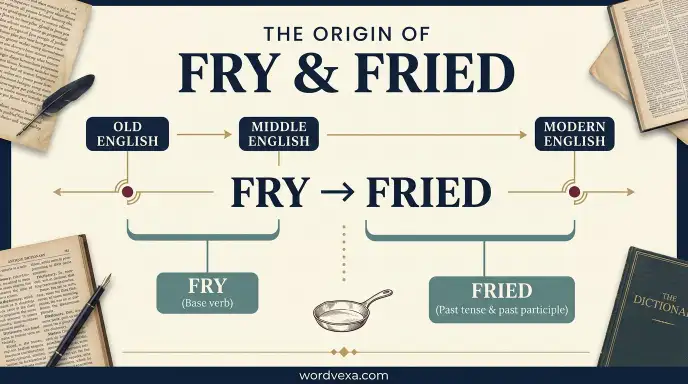
The English verb fry has a long history. It entered Middle English through Old French and can ultimately be traced to Latin frigere, associated with cooking by heat.
Over time, fry developed into the familiar English verb used today for cooking food in hot oil or fat.
The past form fried developed according to English spelling patterns for verbs ending in consonant + y. The spelling therefore reflects both the history of the word and the normal way English forms past-tense verbs.
The important modern forms are:
fry → fried
The word fried is now widely used in everyday English, especially in expressions related to food such as fried chicken, fried rice, fried eggs, and fried fish.
Fried as a Verb vs Fried as an Adjective
The word fried can perform different grammatical jobs.
Fried as a verb
Sarah fried the eggs.
Here, fried tells us what Sarah did. It is the past form of the verb fry.
Fried as an adjective
Sarah ate fried eggs.
Here, fried describes the eggs.
How can you tell the difference?
Look at what the word is doing in the sentence.
If it describes an action, it is functioning as a verb.
He fried the chicken.
If it describes a noun, it can function as an adjective.
He ordered fried chicken.
This distinction is useful for students, ESL learners, and writers who want to understand more than just the spelling.
Fryed or Fried in Different Sentence Structures
The correct form fried works in several grammatical structures.
Simple Past
I fried the fish yesterday.
The action happened in the past.
Present Perfect
She has fried the eggs already.
The past action is connected to the present.
Past Perfect
They had fried the chicken before the guests arrived.
The frying happened before another past event.
Passive Voice
The vegetables were fried in hot oil.
The focus is on the vegetables rather than the person who cooked them.
As an Adjective
We ordered fried potatoes.
Here, fried describes the potatoes.
These examples show why learning fried as a complete word form is more useful than simply memorizing that fryed is wrong.
British English vs American English
There is no standard British-American spelling difference between fried and fryed.
Both British and American English use fried.
| English Variety | Correct Form | Example |
| American English | fried | She fried the eggs. |
| British English | fried | She fried the eggs. |
| Canadian English | fried | He fried the fish. |
| Australian English | fried | They fried the vegetables. |
| International English | fried | We fried some potatoes. |
The spelling fryed is not the standard alternative spelling in any of these varieties.
Style and publishing
If you are writing an American blog, British educational article, Canadian report, or international website, fried is the appropriate spelling.
Which Version Should You Use?
The answer is simple: use fried.
United States
Use fried in everyday, academic, professional, and online writing.
The chef fried the chicken.
United Kingdom
Use fried as well.
She fried the eggs for breakfast.
Canada
Fried is the standard form.
Australia
Use fried in standard English.
International writing
If your content is intended for readers around the world, fried is the safe and standard form.
Academic writing
Use fried when describing cooking methods or processes.
The samples were fried at a controlled temperature.
Business writing
Use fried when the word is needed in menus, food descriptions, reports, or other professional material.
The spelling does not change according to the level of formality.
Why Do People Write Fryed Instead of Fried?
The mistake usually comes from applying an incomplete spelling rule.
Adding -ed mechanically
A learner may think:
fry + ed = fryed
This seems logical because many verbs simply take -ed. But fry follows the consonant + y spelling rule.
Confusing fry with play
Learners may remember:
play → played
and assume:
fry → fryed
The difference is the letter before y.
In play, the y follows a vowel.
In fry, the y follows a consonant.
Learning from pronunciation
English spelling is not always predictable from pronunciation. Someone may hear the ending and assume that -ed can simply be added to the existing spelling.
Typing quickly
Because fryed looks visually plausible, it can also appear as a simple typing or spelling error.
Common Spelling Rules for Verbs Ending in Y
The fry → fried pattern becomes easier when you understand the larger rule.
Consonant + Y
Change y to i and add -ed.
- fry → fried
- try → tried
- cry → cried
- marry → married
- carry → carried
- worry → worried
Vowel + Y
Keep the y and add -ed.
- play → played
- stay → stayed
- enjoy → enjoyed
- employ → employed
- destroy → destroyed
The easy rule
Remember:
Consonant + Y → IED
Vowel + Y → YED
For fry:
fr + y → fried
This rule explains the spelling much better than simply memorizing one word.
Common Mistakes with Fryed or Fried
Here are some of the most common errors.
| Incorrect | Correct | Explanation |
| I fryed an egg. | I fried an egg. | The y changes to i. |
| She fryed the chicken. | She fried the chicken. | Fried is the past form. |
| We have fryed the potatoes. | We have fried the potatoes. | Fried is the past participle. |
| The fish was fryed. | The fish was fried. | Use the past participle in passive voice. |
| He fryed some onions. | He fried some onions. | Fryed is not standard English. |
Memory tip
Use this simple pattern:
TRY → TRIED
CRY → CRIED
FRY → FRIED
A useful sentence to remember is:
I tried, cried, and fried.
The repeated -ied pattern makes the correct spelling easier to recall.
Everyday Examples
The word fried appears in many types of writing.
Emails
I fried the food before the guests arrived.
Business Writing
The vegetables are fried before being served.
News Headlines
Local Restaurant Introduces New Fried Chicken Menu
Blogs
I fried the potatoes until they became golden and crispy.
Social Media
Just fried some eggs for breakfast!
Academic Writing
The samples were fried under controlled conditions.
Daily Conversation
Have you fried the eggs yet?
Yes, I fried them a few minutes ago.
Food Writing
Add the fried onions to the mixture.
These examples show that fried is a normal and widely useful English word.
Fry vs Frying: What Is the Difference?
Both Fry and frying are different forms of the same verb.
Fry
It is the base form.
I fry vegetables every weekend.
Frying
Frying is the present participle.
I am frying vegetables now.
Fried
Fried is the past form.
I fried vegetables yesterday.
The three forms describe different grammatical situations:
fry → frying → fried
Do not use fryed for the past tense.
Fry vs Fry-Up
The expression fry-up is sometimes seen in British English, especially in discussions of breakfast or a meal containing fried food.
For example:
We had a traditional fry-up for breakfast.
This is a separate expression. It does not change the past tense of fry.
The correct verb forms remain:
fry → fried
Google Trends & Modern Usage
Searches for “fryed or fried” are usually driven by spelling and grammar confusion. The question is especially understandable for learners because adding -ed directly to fry appears logical at first.
Modern standard English uses fried as the past tense and past participle of fry. The spelling follows the established consonant + y pattern.
Exact search-volume or Google Trends figures should only be reported when reliable current data is available. Rather than inventing statistics, it is more useful to focus on the actual language pattern behind the search.
The confusion also fits a wider group of common searches:
- tryed or tried
- cryed or cried
- studyed or studied
- replyed or replied
- carryed or carried
These searches share the same basic spelling issue.
Quick Comparison Table
| Version | Meaning | Correct? | Use | Example |
| fry | Cook in hot oil or fat | Yes | Base form | I fry eggs. |
| fried | Past form of fry | Yes | Past tense | I fried eggs. |
| fried | Past participle | Yes | Perfect/passive forms | The eggs were fried. |
| fried | Describes cooked food | Yes | Adjective | Fried eggs are popular. |
| frying | Cooking in progress | Yes | Present participle | She is frying eggs. |
| fryed | Intended past form of fry | No | Avoid | ❌ She fryed eggs. |
Quick Grammar Test: Fryed or Fried?
Test yourself before moving on.
Question 1
She ___ the eggs this morning.
fried / fryed
Question 2
The chicken was ___ in hot oil.
fried / fryed
Question 3
He has ___ the potatoes already.
fried / fryed
Answers
- fried
- fried
- fried
If you chose fried every time, you have mastered the basic rule.
Key Takeaways
- Fried is the correct spelling.
- Fryed is incorrect in standard English.
- Fried is the simple past of fry.
- Fried is also the past participle of fry.
- Fried can function as an adjective.
- The spelling follows the consonant + y → ied rule.
- British and American English both use fried.
- Remember: fry → fried.
- Do not confuse fried with frying, which describes an ongoing action.
- A useful memory phrase is: “I tried, cried, and fried.”
FAQs
Q1. Is fryed or fried correct?
Fried is correct, while fryed is incorrect in standard English. The past tense of fry is formed by changing the final y to i and adding -ed. Therefore, the correct form is fried, as in “She fried the eggs.”
Q2. Why is fried spelled with an i?
The spelling follows the common English rule for verbs ending in a consonant followed by y. The y changes to i before -ed is added. Therefore, fry becomes fried. The same pattern appears in try → tried and cry → cried.
Q3. Is fryed a word?
Fryed is not the standard past-tense spelling of fry. It is normally treated as a spelling mistake. In standard English writing, use fried instead. For example, write “He fried the fish,” not “He fryed the fish.”
Q4. What is the past tense of fry?
The simple past tense of fry is fried. For example, “I fry eggs every morning” changes to “I fried eggs yesterday.” The spelling changes from y to i before the -ed ending.
Q5. What is the past participle of fry?
The past participle of fry is also fried. It can be used with auxiliary verbs and in passive constructions. Examples include “She has fried the eggs” and “The chicken was fried in oil.”
Q6. What is the difference between fry and fried?
Fry is the base form of the verb, while fried is its past tense and past participle. For example, “I fry eggs” describes a present or regular action, while “I fried eggs” describes an action completed in the past.
Q7. Is fried the same in British and American English?
Yes. Fried is the standard spelling in both British and American English. There is no normal regional spelling variation in which fryed replaces fried. Writers can use fried in both varieties of English.
Q8. Why does fry change to fried?
Because fry ends with a consonant followed by y. When -ed is added, the standard spelling rule changes the y to i. This produces fried. Similar examples include reply → replied and carry → carried.
Q9. Is fried a verb or an adjective?
Fried can be either a verb form or an adjective depending on the sentence. In “She fried the eggs,” it is a verb. In “She ate fried eggs,” it describes the eggs and functions as an adjective.
Conclusion
When choosing between fryed or fried, always use fried in standard English. Fryed is a common spelling mistake, but it is not the correct past form of the verb fry.
The reason is a simple English spelling rule. When a verb ends in a consonant followed by y, the y normally changes to i before -ed is added. That gives us fry → fried, just as we have try → tried and cry → cried.
The word fried can be used as a past-tense verb, a past participle, or an adjective. It works naturally in everyday conversation, recipes, restaurant menus, blogs, academic writing, business communication, and many other contexts.
There is also no British-American spelling difference here. Both varieties use fried.
If you remember only one thing, remember this:
Fry has a Y, but its past form is FRIED with an I.
Use fried, not fryed, whenever you need the past form of fry.
Read More Articles:
- Criticising or Criticizing? A Global Spelling Guide
- i or I: When to Capitalize the Pronoun ‘I’ (With Examples)
- Develops vs Developes: Which One Is Grammatically Correct?

I’m Claire Morgan, the author behind wordvexa.com, where I write about English grammar, sentence structure, punctuation, and everyday language. My goal is to make grammar simple, clear, and practical, helping readers understand the rules and apply them with confidence in real-world writing.







