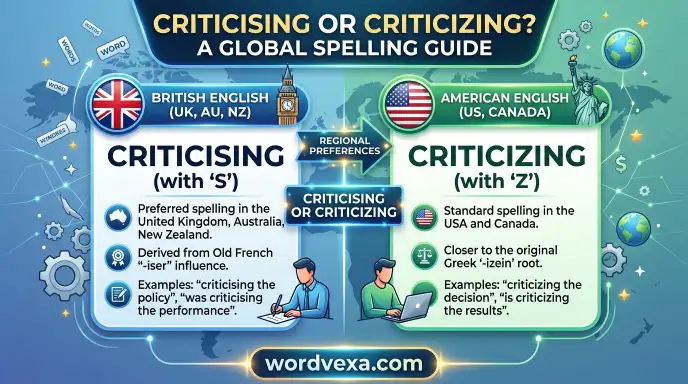
“Criticising” and “criticizing” are both correct spellings of the verb that means to express disapproval, point out faults, or evaluate something in detail.
“Criticizing” with a “z” is the standard spelling in American and Canadian English, while “criticising” with an “s” is preferred in British, Australian, and Commonwealth English.
People search for this keyword because spellcheck tools, word processors, and autocorrect software frequently mark one version as incorrect depending on regional language settings. This creates confusion for writers, students, and professionals aiming for grammatical accuracy.
This guide resolves that confusion by explaining the historical origins, regional rules, and audience-based guidelines to help you choose the correct spelling every time.
Criticising or Criticizing: Quick Answer
The difference comes down to regional spelling preferences. Neither word is wrong, but using the wrong one for your location can look like a mistake.
American English Usage
- Criticizing (with a z) is used in American English and Canadian English.
- Example: The reporter was criticizing the new city budget.
British English Usage
- Criticising (with an s) is used in British English, Australian English, and New Zealand English.
- Example: The newspaper was criticising the prime minister’s new proposal.
Definition and Meaning of Criticising or Criticizing
Clear Definition
Both spellings represent the present participle form of the verb criticize (or criticise).
Simple Meaning
To criticize or criticise means to express disapproval, point out faults, or make a detailed judgment about the good and bad qualities of something.
Context and Usage
You can use this word in two main contexts:
- Finding fault (Negative): Expressing that something or someone is wrong, bad, or unfair.
- Example: Stop criticizing my driving; I am being careful!
- Analyzing or evaluating (Neutral/Constructive): Giving a professional or thoughtful assessment of art, books, film, or academic work.
- Example: The professor spent the lecture criticising the structure of the poem.
The Origin of Criticising or Criticizing

Greek Roots and Suffixes
The word comes from the Greek root krinein, which means “to judge” or “to decide.” This developed into the Greek suffix -izein.
French Influence in the Middle Ages
During the Middle Ages, many Greek words entered the English language through Old French. French spelling changed the -izein suffix to -iser.
Noah Webster’s Reforms
In the late 18th and early 19th centuries, American lexicographer Noah Webster wanted to simplify American spelling. He preferred the original Greek -ize ending because it matched the actual pronunciation of the word.
Meanwhile, British English kept the French-influenced -ise ending. This historical division created the two spellings we use today.
British English vs American English Spelling
Spelling Rules Compared
The choice between criticising and criticizing follows the classic rule for verbs ending in -ise or -ize.
- American English almost exclusively uses -izing for verbs of this type (e.g., organizing, realizing, criticizing).
- British English prefers -ising, though Oxford University Press style (Oxford English Dictionary) accepts -izing as an alternative based on Greek roots. However, everyday British usage heavily favors -ising.
Word Variations Comparison
| Standard / Context | American English (US) | British / Commonwealth English (UK, AU, NZ) |
| Present Participle | Criticizing | Criticising |
| Base Verb | Criticize | Criticise |
| Past Tense | Criticized | Criticised |
| Noun (Person) | Critic | Critic |
| Noun (Action) | Criticism | Criticism |
Which Spelling Should You Use?
United States Readers
Always use criticizing. Using “criticising” will be treated as a spelling error by American readers, editors, and software.
UK and Commonwealth Readers
Use criticising. This fits local style guides and published media in the UK, Australia, and New Zealand.
Canadian Readers
Use criticizing. Canadian English generally uses -ize endings for verbs, matching the American form.
Global Academic or Business Writing
Check your publication’s style guide. If you are submitting to an American journal, use criticizing. If you are writing for an international organization using UK standards, use criticising. The most important rule is to remain consistent throughout your document.
Common Mistakes with Criticising or Criticizing
Mixing Regional Styles
- Incorrect: She was criticizing the plan while analysing the details.
- Correct (US): She was criticizing the plan while analyzing the details.
- Correct (UK): She was criticising the plan while analysing the details.
Misspelling the Noun Form
- Incorrect: He offered helpful criticizm.
- Correct: He offered helpful criticism. (Note: The noun always uses “s”, never a “z”, in both British and American English).
Confusing the Person with the Action
- Incorrect: The movie criticizer gave a bad review.
- Correct: The movie critic gave a bad review.
Criticising or Criticizing in Everyday Examples
Professional Emails
- US Style: “Thank you for the feedback. I appreciate you criticizing the draft before we sent it to the client.”
- UK Style: “Thank you for the feedback. I appreciate you criticising the draft before we sent it to the client.”
News and Journalism
- US Outlet (e.g., The New York Times): “Voters are criticizing local officials over public transit delays.”
- UK Outlet (e.g., BBC News): “MPs are criticising the government’s latest economic report.”
Social Media
- US User: “Why is everyone criticizing the new phone design? It looks fine to me!”
- UK User: “Stop criticising my cooking, I tried my best!”
Criticising or Criticizing: Google Trends & Usage Data
Regional Search Distribution
Search engine data shows that criticizing (with a “z”) is searched far more often globally than criticising (with an “s”).
- United States & Canada: “Criticizing” commands nearly 100% of search volume.
- United Kingdom, Australia, India, and South Africa: “Criticising” shows stronger local interest, though “criticizing” is still searched frequently due to American software defaults.
Global Market Dominance
“Criticizing” leads worldwide because American English dominates online publications, digital media, and global business standards.
Frequently Asked Questions
Q1. Is “criticising” spelled with an S wrong?
No, “criticising” is not wrong. It is the standard British, Australian, and New Zealand spelling.
Q2. Is “criticizing” spelled with a Z acceptable in British English?
Yes, some British publishers, including Oxford University Press, accept “criticizing” with a “z” because of its historical Greek root. However, “criticising” with an “s” remains more popular in the UK.
Q3. How do you spell the noun form of this word?
The noun form is always spelled criticism with an “s” in both American and British English. There is no standard “criticizm” spelling.
Q4. Why does my web browser mark “criticising” as red?
If your browser or spellcheck language is set to “English (US),” it will flag “criticising” as a typo. Change your language setting to “English (UK)” to clear the warning.
Q5. What is the past tense of criticize/criticise?
The past tense is criticized in American English and criticised in British English.
Q6. Can “criticizing” mean something positive?
Yes. In literature, art, and academic fields, “criticizing” can mean providing a balanced evaluation or thoughtful analysis, not just finding fault.
Q7. What are the best synonyms for criticizing/criticising?
Depending on context, common synonyms include evaluating, fault-finding, reprimanding, analyzing, and censuring.
Final Thoughts
The debate between criticising and criticizing comes down to regional spelling preferences. Neither option is grammatically wrong.
“Criticizing” with a “z” is the preferred form in American and Canadian English. “Criticising” with an “s” is the standard choice across the United Kingdom, Australia, and Commonwealth nations.
When deciding which word to use, consider your target audience. If your readers are primarily American, choose “criticizing.” If your writing targets a British or Commonwealth audience, choose “criticising.”
The most crucial step is to keep your spelling consistent throughout your entire text. Avoid switching between American and British forms in the same article or document to maintain a clean, professional standard.
Explore More Articles:
- Fryed or Fried: Correct Spelling & Usage Rules
- Develops vs Developes: Which One Is Grammatically Correct?
- i or I: When to Capitalize the Pronoun ‘I’ (With Examples)

I’m Sloane Mercer, a U.S.-based English language writer focused on grammar, spelling, vocabulary, and everyday English usage. Through Wordvexa, I provide clear and practical explanations to help readers choose the right words and communicate with confidence.








5 thoughts on “Criticising or Criticizing? A Global Spelling Guide”