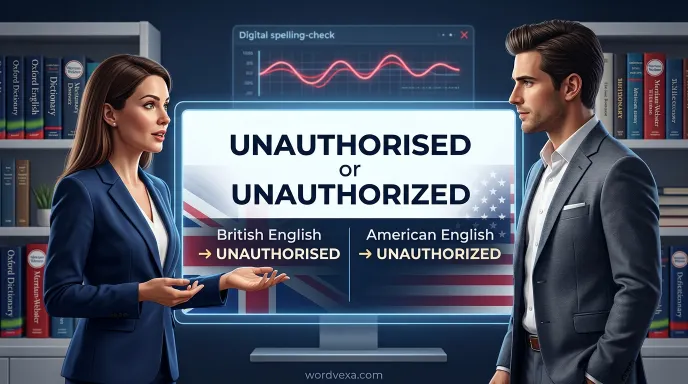
Unauthorised and unauthorized are both correct spellings, but unauthorised is commonly used in British English, while unauthorized is the standard American form. The two words have the same meaning: something that is not officially permitted or approved.
People often search for “unauthorised or unauthorized” when writing emails, school assignments, business documents, websites, or formal notices because the only visible difference is the letter s or z.
This can make it unclear which version to choose. The answer depends mainly on your target variety of English.For example, British English commonly uses unauthorised access, while American English uses unauthorized access.
Both expressions describe access that was not officially permitted. The same difference appears in phrases such as unauthorised use, unauthorized payment, and unauthorised entry.
If you are writing for American readers, choose unauthorized. If you are following British English, unauthorised is appropriate.
For international websites, either can work, but keeping your spelling consistent throughout the article is important.
Unauthorised or Unauthorized: Quick Answer
Both unauthorised and unauthorized are correct.
- Unauthorised → British English
- Unauthorized → American English
- Meaning → Not officially permitted or approved
- Part of speech → Adjective
Quick Examples
British English:
Unauthorised personnel are not allowed inside.
American English:
Unauthorized personnel are not allowed inside.
The meaning remains the same. The spelling changes according to the English variety being used.
Definition and Meaning of Unauthorised or Unauthorized
Clear Definition
Unauthorised/unauthorized means not officially permitted, approved, or allowed.
Cambridge defines unauthorized as something done without someone’s official permission or without permission to be in a particular place.
Simple Meaning
In simple English, something is unauthorized when a person does it without permission.
For example:
The company discovered unauthorized access to the account.
This means someone accessed the account without official permission.
Context and Usage
The word is common in:
- Technology
- Cybersecurity
- Banking
- Business
- Education
- Law
- Workplace communication
- Copyright
- Formal notices
Common phrases include:
- unauthorized access
- unauthorised use
- unauthorized payment
- unauthorised entry
- unauthorized personnel
- unauthorized absence
- unauthorised changes
Oxford specifically lists collocations such as unauthorized access, unauthorized absence, and unauthorized biography.
Grammar and Part of Speech
Unauthorised and unauthorized are adjectives.
They normally describe a noun:
- unauthorized access
- unauthorised payment
- unauthorized use
- unauthorised entry
- unauthorized personnel
The Origin of Unauthorised or Unauthorized
Where Does the Word Come From?
The word is built from un- + authorized.
The prefix un- gives the meaning “not,” while authorized refers to something that has received official permission.
So:
un + authorized = unauthorized
The British spelling follows authorise → unauthorised, while the American spelling uses authorize → unauthorized.
Why Does the Spelling Differ?
The difference is part of the broader spelling variation between British and American English.
British usage commonly has forms ending in -ise, while American English commonly uses -ize. For example:
| British English | American English |
| authorise | authorize |
| organise | organize |
| recognise | recognize |
| apologise | apologize |
However, spelling conventions are not completely uniform across every British dictionary or style guide. For example, Oxford notes that its dictionaries prefer -ize in many words, while other British style guides prefer -ise.
For this particular word, major learner dictionaries identify unauthorised as the British variant of unauthorized.
British English vs American English Spelling
British English: Unauthorised
Unauthorised is commonly used when following British English conventions.
Example:
Unauthorised visitors must report to reception.
American English: Unauthorized
Unauthorized is the standard American spelling.
Example:
Unauthorized visitors must report to reception.
Comparison Table
| Feature | British English | American English |
| Correct form | unauthorised | unauthorized |
| Base verb | authorise | authorize |
| Key letter | s | z |
| Meaning | Not officially permitted | Not officially permitted |
| Example | unauthorised access | unauthorized access |
| Common audience | UK and British-English contexts | US and American-English contexts |
Cambridge labels unauthorized as “UK usually unauthorised,” confirming the regional spelling difference.
Which Spelling Should You Use?
If You Write for the United States
Choose unauthorized.
Example:
The bank detected an unauthorized transaction.
This spelling is suitable for American websites, businesses, schools, and publications.
If You Write for the United Kingdom
Choose unauthorised.
Example:
The bank detected an unauthorised transaction.
If You Write for Commonwealth Audiences
Unauthorised may be the more natural choice in contexts that follow British spelling conventions. However, individual organizations can have their own style guides.
If You Write for a Global Audience
Either spelling can be understood internationally.
The most important rule is consistency.
If your article uses British spelling, do not randomly switch to American spelling in other sections. Likewise, an American-English article should normally stay with unauthorized.
Pronunciation of Unauthorised or Unauthorized
British Pronunciation
Unauthorised is pronounced approximately:
un-AW-thuh-ryzd
American Pronunciation
Unauthorized is pronounced approximately:
un-AW-thuh-ryzd
The pronunciation is very similar, although British and American accents can produce small differences.
The spelling change from s to z does not create a major difference in the word’s meaning or normal pronunciation. Cambridge provides British and American pronunciation information for the word.
Authorized vs Unauthorized
Authorized
It means officially permitted or approved.
The employee is authorized to access the records.
Unauthorized
Unauthorized means not officially permitted or approved.
The employee made an unauthorized change to the records.
These words are opposites.
| Word | Meaning |
| authorized | Officially permitted |
| unauthorized | Not officially permitted |
| authorised | British spelling of authorized |
| unauthorised | British spelling of unauthorized |
Oxford identifies authorized as the opposite of unauthorized.
Unauthorized vs Unlicensed
These words can look similar in some contexts, but they are not always interchangeable.
Unauthorized
Unauthorized means something has not received the required permission or approval.
The software was used without permission.
Unlicensed
Unlicensed generally means something does not have a required license.
The company was operating an unlicensed service.
A person, activity, product, or service can therefore be unauthorized without necessarily being described as unlicensed.
Choosing the right word depends on if the issue is permission or a specific license.
Common Mistakes with Unauthorised or Unauthorized
Mistake 1: Thinking Unauthorised Is Always Wrong
Some writers see the s and assume it is a spelling mistake.
That is incorrect.
Unauthorised is a valid British English form.
Mistake 2: Thinking Unauthorized Is Always American and Therefore Wrong
Unauthorized is not incorrect. It is the standard American form and is also recognized by major English dictionaries.
Mistake 3: Mixing Both Forms
Avoid writing:
The system detected unauthorized access and unauthorised activity.
If the document follows one spelling convention, use the same form consistently.
Mistake 4: Confusing Permission With Licensing
Do not automatically replace unauthorized with unlicensed.
They can describe different situations.
Mistake 5: Using “Unauthorize” When You Need an Adjective
In many sentences, you need the adjective:
Unauthorized users cannot enter the system.
The adjective modifies users.
Unauthorised or Unauthorized in Everyday Examples
In Emails
British English:
Please contact us immediately if you notice any unauthorised activity.
American English:
Please contact us immediately if you notice any unauthorized activity.
In News Writing
Police investigated an unauthorised entry into the building.
Or:
Police investigated an unauthorized entry into the building.
The publication’s spelling style determines which form appears.
In Social Media
Someone made an unauthorized change to my account.
For a British-English audience:
Someone made an unauthorised change to my account.
In Formal Writing
The company accepts no responsibility for unauthorized use of its services.
British version:
The company accepts no responsibility for unauthorised use of its services.
In Technology
The security system blocked unauthorized access.
This is one of the most common contexts for the word. Cambridge also gives unauthorized access and unauthorized use as examples of business usage.
Common Collocations with Unauthorised or Unauthorized
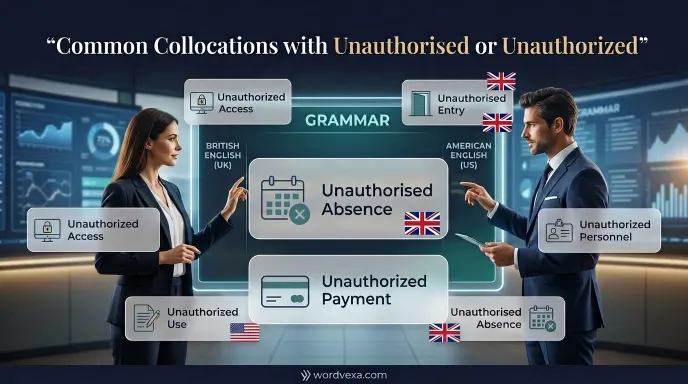
Unauthorized Access
The system detected unauthorized access.
Unauthorized Use
The Unauthorized use of this material is prohibited.
Unauthorized Payment
The customer reported an unauthorized payment.
Unauthorized Personnel
The Unauthorized personnel are not permitted beyond this point.
Unauthorized Absence
The employee’s absence was recorded as unauthorized.
Unauthorized Biography
The author published an unauthorized biography.
These combinations are useful because they show how the adjective naturally works with different nouns. Oxford specifically documents several of these collocations.
Unauthorised or Unauthorized: Google Trends & Usage Data
Search interest for unauthorised and unauthorized can vary by country because people generally search using the spelling conventions familiar in their region.
For example, writers targeting American readers are more likely to encounter unauthorized, while British-English content commonly uses unauthorised.
The word is also strongly connected with practical topics such as:
- cybersecurity
- online accounts
- banking
- software
- workplace rules
- copyright
- access control
This means search intent is not limited to spelling. Some users are actually looking for information about unauthorized access, unauthorized transactions, or unauthorized use.
It is useful to distinguish between the spelling query and the topic query. Someone searching “unauthorised or unauthorized” wants a spelling answer, while someone searching “unauthorized access” may want security information.
Google Trends data can change by date, country, and search category, so exact popularity comparisons should be checked for the specific market and time period being studied.
Unauthorised vs Unauthorized: Comparison Table
| Point | Unauthorised | Unauthorized |
| Spelling | British form | American form |
| Meaning | Without official permission | Without official permission |
| Part of speech | Adjective | Adjective |
| Base word | authorise | authorize |
| Common spelling pattern | -ise | -ize |
| Example | unauthorised access | unauthorized access |
| Suitable for US English | Less typical | Yes |
| Suitable for British English | Yes | Less typical |
| Meaning difference | None | None |
A Simple Decision Guide
Writing for US Readers?
Use unauthorized.
Writing for UK Readers?
Use unauthorised.
Writing for an International Audience?
Choose the spelling that matches your site’s overall English style and use it consistently.
Editing Someone Else’s Text?
Follow the publication, organization, or style guide rather than changing the spelling simply because you prefer one form.
FAQs About Unauthorised or Unauthorized
Q1. Is unauthorised correct?
Yes. Unauthorised is a correct British English spelling of unauthorized.
Q2. Is unauthorized correct?
Yes. Unauthorized is the standard American English spelling and is also recognized as the main dictionary form by major English dictionaries.
Q3. What is the difference between unauthorised and unauthorized?
There is no difference in meaning. The main difference is regional spelling: unauthorised is commonly used in British English, while unauthorized is standard in American English.
Q4. Is unauthorized American or British?
Unauthorized is the standard American spelling. British English commonly uses unauthorised.
Q5. Is “unauthorised access” correct?
Yes. Unauthorised access is correct in British English. In American English, the usual spelling is unauthorized access.
Q6. Which spelling should I use in an American article?
Use unauthorized if the article follows American English spelling conventions.
Q7. Which spelling should I use in a British article?
Use unauthorised if the article follows British English spelling conventions.
Conclusion
Unauthorised and unauthorized are both correct. The choice depends mainly on the English variety you are using. Unauthorised is commonly used in British English, while unauthorized is the standard American spelling. Major dictionaries recognize the regional difference while giving the same core meaning: something done without official permission or approval.
The word is an adjective and commonly appears before nouns such as access, use, payment, entry, personnel, absence, and biography. These common combinations are useful for both everyday and professional writing.
For US-focused content, choose unauthorized. For British-English content, choose unauthorised. If you are writing for an international audience, either form can be understood, but consistency should guide your choice.
Remember the simplest rule: British English commonly uses “unauthorised,” while American English uses “unauthorized.” The spelling changes, but the meaning stays the same.
You May Also Like:
- Emphasize vs Emphasise: American vs British English
- Criticising or Criticizing? A Global Spelling Guide
- Camara or Camera: Common Spelling Mistake Explained

I’m Sloane Mercer, a U.S.-based English language writer focused on grammar, spelling, vocabulary, and everyday English usage. Through Wordvexa, I provide clear and practical explanations to help readers choose the right words and communicate with confidence.








1 thought on “Unauthorized or Unauthorised: Difference, & Correct Usage ”