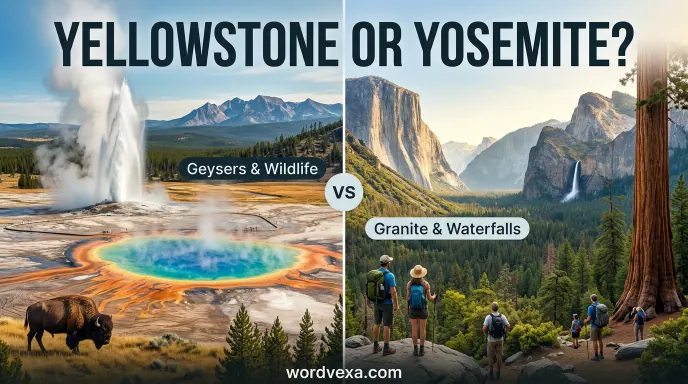
Yellowstone and Yosemite are two different U.S. national parks. Yellowstone, located mainly in Wyoming with portions in Montana and Idaho, is known for geysers, hot springs, wildlife, and volcanic geology.
Yosemite, in California’s Sierra Nevada, is known for granite cliffs, waterfalls, giant sequoias, and glacially shaped landscapes. Neither name is a spelling variant of the other.
People often search for Yellowstone or Yosemite when planning a national park trip, choosing between famous American destinations, or trying to understand which park has the attractions they want to see.
The two names can sound similar because both are iconic U.S. national parks, but they are not interchangeable. They are in different regions and have distinct natural features.
Yellowstone is mainly associated with geothermal activity. It contains more than 10,000 hydrothermal features, including more than 500 geysers. Yosemite, by contrast, is strongly associated with granite formations, waterfalls, valleys, and giant sequoia groves.
This guide explains the difference between Yellowstone and Yosemite, their origins, geography, major attractions, common mistakes, usage examples, and the situations in which each name is appropriate.
Yellowstone or Yosemite: Quick Answer
The easiest way to remember the difference is:
- Yellowstone = geysers, hot springs, wildlife, volcano-related geology.
- Yosemite = granite cliffs, waterfalls, giant sequoias, and mountain scenery.
- Yellowstone covers about 3,472 square miles.
- Yosemite covers about 1,169 square miles.
- Both are national parks in the United States.
- Both names are correct, but they refer to completely different places.
Example 1
“We visited Yellowstone to see Old Faithful and other geothermal features.”
Here, Yellowstone is correct because the sentence refers to its famous geysers.
Example 2
“We went to Yosemite to see El Capitan and Yosemite Falls.”
Yosemite is correct because these landmarks are associated with Yosemite National Park.
Example 3
“Should we visit Yellowstone or Yosemite?”
Both names are correct. The question is asking you to compare two different national parks.
What Does Yellowstone or Yosemite Mean?
Yosemite and Yellowstone are proper names of two different national parks in the United States.
Yellowstone
Yellowstone National Park is known for its geothermal landscape. The park contains hot springs, geysers, mudpots, fumaroles, lakes, waterfalls, and diverse wildlife. It sits over an active volcanic system and has one of the world’s largest concentrations of geysers.
The name Yellowstone is also used for the Yellowstone River and the broader Yellowstone region.
Yosemite
Yosemite National Park is located in California’s Sierra Nevada. Its landscape was heavily shaped by glaciers acting on granite bedrock. Famous features include Yosemite Valley, Half Dome, El Capitan, Yosemite Falls, and giant sequoia groves.
So, when someone says Yellowstone, think primarily of geothermal features and wildlife. When someone says Yosemite, think of granite mountains, waterfalls, valleys, and sequoias.
The Origin of Yellowstone or Yosemite
The names have completely different histories.
Origin of Yellowstone
The name Yellowstone ultimately comes from the Yellowstone River. According to the National Park Service, French-Canadian trappers recorded an Indigenous name that referred to a “Rock Yellow River.” French forms included Roche Jaune and Pierre Jaune. Later, the English form developed into Yellow Stone and eventually the modern spelling Yellowstone.
Yellowstone National Park was established on March 1, 1872. It is widely recognized as the world’s first national park.
Origin of Yosemite
Yosemite has a different linguistic and cultural history connected to the region’s Indigenous peoples and the history of European-American exploration and settlement.
The area became a federally protected national park in 1890. Yosemite had already received protection as a state park before that, and its earlier protected status influenced the development of the idea that became Yellowstone National Park.
The important point for modern writers is simple: Yellowstone and Yosemite are established proper names, not alternate spellings of the same word.
British English vs American English
Unlike pairs such as colour/color or centre/center, Yellowstone and Yosemite do not have separate British and American spellings.
The names remain the same in standard English because they are proper geographical names.
| British English | American English | Example |
| Yellowstone | Yellowstone | Yellowstone National Park is famous for geysers. |
| Yosemite | Yosemite | Yosemite National Park is famous for granite cliffs. |
| Yellowstone National Park | Yellowstone National Park | We visited Yellowstone National Park. |
| Yosemite National Park | Yosemite National Park | Yosemite National Park is in California. |
The U.S. National Park Service’s own style guide lists Yellowstone National Park and Yosemite National Park as proper names.
Is “Yellowstone” British English?
Yes. British writers can use Yellowstone when referring to the American national park.
Is “Yosemite” American English only?
No. Yosemite is the proper name of the California national park and is used unchanged in British, American, Canadian, Australian, and international English.
Which Version Should You Use?
There is no need to choose one spelling based on the country. Choose the name of the park you actually mean.
United States
Use Yellowstone for Yellowstone National Park and Yosemite for Yosemite National Park.
United Kingdom
The same names are used:
- Yellowstone
- Yosemite
British English does not change either proper name.
Canada
Canadian English also uses the standard names Yellowstone and Yosemite.
Australia
Australian English uses the same spellings when referring to these U.S. parks.
International Writing
For international readers, write the full name on first mention:
Yellowstone National Park
or
Yosemite National Park
Afterward, Yellowstone or Yosemite is usually enough when the context is clear.
Academic Writing
Academic and educational writing should use the official geographical names accurately. Avoid changing the spelling to create a supposed British or American variant.
Business Writing
Business documents, travel content, presentations, and reports should use the official names. If the audience may not know the locations, include the state or country when useful.
Common Mistakes with Yellowstone or Yosemite
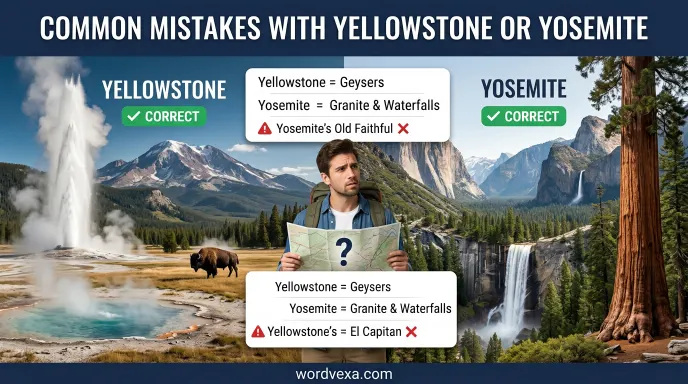
Because the names are both famous national parks, people sometimes confuse them.
| Incorrect or Confusing Use | Correct Use | Explanation |
| “Yosemite’s Old Faithful” | “Yellowstone’s Old Faithful” | Old Faithful is in Yellowstone. |
| “Yellowstone Valley in California” | “Yosemite Valley in California” | Yosemite Valley is in Yosemite National Park. |
| “Yosemite geysers” | “Yellowstone geysers” | Yellowstone is famous for its geysers. |
| “Yellowstone’s El Capitan” | “Yosemite’s El Capitan” | El Capitan is one of Yosemite’s famous granite formations. |
| “Yellowstone Falls in Yosemite” | “Yosemite Falls in Yosemite” | Yosemite Falls is a major Yosemite landmark. |
Memory Tip
Use this simple association:
Yellowstone = hot
Think hot springs, geysers, geothermal activity.
Yosemite = high
Think high granite cliffs, waterfalls, mountains, and valleys.
This is not a complete description of either park, but it is a useful memory aid.
Everyday Examples of Yellowstone or Yosemite
In Emails
“Our family is planning a trip to Yellowstone this summer.”
“Have you ever visited Yosemite National Park?”
In Business Writing
“The travel company offers guided tours of Yellowstone and Yosemite.”
In News Headlines
“Yellowstone Wildlife Draws Visitors”
“Yosemite Waterfalls Attract Summer Visitors”
In Blog Posts
“Yellowstone and Yosemite offer very different national park experiences.”
On Social Media
“Yellowstone was unforgettable!”
“The views in Yosemite were incredible.”
In Academic Writing
“Yellowstone provides an important setting for the study of geothermal systems.”
“Yosemite provides important examples of glacially shaped granite landscapes.”
In Daily Conversation
“Are you going to Yellowstone?”
“No, we’re planning to visit Yosemite.”
Google Trends & Modern Usage
Searches for Yellowstone or Yosemite can arise for several reasons. People may be comparing national parks, planning vacations, searching for landmarks, looking for wildlife information, or trying to decide which destination matches their interests.
The two names are also frequently connected with different search topics.
Yellowstone-related searches commonly center on:
- Geysers
- Old Faithful
- Hot springs
- Wildlife
- Yellowstone Lake
- Grand Canyon of the Yellowstone
Yosemite-related searches commonly center on:
- Yosemite Valley
- Yosemite Falls
- Half Dome
- El Capitan
- Giant sequoias
- Hiking and mountain scenery
Yellowstone has more than 10,000 hydrothermal features and more than 500 active geysers, according to National Park Service information. Yosemite is particularly recognized for its granite cliffs, waterfalls, giant sequoia groves, and glacial landscape.
Search popularity can change over time and may vary by season, news coverage, travel trends, and location. Exact Google Trends figures should therefore be checked directly for the specific country and date range being studied rather than assumed.
Quick Comparison Table
| Version | Meaning | Correct? | Region | Example |
| Yellowstone | U.S. national park known for geothermal features and wildlife | Yes | Mainly Wyoming, with Montana and Idaho portions | “We visited Yellowstone.” |
| Yosemite | U.S. national park known for granite cliffs, waterfalls, and sequoias | Yes | California | “We visited Yosemite.” |
| Yellowstone National Park | Official full park name | Yes | United States | “Yellowstone National Park is enormous.” |
| Yosemite National Park | Official full park name | Yes | United States | “Yosemite National Park is in California.” |
| “Yellowstone” for Yosemite | Confuses two different parks | No | N/A | “Yosemite is not Yellowstone.” |
| “Yosemite” for Yellowstone | Confuses two different parks | No | N/A | “Yellowstone is not Yosemite.” |
Yellowstone vs Yosemite: At a Glance
| Feature | Yellowstone | Yosemite |
| Location | Wyoming, Montana, and Idaho | California |
| Main landscape | Geothermal areas, lakes, forests, valleys | Granite cliffs, valleys, waterfalls, mountains |
| Famous for | Geysers and hot springs | Granite formations and waterfalls |
| Major landmark | Old Faithful | Yosemite Valley |
| Wildlife | Highly diverse | Highly diverse |
| Giant sequoias | Not a defining feature | Yes |
| Geysers | Major feature | Not a defining feature |
| Established as a national park | 1872 | 1890 |
| Approximate area | 3,472 sq. mi. | 1,169 sq. mi. |
| Proper spelling | Yellowstone | Yosemite |
The area figures come from National Park Service information.
Key Takeaways
- Yellowstone and Yosemite are different national parks.
- Yellowstone is strongly associated with geysers, hot springs, wildlife, and volcanic geology.
- Yosemite is known for granite cliffs, waterfalls, valleys, and giant sequoias.
- There is no British vs American spelling difference for either name.
- Both names should be capitalized because they are proper geographical names.
- Yellowstone National Park was established in 1872.
- Yosemite became a national park in 1890.
- Use Yellowstone when referring to Yellowstone National Park.
- Use Yosemite when referring to Yosemite National Park.
- A simple memory aid is Yellowstone = geothermal, while Yosemite = granite and waterfalls.
FAQs About Yellowstone or Yosemite
Q1. Is Yellowstone the same as Yosemite?
No. Yellowstone and Yosemite are two separate U.S. national parks. Yellowstone is primarily associated with geothermal features such as geysers and hot springs, while Yosemite is famous for granite cliffs, waterfalls, valleys, and giant sequoias. They are also located in different parts of the United States.
Q2. Which is bigger, Yellowstone or Yosemite?
Yellowstone is larger. The National Park Service lists Yellowstone at about 3,472 square miles, while Yosemite covers about 1,169 square miles. The two parks therefore differ considerably in physical size as well as landscape and natural features.
Q3. Is Yellowstone in California?
No. Yellowstone National Park is primarily in Wyoming, with portions extending into Montana and Idaho. Yosemite National Park is in California’s Sierra Nevada. This geographic difference is one of the easiest ways to distinguish the two parks.
Q4. Is Yosemite known for geysers?
Yosemite is not primarily known for geysers. Its best-known natural features include granite formations, waterfalls, valleys, and giant sequoias. Yellowstone, in contrast, contains more than 500 active geysers and more than 10,000 hydrothermal features.
Q5. Is Yellowstone or Yosemite better for waterfalls?
Both parks have waterfalls, but Yosemite is particularly famous for them. Yosemite Falls reaches 2,425 feet and is one of North America’s tallest waterfalls. Yellowstone also has numerous waterfalls, including the Lower Falls of the Yellowstone River.
Q6. Is Yellowstone or Yosemite better for wildlife?
Both parks support diverse wildlife. Yellowstone has 67 species of mammals and approximately 330 bird species according to the National Park Service. Yosemite also supports hundreds of wildlife species. The parks differ more in their ecosystems and landscapes than in if they contain wildlife.
Q7. Is Yosemite a British spelling of Yellowstone?
No. This is a common misunderstanding caused by the similarity of the names. Yosemite and Yellowstone are completely different proper names. British, American, Canadian, and Australian English generally use these names without changing their spelling.
Q8. When was Yellowstone established?
Yellowstone National Park was established on March 1, 1872. The National Park Service describes it as the world’s first national park. Yosemite received national park status in 1890, although the Yosemite area had received earlier protection.
Q9. Why is Yellowstone called Yellowstone?
The name comes from the Yellowstone River. Historical accounts describe an Indigenous name referring to a yellow-colored rock or stone river. French forms such as Roche Jaune were later translated into English, eventually producing the modern name Yellowstone.
Q10. Why do people confuse Yellowstone and Yosemite?
The names look and sound somewhat similar, and both are famous U.S. national parks. However, their locations, landscapes, histories, and major attractions are different. Remembering Yellowstone for geysers and Yosemite for granite cliffs and waterfalls makes the distinction easier.
Conclusion
Yellowstone or Yosemite is not a question about two spellings of the same word. They are two distinct national parks with different locations, landscapes, and natural features.
Yellowstone is especially recognized for its extraordinary geothermal system. The park contains thousands of hydrothermal features, including hundreds of geysers, along with lakes, waterfalls, forests, and abundant wildlife.
Yosemite offers a different landscape. Its identity is closely connected with granite cliffs, glacially shaped valleys, waterfalls, mountain scenery, and giant sequoia groves.
For writing, the choice is simple: use Yellowstone when you mean Yellowstone National Park and Yosemite when you mean Yosemite National Park. Neither is a British or American spelling variation of the other.
Remember: Yellowstone brings geothermal wonders to mind, while Yosemite brings granite cliffs and waterfalls to mind.
If you are comparing the two for travel, geography, or an academic project, identifying the specific features you want to explore will make the distinction even clearer.
You May Also Like:

I’m Claire Morgan, the author behind wordvexa.com, where I write about English grammar, sentence structure, punctuation, and everyday language. My goal is to make grammar simple, clear, and practical, helping readers understand the rules and apply them with confidence in real-world writing.








2 thoughts on “Yellowstone or Yosemite: Key Differences You Need to Know”