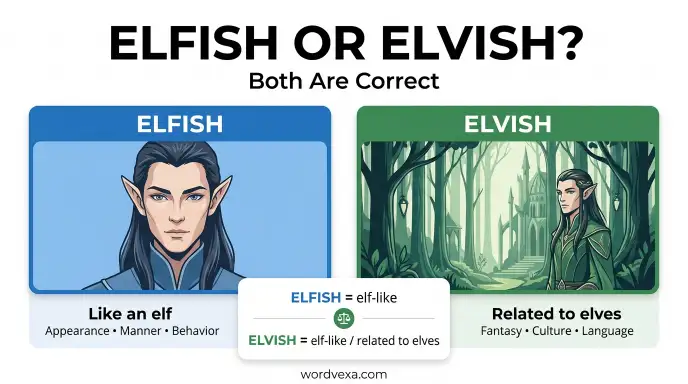
Elfish or elvish are both correct English adjectives meaning “like an elf” or “relating to elves.” These two words have very similar meanings, but their usage can vary depending on context.
If you are describing an elf-like appearance, behavior, or quality, elfish can sound natural. In fantasy writing, elvish is especially common when referring to elf cultures, kingdoms, characters, or languages.
Many writers become confused because the words look different even though their meanings overlap.
Some people assume that elfish is a spelling mistake and that elvish is the only correct form. That is not the case. Both words have a long history in English and are recognized in modern dictionaries.
In this guide, you will learn the meaning, origin, usage, and key differences between elfish or elvish, along with practical examples.
You will also see which form works best in everyday, academic, professional, and fantasy writing. Let’s look at the distinction more closely.
Elfish or Elvish: Quick Answer
If you are wondering if to write elfish or elvish, the answer is simple: both are correct.
The two adjectives have very similar meanings. They can describe something that resembles an elf or is connected with elves.
Examples of Elfish
- She had an elfish face.
- His smile had an elfish quality.
- The child moved with an elfish energy.
Examples of Elvish
- The story describes an ancient elvish kingdom.
- The characters speak an elvish language.
- She wore an elvish costume for the festival.
A useful rule is:
- Elfish = like an elf, especially in appearance, behavior, or manner.
- Elvish = like or related to elves, especially in fantasy or literary contexts.
- Both can be correct when the intended meaning is simply “elf-like.”
So, if you wrote elfish, you have not automatically made a spelling mistake.
What Does Elfish or Elvish Mean?
Elfish and elvish are both correct English words. Both can mean “like an elf” or “relating to elves.” In modern usage, elfish often describes an elf-like appearance or manner, while elvish is especially familiar in fantasy writing about elves, their cultures, kingdoms, or languages. Neither spelling is simply a mistake.
What Does Elfish Mean?
Elfish is an adjective that means relating to an elf or resembling an elf.
For example:
She had an elfish face with bright eyes.
Here, elfish describes a quality that reminds the writer of an elf.
It can describe:
- Appearance
- Facial features
- Behavior
- Manner
- Personality
- General qualities associated with elves
You might write:
His playful, mischievous behavior seemed almost elfish.
The word does not have to refer to a literal elf. It can describe something that simply has an elf-like quality.
What Does Elvish Mean?
Elvish also means relating to or resembling an elf.
For example:
The forest had an elvish atmosphere.
It can also be used for fictional or fantasy settings:
The novel describes several elvish kingdoms.
This makes elvish particularly familiar in fantasy literature and games.
Are Elfish and Elvish Synonyms?
Yes. Major dictionary sources treat the two words as synonyms.
That means you should not think of them as two words with completely different definitions.
The difference is mainly about context, style, and what sounds natural in a particular sentence.
For example:
She has an elfish face.
sounds natural when describing someone’s appearance.
Meanwhile:
The heroes entered an ancient elvish kingdom.
sounds natural when discussing a fantasy world.
The meanings overlap, but the surrounding noun can influence which adjective feels more suitable.
The Origin of Elfish or Elvish
The history of elfish and elvish is much older than modern fantasy novels.
The Origin of Elf
The word elf comes from Old English forms such as elf and ælf. It is connected to older Germanic words referring to supernatural beings.
The modern plural is elves, which can make the spelling elvish seem more logical to modern readers.
However, English word formation is not always based on simply attaching a suffix to the modern plural form.
The Origin of Elfish
Etymological records trace elfish back to around the year 1200.
It developed from elf plus the adjective-forming suffix -ish.
The original sense was connected with being of, belonging to, or resembling elves.
So:
elf + ish = elfish
is a useful way to understand its formation.
The Origin of Elvish
Elvish also dates to around the year 1200.
It developed from elf plus -ish, with an altered stem form.
This is important because it shows that elvish is not a modern replacement for elfish.
Both forms have a long history in English.
Why Do We Have Both Forms?
English has developed through centuries of sound changes, spelling changes, dialect differences, and competing word forms.
The words elfish and elvish survived alongside each other.
Modern fantasy literature also helped make elvish highly familiar, especially when referring to fictional elf cultures and languages.
The important point is that neither word needs to be treated as a spelling error.
British English vs American English
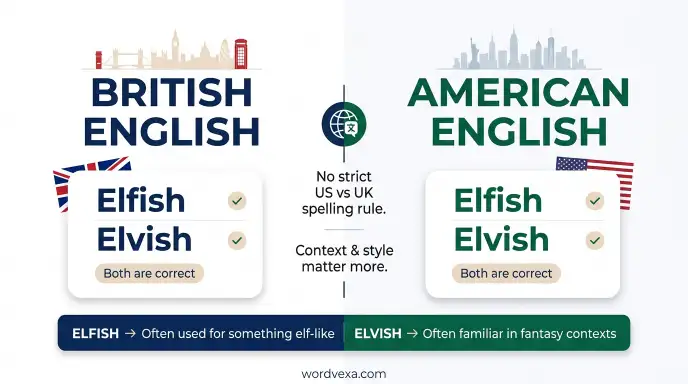
A common question is if elfish is British English and elvish is American English.
There is no simple rule like that.
Both forms are established in English, and both can be used in British and American writing.
| British English | American English | Example |
| elfish | elfish | She has an elfish appearance. |
| elvish | elvish | The story features an elvish kingdom. |
| elfish | elfish | His smile looked elfish. |
| elvish | elvish | They speak an elvish language. |
The choice is therefore not mainly a US-versus-UK spelling issue.
Regional Differences
You may encounter different preferences depending on the writer, publication, genre, or fictional setting.
Fantasy writing is especially likely to use elvish, while general descriptive writing may use elfish.
However, this is a usage tendency rather than a strict geographical rule.
Style Guides
Most style guides do not require writers to change elfish into elvish simply because they are writing for an American or British audience.
If a publisher, academic institution, or fictional universe has a house style, follow that preference.
Publishing Preferences
Consistency matters more than trying to create an artificial regional distinction.
If your article uses elvish for a particular fantasy culture, continue using elvish throughout that discussion.
If you are describing an individual’s elf-like appearance, elfish may be a natural choice.
Which Version Should You Use?
There is no single spelling that must be used in every situation.
United States
American writers can use both.
For general descriptions:
She had an elfish appearance.
For fantasy settings:
The novel features an elvish civilization.
United Kingdom
British writers can also use both forms.
Choose according to context and the style of the publication.
Canada
Canadian English can use elfish and elvish.
If you are writing for a particular publication, follow its preferred terminology.
Australia
Australian writers can likewise use either form.
The meaning and context should guide the choice.
International Writing
For an international audience, elvish may be immediately familiar in fantasy contexts.
However, elfish is also clear when the intended meaning is “like an elf.”
Academic Writing
Use the word that accurately matches your subject.
For example:
The author gives the character an elfish appearance.
Or:
The novel presents an elaborate elvish culture.
Do not change the spelling merely to make the writing sound more formal.
Business Writing
These words are uncommon in ordinary business communication.
If you need one, use the form that fits your intended meaning:
The artwork has an almost elvish quality.
The important thing is clarity.
Common Mistakes
Mistake 1: Thinking Elfish Is Wrong
Incorrect assumption:
Elfish is an incorrect spelling of elvish.
Correct understanding:
Elfish is an established English adjective.
It has its own long history and means relating to or resembling an elf.
Memory tip:
Think of elf + ish = elfish.
Mistake 2: Thinking Elvish Is Only a Fantasy Word
Incorrect assumption:
Elvish is not a real English word.
Correct understanding:
Elvish is an established English adjective.
It can mean like an elf or relating to elves. Modern fantasy has simply made the word especially familiar.
Memory tip:
Think of elves → elvish when talking about an elf-related fantasy setting.
Mistake 3: Assuming the Two Words Have Opposite Meanings
Incorrect:
Elfish means one thing, while elvish means something completely different.
Correct:
The two words have overlapping meanings.
Context can influence which one sounds more natural, but they are not opposites.
Mistake 4: Assuming One Is British and One Is American
Incorrect:
Elfish is British, while elvish is American.
Correct:
Both forms can be used in different varieties of English.
The difference is more about usage and context than national spelling rules.
Mistake 5: Changing Elfish to Elvish Automatically
Consider:
She has an elfish face.
There is no need to “correct” this to:
She has an elvish face.
The original sentence is already acceptable.
Everyday Examples
Emails
The decorations gave the room an almost elvish atmosphere.
Business Writing
The designer created an elegant, slightly elfish appearance.
News Headlines
Winter Festival Creates an Elvish Atmosphere in the City
Blogs
Her elfish features reminded me of a fantasy character.
Social Media
This forest looks completely elvish! 🌿
Academic Writing
The poem uses elvish imagery to create a supernatural atmosphere.
Daily Conversation
You have an elfish smile.
Fiction
The travelers entered an ancient elvish city hidden beyond the mountains.
Creative Description
His elfish face and quick movements made him seem almost magical.
These examples show an important point: both words can work, but context influences which one feels more natural.
Google Trends & Modern Usage
Searches for elfish or elvish usually come from people who are unsure if one form is a spelling mistake or if the two words have different meanings.
Common search questions include:
- Is elfish a word?
- Is elvish a word?
- Is elfish or elvish correct?
- What is the difference between elfish and elvish?
- Should I say elfish face or elvish face?
- Is elvish a fantasy word?
- What does elfish mean?
- What does elvish mean?
Modern dictionary usage confirms that both forms remain established.
One reason elvish may feel especially familiar is its strong connection with fantasy literature and fictional elf cultures. Dictionary examples include elvish kingdoms, languages, looks, and characters.
Meanwhile, elfish is also commonly used for descriptions of appearance and manner.
Exact Google Trends figures should not be stated without checking a current Google Trends dataset for the specific region and time period. The usage discussion here is therefore based on established dictionary usage and general modern patterns, not invented search statistics.
Quick Comparison Table
| Version | Meaning | Correct? | Region | Example |
| Elfish | Like or relating to an elf | Yes | International | She has an elfish face. |
| Elvish | Like or relating to an elf or elves | Yes | International | The story has an elvish setting. |
| Elfish | Elf-like in appearance or manner | Yes | International | His smile was elfish. |
| Elvish | Connected with elves, especially in fantasy | Yes | International | They entered an elvish kingdom. |
Context Comparison
| Context | Natural Choice | Why? |
| Elf-like face | Elfish | Natural descriptive use |
| Elf-like smile | Elfish | Describes a quality |
| Elf-like behavior | Elfish | Focuses on manner |
| Fantasy kingdom | Elvish | Common fantasy usage |
| Fantasy culture | Elvish | Relates to elves |
| Fantasy language | Elvish | Familiar literary usage |
| General elf-like quality | Either | Both are correct |
Key Takeaways
- Elfish and elvish are both correct English words.
- Both can mean “like an elf” or “relating to elves.”
- Elfish often works naturally for appearance, behavior, or manner.
- Elvish is especially familiar in fantasy and literary contexts.
- There is no simple rule that makes one British and the other American.
- Elfish is not a misspelling of elvish.
- Elvish is not merely a fictional or modern word.
- Choose the form that best matches your context and maintain consistency.
FAQs
Q1. Is elfish a correct word?
Yes. Elfish is a correct English adjective. It means relating to or resembling an elf. You can use it to describe appearance, behavior, manner, or another quality associated with elves. For example, “She had an elfish face” is a perfectly valid sentence.
Q2. Is elvish a correct word?
Yes. Elvish is also a correct English adjective. It can mean like an elf or relating to elves. It is especially familiar in fantasy writing, where writers may use it for fictional elf cultures, kingdoms, languages, characters, and traditions.
Q3. What is the difference between elfish and elvish?
The meanings overlap greatly. Both can mean “like an elf” or “relating to elves.” In modern usage, elfish often feels natural when describing an elf-like appearance or manner, while elvish is particularly common in fantasy contexts.
Q4. Is elfish a misspelling of elvish?
No. Elfish is not a misspelling of elvish. It is an established English adjective with a long history. Therefore, changing elfish to elvish is not automatically a correction. The correct choice depends on what you want to express.
Q5. Is elvish only used in fantasy?
No. Although elvish is strongly associated with fantasy, its basic dictionary meaning is broader. It can describe something that resembles an elf or relates to elves. Fantasy literature has simply made the word particularly familiar in modern English.
Q6. Which is correct: elfish face or elvish face?
Both can be correct, but elfish face is a natural choice when you mean a face that resembles an elf. Elvish face can also work, especially in a fantasy context. The difference is one of style and context, not basic grammatical correctness.
Q7. Which is correct: elfish language or elvish language?
Elvish language is the more familiar phrase in fantasy contexts. It is commonly understood as referring to a language associated with elves. However, elfish is also an established adjective, so the choice should depend on the specific context or fictional terminology.
Q8. Is elfish British and elvish American?
No. There is no simple British-American spelling distinction here. Both elfish and elvish can be found in English varieties on both sides of the Atlantic.
Writers should choose based on context, house style, or the terminology used by the source they are discussing.
Q9. Why does elvish use “v” instead of “f”?
The spelling reflects the historical development of the word rather than a simple rule based on the modern plural elves.
Both elfish and elvish have very old histories in English. Their forms developed alongside changes in English spelling and word formation.
Q10. Which should I use, elfish or elvish?
Use elfish when describing something as elf-like, especially an appearance or manner, if it sounds natural in your sentence.
Use elvish when discussing elves, especially a fictional elf culture, kingdom, or language. When either works, choose the form that best fits your context and use it consistently.
Conclusion
Elfish or elvish is not a simple right-versus-wrong spelling question. Both words are established English adjectives, and both can describe something that resembles an elf or relates to elves.
The main difference you are likely to notice today is context. Elfish often works naturally when describing an elf-like face, smile, movement, behavior, or manner. Elvish is especially familiar in fantasy writing, where it can describe fictional elf cultures, kingdoms, languages, and traditions.
There is also no reliable rule that says elfish belongs to British English while elvish belongs to American English. Writers in both varieties can use either form.
If you are writing general English, choose the word that sounds natural in your sentence. If you are writing fantasy, follow the terminology of the fictional world or source you are discussing.
Remember: both are correct, but context helps you choose the better fit.
For more practical guides to confusing English words and spelling choices, explore other grammar and usage articles on Wordvexa.
You May Also Like:
- NIV or NLT: Which Bible Translation Should You Choose?
- Cabbage or Lettuce: Key Differences, and Culinary Uses
- Aides or Aids: How to Use Each Word Correctly

I’m Claire Morgan, the author behind wordvexa.com, where I write about English grammar, sentence structure, punctuation, and everyday language. My goal is to make grammar simple, clear, and practical, helping readers understand the rules and apply them with confidence in real-world writing.








3 thoughts on “Elfish or Elvish: Which One Is Correct?”