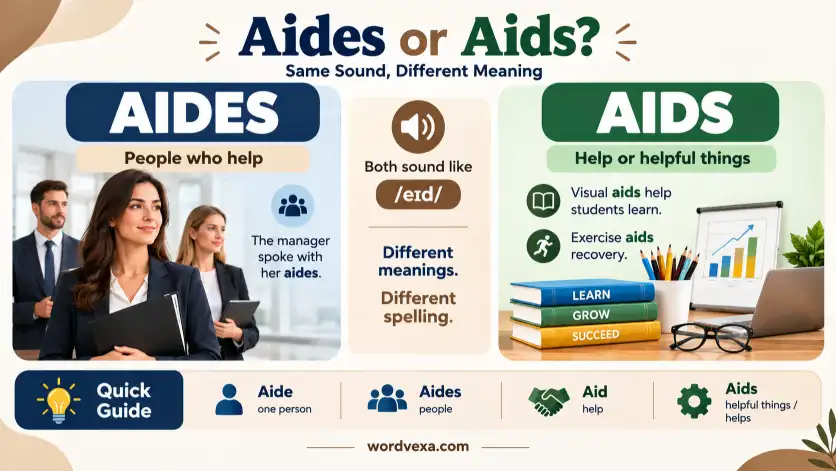
Aides or aids are different words with different meanings, even though they sound exactly alike in standard English. Aides refers to people who assist someone, while aids usually refers to help, useful things, or the verb aids, meaning “helps.”
This confusion is common because English has many homophones. When you hear aides and aids in conversation, there is no obvious way to know which spelling the speaker means. The difference becomes clear only when you see the word in context.
For example, The president spoke with his aides refers to assistants. In contrast, The teacher used visual aids refers to helpful teaching materials. Similarly, Exercise aids recovery uses aids as a verb.
Knowing the difference is useful in emails, academic writing, business communication, journalism, and everyday English.
In this guide, you will learn the meanings, origins, grammar rules, common mistakes, regional usage, and practical examples of aides or aids.
Aides or Aids: Quick Answer
The simplest way to understand aides or aids is to look at what the word describes.
- aide = one person who helps
- aides = people who help
- aid = help or assistance
- aids = helpful things or resources
- aids = helps, when used as a verb
Example 1: Aides
The mayor met with her aides.
Here, aides means assistants.
Example 2: Aids
The teacher used visual aids.
Here, aids means helpful teaching materials.
Example 3: Aids as a verb
This exercise aids memory.
Here, aids means helps.
The easiest rule
AIDES = PEOPLE
AIDS = HELP, HELPFUL THINGS, OR “HELPS”
If you can replace the word with assistants, choose aides. If you can replace it with help, support, or helpful tools, choose aid/aids.
What Does Aides or Aids Mean?
Aides means people who assist or help someone, especially in a professional or official role. Aids can mean helpful things, forms of assistance, or the third-person singular verb aids, meaning “helps.” Although aides and aids sound alike, they have different spellings, meanings, and grammatical functions.
What Does “Aide” Mean?
An aide is a person who helps or assists another person. The word is often used for someone working in a professional, official, political, educational, military, or healthcare setting.
For example:
She works as an aide to the director.
The word describes one person.
The plural is:
The director met with his aides.
Aides therefore means two or more people who assist someone.
Common expressions include:
- political aide
- government aide
- presidential aide
- military aide
- teacher’s aide
- nursing aide
- personal aide
- administrative aide
What Does “Aid” Mean?
Aid means help, assistance, or support. It can function as both a noun and a verb.
As a noun:
The organization provided emergency aid.
As a verb:
The new software can aid employees.
The noun aid can also refer to something that makes a task easier:
A dictionary is a useful aid for language learners.
What Does “Aids” Mean?
Aids has two important grammatical uses.
First, it can be the plural of the countable noun aid:
The classroom contains several learning aids.
Second, it can be the third-person singular form of the verb aid:
This method aids learning.
In this sentence, aids means helps.
This is why you should not assume that aids is always a noun. Context determines its grammatical role.
Aides vs Aids: The Core Difference
The biggest difference is simple:
| Word | Main Meaning | Part of Speech | Example |
| aide | A person who helps | Noun | She is an aide. |
| aides | People who help | Noun | Her aides arrived. |
| aid | Help or assistance | Noun/Verb | They received aid. |
| aids | Helpful things | Noun | Visual aids are useful. |
| aids | Helps | Verb | Exercise aids recovery. |
The spelling aides should not be used simply because the sentence is about “help.” It is specifically associated with a person who assists.
The Origin of Aides or Aids
The history of these words helps explain why they look different but share similar meanings.
Aid entered English through French and is ultimately related to Latin words associated with helping. It developed into a general English word for help, assistance, and support.
Aide is also connected to French aide, meaning help or helper. English use of aide was especially influenced by the French military expression aide-de-camp, referring to an officer who assists a senior officer.
Over time, aide became established in English as a noun for a person who assists someone, while aid remained the broader term for help or assistance.
The result is the distinction we use today:
- aide/aides = person or people who assist
- aid/aids = help, assistance, helpful things, or the verb aid
The words sound alike, but their written forms communicate different meanings.
Why Do People Confuse Aides and Aids?
They Sound the Same
The biggest reason is pronunciation.
Aide and aid are pronounced the same way, and their plural forms aides and aids also sound alike.
When someone says:
“The senator met with her aides.”
you cannot determine the spelling from sound alone.
They Have Related Meanings
Both words are connected with helping.
An aide is a person who helps.
An aid is help or something that helps.
Because the meanings are related, writers sometimes choose the wrong spelling.
Fast Typing Causes Mistakes
People who know the difference may still type the wrong word when writing quickly. This is especially common in emails, notes, school assignments, and online communication.
The Simple Solution
Do not focus on pronunciation. Ask:
Am I talking about a person or about help?
If it is a person, use aide/aides.
If it is help or a helpful thing, use aid/aids.
The Difference Between Aide, Aides, Aid, and Aids
Aide
Aide means one person who helps.
The teacher’s aide helped the students.
Aides
Aides means more than one person who helps.
The teacher’s aides prepared the classroom.
Aid
Aid means help or assistance.
The charity provided aid to the community.
It can also be a verb:
The program will aid students.
Aids
Aids can mean multiple helpful things.
Visual aids make the lesson clearer.
It can also be a verb:
This tool aids communication.
When Should You Use Aides?
When Referring to Assistants
Use aides when you mean people who assist someone.
The manager discussed the plan with her aides.
In Government and Politics
The word is common for people who assist government officials and political figures.
The governor met with senior aides.
In Education
Teacher’s aide and teacher’s aides refer to people who assist teachers.
The teacher’s aides helped organize the classroom.
In Healthcare and Caregiving
The word may describe people who provide assistance in healthcare or care settings.
The nursing aides prepared the patients’ rooms.
When Should You Use Aid or Aids?
For General Help
Use aid when you mean help or assistance in general.
The victims received medical aid.
For Helpful Tools
Use aids when referring to separate things that help.
The presentation included several visual aids.
For Devices
Some devices are commonly described as aids.
Hearing aids can help people hear more clearly.
As a Verb
Use aids when the subject is singular and the meaning is “helps.”
Good sleep aids concentration.
Compare:
Good habits aid concentration.
This habit aids concentration.
Aides or Aids in Formal Writing
Both words are completely acceptable in formal writing when used correctly.
Academic Writing
Visual aids can improve students’ understanding of complex concepts.
Business Writing
The director asked his aides to prepare the report.
Professional Emails
Please contact my aides if you need additional information.
Journalism
The minister met with senior aides before the announcement.
The main requirement is accuracy. Formal writing does not change the basic distinction between the words.
British English vs American English
British and American English generally use aide, aides, aid, and aids in the same way. The difference is based on meaning and grammar rather than regional spelling.
| Meaning | British English | American English | Example |
| One assistant | aide | aide | He is an aide to the director. |
| Several assistants | aides | aides | Her aides attended the meeting. |
| General help | aid | aid | The victims received aid. |
| Helpful things | aids | aids | The teacher used visual aids. |
| “Helps” as a verb | aids | aids | This method aids learning. |
Regional Usage
There is no major British-American spelling change such as the differences seen in words like colour/color or organise/organize.
The same basic rule applies:
People → aides
Help or helpful things → aid/aids
Publishing Preferences
Publishers, newspapers, schools, and businesses may use different style guides. However, those style choices do not normally change the fundamental meanings of aides and aids.
Which Version Should You Use?
United States
Use aides for assistants.
The senator met with her aides.
Use aid/aids for assistance or helpful things.
The students used visual aids.
United Kingdom
The same distinction applies.
The minister spoke with his aides.
The organization provided humanitarian aid.
Canada
Canadian English generally follows the same pattern:
aides = assisting people
aid/aids = help or helpful things
Australia
Australian English also normally uses these words according to their meaning rather than a regional spelling rule.
International Writing
For international audiences, make the meaning obvious through context.
Instead of:
The program provides aids.
consider:
The program provides learning aids.
The extra word makes the meaning immediately clear.
Academic Writing
Use aids for learning tools and aid for assistance.
Visual aids support classroom learning.
The researchers worked with the aid of specialized software.
Business Writing
Use aides for assistants.
The executive met with her senior aides.
Use aids for helpful tools or the verb aids.
The software aids customer-service teams.
Common Mistakes With Aides or Aids
Mistake 1: Using “Aids” for People
Incorrect:
The president met with his aids.
Correct:
The president met with his aides.
Explanation: The sentence refers to assistants who are people.
Memory tip: AIDES = ASSISTANTS.
Mistake 2: Writing “Aides” for Visual Materials
Incorrect:
The teacher prepared visual aides.
Correct:
The teacher prepared visual aids.
Explanation: Charts, pictures, diagrams, and videos are helpful materials, not people.
Memory tip: VISUAL AIDS = HELPFUL MATERIALS.
Mistake 3: Using “Aids” for General Assistance
Less natural:
The organization provided humanitarian aids.
Natural:
The organization provided humanitarian aid.
Explanation: When aid means general assistance, it is commonly treated as an uncountable noun.
Mistake 4: Forgetting the Singular Verb
Incorrect:
This method aid students.
Correct:
This method aids students.
Explanation: This method is singular, so the verb takes -s.
Compare:
This method aids students.
These methods aid students.
Mistake 5: Confusing Aide With Aid
Incorrect:
She works as an aid to the manager.
Correct:
She works as an aide to the manager.
Explanation: A person who assists a manager is an aide.
Everyday Examples
Emails
My aides will contact you about the meeting.
I have attached several visual aids.
Business Writing
The CEO spoke with her senior aides.
The new system aids employees in managing orders.
News Headlines
Minister Meets With Senior Aides
New Technology Aids Medical Research
Blogs
Visual aids can make difficult grammar rules easier to understand.
Political aides often help officials prepare for major meetings.
Social Media
These study aids helped me prepare for my exam.
The candidate’s aides shared the announcement.
Academic Writing
Visual aids can improve comprehension.
The software aids researchers in analyzing data.
Daily Conversation
She works as a teacher’s aide.
This chart is a useful aid for remembering the rules.
Aides or Aids in Common Expressions
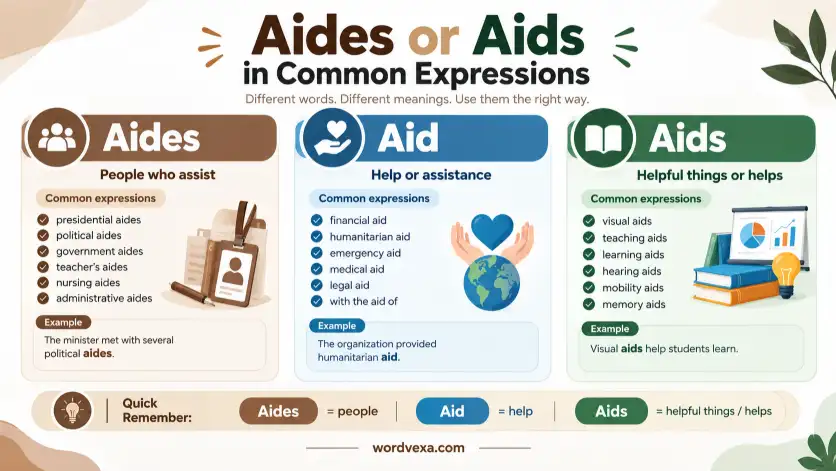
Common Expressions With Aides
- presidential aides
- political aides
- government aides
- senior aides
- teacher’s aides
- nursing aides
- personal aides
- administrative aides
These expressions refer to people.
Common Expressions With Aid
- financial aid
- humanitarian aid
- emergency aid
- medical aid
- legal aid
- first aid
- with the aid of
- come to someone’s aid
These expressions generally involve help or assistance.
Common Expressions With Aids
- visual aids
- teaching aids
- learning aids
- memory aids
- hearing aids
- mobility aids
- educational aids
These usually refer to things or resources that provide assistance.
How to Remember Aides or Aids
The Person Test
Ask:
Is it a person?
If yes, use aide/aides.
The politician’s aides arrived.
The Help Test
Ask:
Does it mean help or assistance?
If yes, use aid.
The organization provided aid.
The Tool Test
Ask:
Is it something that helps me do something?
If yes, aid/aids may be correct.
Visual aids help students learn.
The “Helps” Test
If you can replace aids with helps, it is probably the verb.
Exercise aids sleep.
Exercise helps sleep.
Google Trends & Modern Usage
The search query aides or aids is understandable because the words are homophones. People hear the same pronunciation but need to select the correct spelling when writing.
Modern English uses aides most often in contexts involving assistants, especially professional or official roles. The word appears in expressions such as political aides, government aides, and senior aides.
Aid and aids have a much broader range of uses. They appear in education, healthcare, government, business, technology, and everyday communication.
Common search questions include:
- aides or aids which is correct?
- is it aids or aides?
- visual aids or visual aides?
- political aides or political aids?
- what does aide mean?
- what is the difference between aid and aide?
- is aids a verb?
- aide vs aid meaning
Exact search-volume or regional popularity figures should not be assumed without current keyword data. The general usage pattern is clear, though: aides is associated with assisting people, while aid/aids is associated with help, helpful things, or the verb aid.
Quick Comparison Table
| Version | Meaning | Correct? | Typical Use | Example |
| aide | One person who assists | Yes | Person | She is an aide. |
| aides | People who assist | Yes | People | His aides attended. |
| aid | Help or assistance | Yes | General help | They received aid. |
| aid | Something that helps | Yes | Single tool/resource | This is a useful aid. |
| aids | Helpful things | Yes | Tools/resources | Visual aids help students. |
| aids | Helps | Yes | Verb | Exercise aids recovery. |
| aids | People who assist | No | Incorrect meaning | ❌ The president met his aids. |
| aides | Helpful materials | No | Incorrect meaning | ❌ Visual aides. |
Key Takeaways
- Aide means one person who assists.
- Aides means two or more assisting people.
- Aid means help, assistance, or support.
- Aids can mean multiple helpful things.
- Aids can also mean “helps” as a verb.
- Aides and aids sound the same.
- British and American English generally use the same forms.
- Remember: aides are people, while aids are help or things that help.
FAQs
Q1. What is the difference between aides and aids?
Aides refers to people who assist someone, while aids can refer to helpful things, forms of assistance, or the verb aid. For example, The manager met with her aides means assistants. The teacher used visual aids means helpful materials. In Exercise aids recovery, aids means “helps.”
Q2. Is aides the plural of aide?
Yes. Aides is the plural form of aide. An aide is a person who assists another person, often in a professional or official role. For example, The director asked an aide to prepare the documents. If several assistants are involved, write aides: The director asked his aides to prepare the documents.
Q3. Is aids the plural of aid?
Yes, when aid is used as a countable noun for separate helpful things. For example, visual aids means several teaching materials or resources. However, aid is often uncountable when it means general assistance, as in financial aid or humanitarian aid. Context determines if the plural aids is appropriate.
Q4. Do aides and aids sound the same?
Yes. Aides and aids are normally pronounced the same in standard English. This makes them homophones and explains why they are often confused in writing. Since pronunciation does not reveal the spelling, you need to consider the meaning and grammatical role of the word in the sentence.
Q5. Is it visual aids or visual aides?
The correct phrase is visual aids. Visual aids are materials or tools that help people understand information, such as charts, diagrams, pictures, videos, or models. Aides refers to people, so visual aides is incorrect when you mean teaching or presentation materials.
Q6. Is political aides correct?
Yes. Political aides is correct when referring to people who assist politicians or political officials. For example, The minister met with several political aides. Here, aides is the plural of aide, which means an assistant. Using political aids would normally change the meaning to forms or things that provide assistance.
Q7. Is financial aids correct?
Usually, the standard expression is financial aid when you mean financial assistance generally. For example, Students can apply for financial aid. Aids can be correct in a more specific context involving separate types or resources, but it should not automatically replace the common phrase financial aid.
Q8. Is aids a verb?
Yes. Aids is the third-person singular present form of the verb aid, meaning “helps.” For example, Regular exercise aids concentration. With a plural subject, use aid instead: Regular exercises aid concentration. The -s ending appears because the subject in the first sentence is singular.
Conclusion
Understanding aides or aids becomes easy when you focus on the meaning rather than the pronunciation. Aides refers to people who assist someone, while aid refers to help, support, or assistance.
Aids can refer to several helpful things, such as visual aids or hearing aids, and it can also be the verb aid meaning “helps.”
The words sound alike, so it is natural for students, ESL learners, and even experienced writers to confuse them. The spelling, however, changes the meaning.
Use aide for one assisting person and aides for several. Use aid for general help or assistance, and aids for multiple helpful things or for the verb meaning “helps.”
This distinction applies across major varieties of English, including British, American, Canadian, and Australian English.
The easiest rule is one you can remember in seconds:
Aides are people. Aids are help or things that help.
Keep that rule in mind, and choosing between aides or aids will become much easier in your everyday, academic, and professional writing.
Discover More Articles:
- Cabbage or Lettuce: Key Differences, and Culinary Uses
- Catholic or Christian: What Is the Difference?
- Patience or Patient: What’s the Difference?

I’m Sloane Mercer, a U.S.-based English language writer focused on grammar, spelling, vocabulary, and everyday English usage. Through Wordvexa, I provide clear and practical explanations to help readers choose the right words and communicate with confidence.








2 thoughts on “Aides or Aids: How to Use Each Word Correctly”