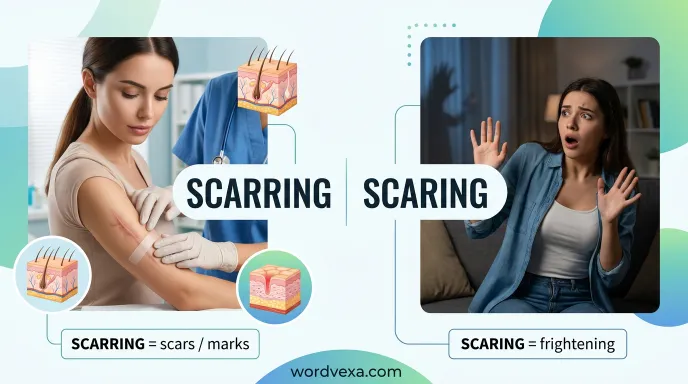
Scarring or scaring are both correct English words, but they have different meanings: scarring relates to scars, while scaring means frightening someone.
People often search for “scarring or scaring” because these words look and sound very similar. The extra r changes the meaning completely. If you are writing about a wound leaving a mark, scarring is correct.
If you mean making someone afraid, scaring is correct. Understanding this small spelling difference can prevent confusion in emails, essays, medical writing, social media posts, and everyday conversations.
The key is to look at the base words: scar → scarring and scare → scaring. Once you know which verb or noun you mean, choosing the correct form becomes much easier.
Scarring or Scaring: Quick Answer
Scarring and scaring are both correct, but they are used in different situations.
| Word | Meaning | Example |
| Scarring | Leaving or developing scars | The injury caused permanent scarring. |
| Scaring | Frightening someone | You are scaring me. |
Easy way to remember
- Scar + ring = scarring → related to a scar
- Scare + ing = scaring → related to scare
Correct: The accident caused facial scarring.
Correct: The loud noise was scaring the children.
Definition and Meaning of Scarring or Scaring
What Does Scarring Mean?
Scarring is the process of forming, developing, or leaving a scar on the skin or another surface.
The word comes from the noun and verb scar.
Examples:
- The wound caused scarring.
- Severe acne can result in facial scarring.
- The burn left noticeable scarring.
Scarring can also be used figuratively to describe lasting emotional or psychological effects.
Example:
The experience was emotionally scarring.
Here, the word does not refer to a physical scar. It means the experience had a lasting harmful effect.
What Does Scaring Mean?
Scaring is the present participle of the verb scare. It means frightening someone or causing fear.
Examples:
- You are scaring me.
- The movie is scaring the children.
- The sudden sound was scaring the dog.
The basic form is:
scare → scaring
Why Are They Confused?
The words differ by only one letter:
- scar → scarring
- scare → scaring
However, their meanings are completely different.
The Origin of Scarring or Scaring
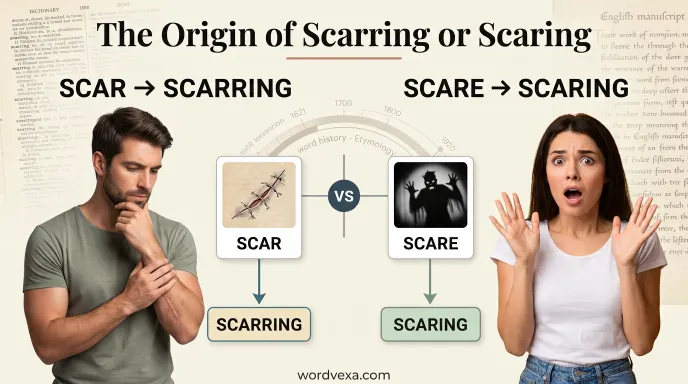
The two words come from different base words.
Scar is an old word referring to a mark left on the body after an injury. English adopted the word through older Germanic and Scandinavian influences.
Scare has Germanic roots and has long been associated with frightening or causing fear.
The spelling difference becomes clearer when the words are changed into their -ing forms.
Scar + -ing
When scar becomes a present participle, the final r is doubled:
scar → scarring
This spelling follows the rule used for some short words ending in a consonant where the final consonant is doubled before adding -ing.
Scare + -ing
With scare, the final silent e is removed before adding -ing:
scare → scaring
Therefore:
scar → scarring
scare → scaring
The difference is not a British-versus-American spelling issue. Both forms are standard in both major varieties of English.
British English vs American English Spelling
There is no major British-American spelling difference between scarring and scaring.
Both British and American English use:
- scarring
- scaring
The important difference is their meaning, not their regional spelling.
| Meaning | British English | American English |
| Formation of scars | scarring | scarring |
| Frightening someone | scaring | scaring |
| Past form of scar | scarred | scarred |
| Past form of scare | scared | scared |
| Base verb | scar | scar |
| Base verb | scare | scare |
Examples
British English:
The injury caused significant scarring.
American English:
The injury caused significant scarring.
British English:
You are scaring the baby.
American English:
You are scaring the baby.
So, unlike pairs such as colour/color or realise/realize, you do not need to choose between British and American spelling here.
Which Spelling Should You Use?
Your choice depends on what you want to say, not where your readers live.
Use “scarring” when:
You are talking about:
- scars
- injuries
- burns
- acne marks
- wounds
- lasting physical marks
- lasting emotional effects
Example:
The surgery may cause some scarring.
Use “scaring” when:
You are talking about:
- fear
- frightening someone
- causing someone to feel afraid
- frightening animals or people
Example:
Stop scaring your brother.
For Global Audiences
Both spellings are internationally understandable. You simply need to choose the word that matches your intended meaning.
A useful test is:
Does the sentence involve a scar? → scarring
Does the sentence involve fear? → scaring
Common Mistakes with Scarring or Scaring
Mistake 1: Using “scaring” for scars
Incorrect:
The accident caused permanent scaring.
Correct:
The accident caused permanent scarring.
The sentence is about scars, so scarring is required.
Mistake 2: Using “scarring” for frightening
Incorrect:
You are scarring me!
Correct:
You are scaring me!
The sentence means “You are frightening me,” so scaring is correct.
Mistake 3: Writing “scarrering”
Incorrect:
The injury is scarrering.
Correct:
The injury is scarring.
Do not add -ering. The correct form is simply:
scar + ring = scarring
Mistake 4: Confusing “scarred” and “scared”
These words are also easy to confuse.
- Scarred = marked by a scar
- Scared = frightened
Example:
His face was scarred after the accident.
Example:
He was scared during the storm.
Scarring or Scaring in Everyday Examples
In Emails
Scarring:
The doctor explained that the treatment may reduce visible scarring.
Scaring:
I apologize for scaring you with the unexpected message.
In News Writing
Scarring:
Doctors are studying new treatments for severe skin scarring.
Scaring:
The sudden explosion was scaring residents in the area.
On Social Media
Scarring:
This product helped reduce my acne scarring.
Scaring:
That horror movie is scaring me!
In Formal Writing
Scarring:
Early treatment may help reduce permanent scarring.
Scaring:
The repeated warnings were scaring local residents.
In Everyday Conversation
Scarring:
The cut left some scarring.
Scaring:
Why are you scaring me?
Scarring or Scaring: Google Trends & Usage Data
Search interest for scarring and scaring can vary because they belong to different semantic categories.
Scarring is commonly connected with topics such as:
- dermatology
- injuries
- acne
- surgery
- burns
- skincare
- emotional trauma
Scaring is commonly associated with:
- fear
- horror movies
- jokes
- frightening experiences
- children
- animals
- entertainment
Search volume can also change with current events, seasonal interests, health topics, and entertainment trends. Google Trends data should therefore be interpreted by country, time period, and search context rather than treating one global result as a permanent measure of word popularity.
The important point for writers is that search intent differs greatly:
scarring → scars and lasting marks
scaring → frightening or causing fear
Scarring or Scaring: Side-by-Side Comparison
| Feature | Scarring | Scaring |
| Base word | Scar | Scare |
| Basic meaning | Forming or leaving a scar | Causing fear |
| Related noun | Scar | Scare |
| Main context | Injuries, skin, emotional damage | Fear and frightening |
| Example | The wound caused scarring. | You are scaring me. |
| Opposite concept | Healing/no scar | Reassuring |
| British spelling | Scarring | Scaring |
| American spelling | Scarring | Scaring |
Simple Memory Trick
Think of the final letter of the base word:
scar → scarring
scare → scaring
If the sentence is about a scar, keep the extra r.
If the sentence is about scare, remove the silent e before adding -ing.
FAQs About Scarring or Scaring
Q1. Is “scarring” a correct word?
Yes. Scarring is correct when referring to the formation or presence of scars.
Q2. Is “scaring” a correct word?
Yes. Scaring is the -ing form of scare and means frightening someone or something.
Q3. What is the difference between scarring and scaring?
Scarring relates to scars or lasting marks. Scaring means causing fear.
Q4. Is it “scarring me” or “scaring me”?
If you mean frightening someone, the correct phrase is “scaring me.”
Example: You are scaring me.
Q5. Is it “skin scaring” or “skin scarring”?
The correct expression is generally skin scarring when referring to scars or marks on the skin.
Q6. Is “scarring” a British spelling?
Yes, scarring is used in British English. It is also the standard spelling in American English.
Q7. How can I remember scarring vs scaring?
Remember the base words:
scar → scarring
scare → scaring
Think scar = scarring and scare = scaring.
Conclusion
Scarring and scaring are both correct English words, but they have completely different meanings. Scarring refers to the formation or development of scars and can also describe lasting emotional effects. Scaring means frightening someone or causing fear.
The easiest way to choose the correct spelling is to identify the base word. If your sentence comes from scar, use scarring. If it comes from scare, use scaring. For example, “The injury caused scarring” discusses a physical mark, while “The noise was scaring the children” describes fear.
There is no meaningful British-versus-American spelling difference between these two forms. Both varieties use scarring and scaring in the same way.
Once you connect each word to its base form and meaning, this common spelling confusion becomes simple to avoid in professional, academic, and everyday writing.
Explore More Articles:
- Vans vs Converse: Which Style Fits You Best?
- Memaw or Meemaw: Which Spelling Is Correct?
- Yellowstone or Yosemite: Key Differences You Need to Know

I’m Claire Morgan, the author behind wordvexa.com, where I write about English grammar, sentence structure, punctuation, and everyday language. My goal is to make grammar simple, clear, and practical, helping readers understand the rules and apply them with confidence in real-world writing.







