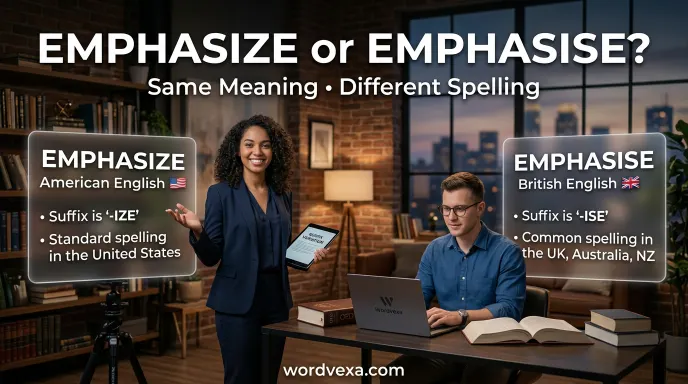
Emphasize and emphasise are both correct spellings of the same verb. Emphasize is preferred in American English, while emphasise is common in British English and other varieties that follow British spelling. The word means to give special importance, attention, or prominence to something.
This spelling difference often causes confusion because the words sound the same and have identical meanings. The difference comes from regional spelling conventions, especially the use of -ize and -ise endings.
This guide explains when to use emphasize or emphasise, how the spellings developed, and which version is appropriate for American, British, Canadian, and Australian English.
You will also see practical examples, common mistakes, usage patterns, and a quick comparison to help you choose the right form.
Emphasize or Emphasise: Quick Answer
The difference is mainly regional spelling, not meaning.
- Emphasize = preferred in American English
- Emphasise = preferred in British English
- Both mean to give special importance or attention to something
- Both are pronounced the same way
- Neither spelling changes the meaning of the sentence
Examples
American English:
The teacher wanted to emphasize the importance of practice.
British English:
The teacher wanted to emphasise the importance of practice.
International writing:
The report emphasises the need for better communication.
If your audience follows American English, choose emphasize. If you are writing in British English, emphasise is a natural choice.
What Does Emphasize or Emphasise Mean?
Emphasize and emphasise are verbs that mean to give extra importance, attention, or prominence to something.
For example:
The coach emphasized the importance of teamwork.
Here, emphasized means that the coach gave special attention to teamwork.
The two spellings can be used in the same contexts:
- Emphasize a point
- Emphasise a point
- Emphasize the importance of education
- Emphasise the need for change
- Emphasize a key detail
- Emphasise an important idea
The only major difference is spelling convention.
Related Forms
| Form | American English | British English |
| Base verb | emphasize | emphasise |
| Past tense | emphasized | emphasised |
| Present participle | emphasizing | emphasising |
| Noun | emphasis | emphasis |
Notice that emphasis keeps the same spelling in both varieties.
The Origin of Emphasize or Emphasise
The word emphasize/emphasise is connected to the Greek word emphainein, meaning to show or make clear. It entered English through French and Latin influences.
The spelling difference developed as English spelling conventions evolved in different regions.
The -ize ending has a long history in English and is used widely in American English. British English has traditionally allowed both -ize and -ise spellings in some words, but -ise is very common in British usage.
This means the difference between emphasize and emphasise is not a difference in meaning or pronunciation. It is primarily a matter of spelling tradition and regional style.
British English vs American English
The clearest distinction is regional.
| Feature | British English | American English | Example |
| Preferred spelling | emphasise | emphasize | She wants to emphasise/emphasize the point. |
| Past tense | emphasised | emphasized | He emphasised/emphasized the risks. |
| -ing form | emphasising | emphasizing | They are emphasising/emphasizing quality. |
| Meaning | Same | Same | Give special importance |
| Pronunciation | Same | Same | Usually pronounced the same |
British and American style guides may have different preferences for words ending in -ise/-ize. The important point is to choose one spelling system and use it consistently throughout your writing.
Which Version Should You Use?
United States
Use emphasize in American English.
The study emphasizes the importance of sleep.
American dictionaries and style conventions commonly use the -ize spelling.
United Kingdom
Use emphasise if you are following the common British spelling convention.
The study emphasises the importance of sleep.
Canada
Canadian English can show both British and American influences. Emphasize is widely used, although Canadian spelling has its own conventions across different words.
For formal Canadian writing, follow the style guide required by your school, employer, publisher, or institution.
Australia
Australian English generally follows British spelling conventions, so emphasise is commonly preferred.
The report emphasises the importance of safety.
International Writing
For international readers, either form can work. The most important rule is consistency.
Do not switch randomly between:
The article emphasizes the problem.
and:
The article emphasises the solution.
Choose the spelling system that matches your target audience.
Academic Writing
Follow the style guide required by your institution or journal.
Consistency matters more than choosing one form universally.
Business Writing
Use the spelling convention expected by your company, client, or audience. American-facing businesses commonly use emphasize, while British-facing organizations often use emphasise.
Common Mistakes with Emphasize or Emphasise
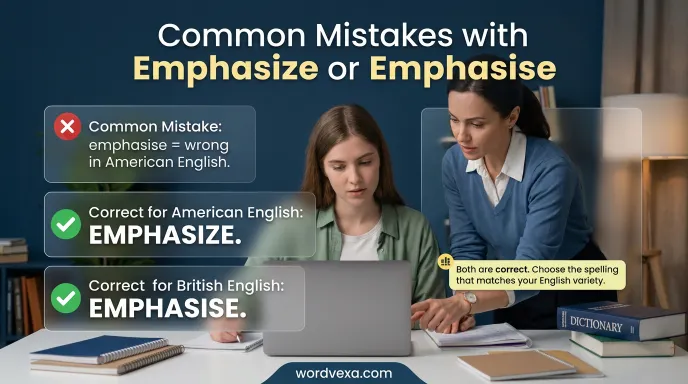
Mistake 1: Mixing spelling systems
Incorrect style:
The report emphasizes one issue but emphasises another.
The sentence is understandable, but the spelling is inconsistent.
Better:
The report emphasizes one issue but emphasizes another.
Or, in British English:
The report emphasises one issue but emphasises another.
Memory tip: Pick -ize or -ise and stay consistent.
Mistake 2: Thinking one spelling is always wrong
It is incorrect to assume that emphasise is simply a misspelling of emphasize, or vice versa.
Both are established spellings.
Mistake 3: Changing the meaning
The spelling does not change the meaning.
She emphasized the main idea.
and
She emphasised the main idea.
Both mean that she gave special importance to the main idea.
Everyday Examples of Emphasize or Emphasise
Emails
American:
I want to emphasize that the deadline has not changed.
British:
I want to emphasise that the deadline has not changed.
Business Writing
The company emphasizes customer service in its training program.
The company emphasises customer service in its training programme.
The spelling can change along with other regional conventions.
News Headlines
Experts emphasize the need for better preparation.
Experts emphasise the need for better preparation.
Blogs
This example emphasizes why clear writing matters.
Social Media
Just wanted to emphasize this important point!
Academic Writing
The findings emphasize the importance of further research.
A British academic publication might use:
The findings emphasise the importance of further research.
Daily Conversation
I just want to emphasize one thing.
The spoken form does not reveal which spelling you would use in writing.
Google Trends & Modern Usage
Search interest for “emphasize or emphasise” usually reflects the fact that English has different spelling conventions across regions. People may search the two forms when writing essays, reports, emails, applications, or other formal content.
The distinction is especially useful for writers who work with both American and British English.
There is no need to treat one spelling as a universal replacement for the other. Modern English writing generally follows the conventions of its intended audience, publisher, institution, or style guide.
For exact current search-volume or regional trend figures, Google Trends should be checked directly because search interest changes over time and varies by location.
Quick Comparison Table
| Version | Meaning | Correct? | Region | Example |
| Emphasize | Give special importance | Yes | American English | The report emphasizes safety. |
| Emphasise | Give special importance | Yes | British English | The report emphasises safety. |
| Emphasized | Gave special importance | Yes | American English | She emphasized the point. |
| Emphasised | Gave special importance | Yes | British English | She emphasised the point. |
Spelling Pattern Comparison
| Word | American English | British English |
| Emphasize | ✅ Preferred | Also accepted in some British styles |
| Emphasise | ❌ Usually not preferred | ✅ Common |
| Emphasized | ✅ Preferred | Usually emphasised |
| Emphasizing | ✅ Preferred | Usually emphasising |
Key Takeaways
- Emphasize and emphasise have the same meaning.
- Emphasize is the standard American English spelling.
- Emphasise is common in British English.
- The words are pronounced the same way.
- The difference is mainly regional spelling.
- Canadian English can reflect both British and American influences.
- Australian English commonly follows the British -ise pattern.
- Always follow your required style guide in academic and professional writing.
- Most importantly, stay consistent throughout the same document.
Frequently Asked Questions
Q1. Is emphasize or emphasise correct?
Both emphasize and emphasise are correct spellings. Emphasize is preferred in American English, while emphasise is common in British English and other varieties influenced by British spelling. They have exactly the same meaning and are pronounced the same way.
Q2. Is emphasize American or British English?
Emphasize is the standard spelling commonly associated with American English. British English commonly uses emphasise, although British spelling conventions can permit -ize spellings in certain words. Always follow the style guide required for your audience or publication.
Q3. Is emphasise British English?
Yes. Emphasise is a common British English spelling. It is also used in several other varieties of English that follow British spelling conventions. The American English equivalent is generally emphasize.
Q4. Do emphasize and emphasise have different meanings?
No. Emphasize and emphasise have the same meaning. Both mean to give special importance, attention, or prominence to something. The difference is spelling rather than meaning, pronunciation, or grammatical function.
Q5. Which spelling should I use in American English?
Use emphasize for American English writing. For example: “The teacher emphasized the importance of revision.” Use the related American forms emphasized and emphasizing as well.
Q6. Which spelling should I use in British English?
Emphasise is a common choice in British English. For example: “The teacher emphasised the importance of revision.” The related forms are emphasised and emphasising.
Q7. Is emphasize or emphasise used in academic writing?
Both can appear in academic writing. The correct choice depends on the English variety and style guide being followed. American publications commonly use emphasize, while British publications commonly use emphasise. Consistency throughout the paper is essential.
Q8. Is emphasise a spelling mistake?
No. Emphasise is an established English spelling. It is commonly used in British English and related spelling systems. It should not automatically be marked as incorrect simply because American English uses emphasize.
Q9. Are emphasize and emphasise pronounced differently?
No. In standard usage, emphasize and emphasise are pronounced the same way. The difference appears in writing, not in the basic pronunciation of the word.
Q10. What is the past tense of emphasize or emphasise?
The American form is emphasized. The common British form is emphasised. For example, “The teacher emphasized the rule” and “The teacher emphasised the rule” are equivalent sentences using different regional spelling conventions.
Conclusion
Emphasize and emphasise are both correct spellings of the same English verb. The main difference is regional: emphasize is the standard American English form, while emphasise is common in British English and several other varieties.
The best choice depends on your audience and the style guide you are following. Use emphasize for American-focused writing and emphasise when following a British spelling system. I
n Canada and other international settings, check the requirements of your institution, publisher, or organization.
The most important rule is consistency. Once you choose an English variety, keep related spellings such as emphasized/emphasised and emphasizing/emphasising consistent throughout your document.
Remember: same meaning, same pronunciation, different regional spelling.
If you are writing for an international audience, checking the publication or organization’s preferred style can help you make the right choice.
You May Also Like:
- Delux or Deluxe: Which Spelling Is Correct?
- Criticising or Criticizing? A Global Spelling Guide
- Develops vs Developes: Which One Is Grammatically Correct?

I’m Claire Morgan, the author behind wordvexa.com, where I write about English grammar, sentence structure, punctuation, and everyday language. My goal is to make grammar simple, clear, and practical, helping readers understand the rules and apply them with confidence in real-world writing.








3 thoughts on “Emphasize vs Emphasise: American vs British English”