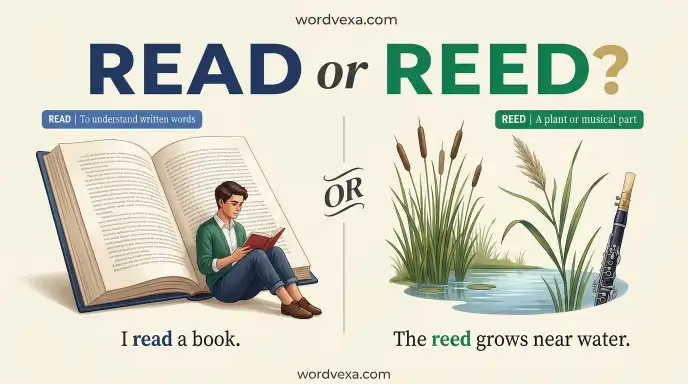
The words read or reed sound the same in many sentences, but they have completely different meanings and grammatical roles.
Read is mainly a verb or noun connected with understanding written words, while reed is a noun for a tall, stiff plant or a thin part used in some musical instruments.
This makes read or reed a common spelling confusion, especially for English learners. The problem comes from pronunciation: both words are pronounced /riːd/ when read is in the present tense.
However, read has another pronunciation, /red/, when it is used as the past tense or past participle.
In this guide, you will learn the exact difference between read and reed, their meanings, origins, pronunciation, common mistakes, regional usage, and practical examples.
You will also see how to remember which spelling to use in everyday writing.
Read or Reed: Quick Answer
The easiest way to understand read or reed is to look at their meanings.
- Read = to understand written words or symbols.
- Reed = a tall plant that often grows near water.
- Reed can also mean a thin vibrating strip used in some musical instruments.
- Read is usually a verb, although it can also be a noun.
- Reed is a noun.
Examples
- I read a book every evening.
- She read the letter yesterday.
- A reed grew beside the pond.
- The clarinet has a reed that vibrates when played.
A useful point to remember is that read has two common pronunciations. The present form is pronounced like reed, while its past form is pronounced like red. Cambridge gives /riːd/ for present-tense read and /red/ for its past tense and past participle.
What Does Read or Reed Mean?
Read and reed are different words with different meanings. Read means to look at written words and understand them, while reed means a tall, stiff plant that commonly grows near water or a thin strip used in certain musical instruments. They sound the same when read is pronounced /riːd/, but their spelling and meaning are different.
What Does Read Mean?
Read means to look at written words, symbols, or information and understand their meaning. It can also mean to say written words aloud.
For example:
- I read the newspaper every morning.
- Please read the instructions carefully.
- She read the story to the children.
The word can also have wider meanings. You can read a map, read music, read a meter, or read a situation. Cambridge lists meanings involving understanding written information, saying written words aloud, interpreting signs, showing measurements, and understanding a situation.
As a noun, a read can refer to something that is worth reading:
- That article was an interesting read.
- This book is a quick read.
What Does Reed Mean?
Reed is a noun. It usually refers to a tall, stiff plant that grows in groups, often near water.
Examples:
- The reeds grew along the riverbank.
- The bird disappeared among the reeds.
A reed can also be a thin piece of wood or another material that vibrates to produce sound in certain musical instruments. Clarinets and oboes are familiar examples.
Read vs Reed in One Sentence
Think of it this way:
You read a book, but a reed grows near water.
That simple contrast solves most spelling problems.
The Origin of Read or Reed
Although read and reed sound alike in some contexts, they have different histories.
Origin of Read
The verb read comes from Old English forms such as rǣdan, which had meanings including “to advise,” “to counsel,” “to interpret,” and “to read.” Its history can be traced through Middle English forms into modern English.
The older sense of the word was connected with interpreting or understanding. Over time, the meaning associated with interpreting written material became central to modern English.
This history helps explain why read has several related meanings today. We can read words, read signs, read music, or even read a situation.
Origin of Reed
Reed has a separate origin. It developed from Old English hreod, meaning a reed or rush. The word continued through Middle English forms before becoming the modern reed.
The musical meaning developed from the use of actual reed material in pipes and other instruments. Later, reed came to refer to the vibrating component used in certain instruments.
So, despite their similar pronunciation, read and reed are not different spellings of the same word. They are separate words with separate histories.
British English vs American English
There is no major British-versus-American spelling difference between read and reed. Both varieties use the same spellings and the same basic meanings.
The important difference is the pronunciation of read, because its pronunciation changes according to tense.
| Feature | British English | American English | Example |
| Read, present | /riːd/ | /riːd/ | I read every day. |
| Read, past | /red/ | /red/ | I read it yesterday. |
| Reed, noun | /riːd/ | /riːd/ | A reed grows near water. |
| Reed, musical part | /riːd/ | /riːd/ | Replace the reed. |
Cambridge lists the same basic pronunciations for British and American English: present-tense read as /riːd/, past-tense read as /red/, and reed as /riːd/.
Why This Causes Confusion
The confusion becomes especially strong when someone hears the word instead of seeing it.
For example:
I read about the reed.
The first word means “looked at and understood information.” The second refers to the plant or musical component.
When spoken in the present tense, read and reed sound identical. Context tells the listener which word is intended.
Which Version Should You Use?
Use the spelling according to the meaning, not according to the country where you are writing.
United States
Use read when referring to reading written material.
I need to read this report.
Use reed when referring to the plant or musical component.
The musician replaced the reed.
United Kingdom
The same distinction applies.
She read the instructions.
Tall reeds surrounded the pond.
Canada
Canadian English also uses read and reed according to their meanings. There is no special Canadian spelling for this distinction.
Australia
Australian English follows the same basic distinction.
He read the article.
The reeds were moving in the wind.
International Writing
For international readers, context is especially helpful. If you are writing for ESL learners, students, or a broad audience, choose clear sentences that make the meaning obvious.
Academic Writing
Use read when discussing texts, research papers, books, articles, and other written sources.
Students should read the assigned chapter before class.
Use reed only when the subject actually concerns plants, biology, musical instruments, or another relevant context.
Business Writing
Use read for documents, emails, reports, contracts, and instructions.
Please read the attached report before the meeting.
Using reed in this sentence would be incorrect because the intended meaning involves reading a document.
Common Mistakes with Read or Reed
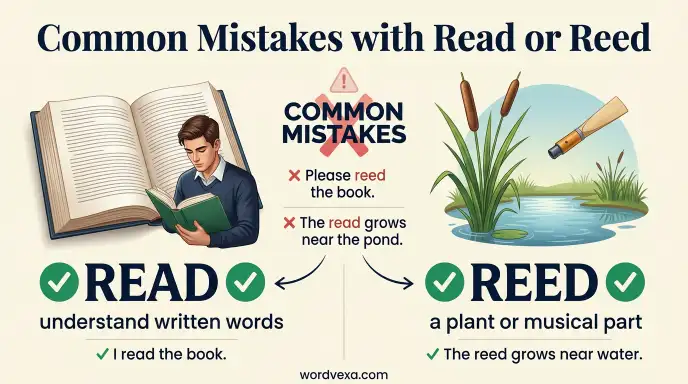
Mistake 1: Using Reed for Reading
Incorrect:
Please reed the instructions.
Correct:
Please read the instructions.
Why?
The sentence asks someone to look at and understand written information. Therefore, the correct word is read.
Memory tip:
Read a book. Reed is a plant.
Mistake 2: Using Read for the Plant
Incorrect:
The read grew beside the lake.
Correct:
The reed grew beside the lake.
Why?
The sentence refers to a plant, so reed is required.
Mistake 3: Confusing the Past Pronunciation
The spelling remains read, but the pronunciation changes.
I read the book every week.
/riːd/
I read the book yesterday.
/red/
This is one of the unusual features of English spelling and pronunciation. The written form stays the same, but tense changes the pronunciation.
Mistake 4: Assuming Same Sound Means Same Word
Homophones are words that sound alike but have different meanings or spellings. Read and reed can be homophones when read is pronounced /riːd/.
The sound alone cannot tell you which spelling to use. You must consider the meaning and sentence context.
Everyday Examples of Read or Reed
In Emails
Please read the attached document before Friday.
I have read your message and will respond soon.
In Business Writing
All employees should read the updated policy.
The technician replaced the instrument’s reed.
In News Headlines
Scientists read new signals from the device.
Strong winds damaged the reeds along the river.
In Blogs
If you read this guide carefully, the difference becomes simple.
On Social Media
I finally read that book everyone was talking about.
In Academic Writing
Students were asked to read three research articles.
The study examines plant species found among wetland reeds.
In Daily Conversation
Did you read my message?
Yes, I read it this morning.
Look at those reeds near the water.
These examples show why context matters. The surrounding words usually make the intended meaning clear.
Google Trends & Modern Usage
Search interest around read or reed is understandable because the two words create a classic homophone problem. People often search the pair when they are unsure which spelling belongs in a sentence.
Modern dictionaries continue to distinguish the words clearly. Read is used for understanding written information and several related meanings, while reed refers mainly to a plant and to the vibrating component of certain musical instruments.
Another reason this keyword attracts learners is the unusual pronunciation of read. Its present form sounds like reed, but its past form sounds like red. This makes spelling and pronunciation especially challenging for English learners.
There is no need to assume that one spelling is more common because of British or American English. The distinction is based on meaning rather than regional spelling.
Exact Google Trends figures are not included here because search-interest data can change over time and should be checked directly for the specific date range and region being studied.
Quick Comparison Table
| Version | Meaning | Correct? | Region | Example |
| read | Understand written words | Yes | International | I read every night. |
| read | Past form of read | Yes | International | I read it yesterday. |
| reed | Tall plant near water | Yes | International | The reed grew beside the pond. |
| reed | Vibrating part of some instruments | Yes | International | The clarinet reed needs replacing. |
| reed for reading | Incorrect use | No | All regions | ❌ Please reed this. |
| read for plant | Incorrect use | No | All regions | ❌ A read grew there. |
Key Takeaways
- Read and reed are different words.
- Read usually means to look at and understand written information.
- Reed is a tall, stiff plant that often grows near water.
- Reed can also mean a vibrating part of some musical instruments.
- Present-tense read is pronounced /riːd/.
- Past-tense read is pronounced /red/.
- Reed is pronounced /riːd/.
- British and American English use the same spellings for these words.
- Context is the best way to identify the intended meaning.
- Remember: You read a book, but a reed grows near water.
FAQs About Read or Reed
Q1. Is it read or reed a book?
The correct word is read: “I read a book every night.” Read is the verb used for looking at written words and understanding their meaning. Reed refers to a plant or a component used in some musical instruments, so it cannot be used for the act of reading.
Q2. Are read and reed homophones?
Yes, they can be homophones when read is used in the present tense and pronounced /riːd/. Reed is also pronounced /riːd/. They sound the same but have different spellings and meanings. The past tense of read, however, is pronounced /red/.
Q3. What is the difference between read and reed?
Read is mainly a verb connected with understanding written words or information. Reed is a noun referring to a tall plant or a thin vibrating part of some musical instruments. The two words may sound identical in pronunciation, but their meanings are completely different.
Q4. Is “reed” the past tense of “read”?
No. The past tense of read is still spelled read, not reed. The difference is pronunciation. Present read is pronounced /riːd/, while past read is pronounced /red/. For example, “I read every day” uses /riːd/, while “I read it yesterday” uses /red/.
Q5. How do you pronounce read and reed?
Present-tense read and reed are both pronounced /riːd/. Past-tense read is pronounced /red/. Cambridge gives these pronunciations for both British and American English.
Q6. What is a reed?
A reed is a tall, stiff plant that commonly grows near water. The word can also describe a thin vibrating component in musical instruments such as clarinets and oboes. In both cases, reed is a noun.
Q7. Can read be a noun?
Yes. Read can be used as a noun in expressions such as “a good read” or “an easy read.” In this use, it refers to something that is enjoyable or suitable to read. Most commonly, however, read is encountered as a verb.
Q8. Why does read have two pronunciations?
English read keeps the same spelling in its present and past forms, but the pronunciation changes. Present read is /riːd/, while past and past participle read are /red/. This spelling pattern developed as English grammar and pronunciation changed over time.
Q9. Is “Please reed this” correct?
No. The correct sentence is “Please read this.” The sentence asks someone to look at and understand written information. Reed would be correct only if you were talking about a plant or a musical instrument component.
Q10. How can I remember read vs reed?
Use this simple memory trick: Read = words; reed = plant. You read a book, letter, email, or article. A reed grows near water or can be part of a musical instrument. Thinking about the meaning will help you choose the correct spelling.
Conclusion
The difference between read or reed becomes simple once you focus on meaning. Read is the word you use when talking about understanding written words, information, signs, music, or similar material. Reed is a noun for a tall plant that often grows near water, and it can also describe a vibrating part of certain musical instruments.
The pronunciation can make this pair confusing. Present-tense read sounds like reed, while past-tense read sounds like red. Importantly, British and American English do not use different spellings for this distinction.
When writing, do not choose between read and reed based on sound. Look at the meaning of the sentence. If you are talking about written information, choose read. If you mean the plant or musical component, choose reed.
Remember: You read words, but a reed grows near water.
If this guide helped clear up the confusion, keep it nearby when you come across other commonly confused English words.
Explore More Articles:
- Sewed or Sewn: Which Is Correct? Meaning, Grammar & Examples
- NIV or NLT: Which Bible Translation Should You Choose?

I’m Claire Morgan, the author behind wordvexa.com, where I write about English grammar, sentence structure, punctuation, and everyday language. My goal is to make grammar simple, clear, and practical, helping readers understand the rules and apply them with confidence in real-world writing.








3 thoughts on “Read or Reed: Meaning, Spelling, and Usage”