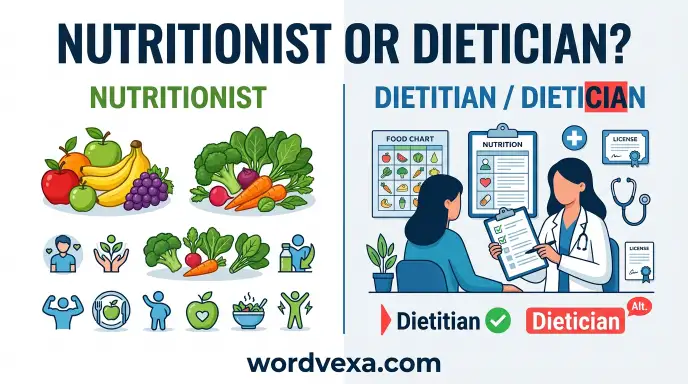
Nutritionist or dietician refers to a comparison between nutrition professionals and the different meanings, qualifications, and usage of the terms nutritionist, dietitian, and dietician.
Many people search for nutritionist or dietician because they are unsure which professional to choose or which term is correct in English.
A nutritionist generally works with food, nutrition, and healthy eating, but the title can have different meanings depending on the country.
A dietitian is a trained professional in dietetics who may provide specialized nutrition care, depending on local regulations and credentials.
Dietician is an accepted spelling variant of dietitian, although dietitian is generally preferred in professional writing.
The confusion becomes greater because professional titles and regulations differ across countries. A person looking for nutrition advice may also wonder if a nutritionist and dietitian have the same qualifications.
In this guide, you will learn the difference between these terms, the preferred spelling, regional usage, common mistakes, and practical examples. Let’s start with the quick answer.
Nutritionist or Dietician: Quick Answer
Nutritionist or dietician is not simply a choice between two identical professional titles. A nutritionist generally works in nutrition, while a dietitian is specifically trained in dietetics. Dietician is an alternative spelling of dietitian.
What Does Nutritionist or Dietician Mean?
The phrase “nutritionist or dietician” usually reflects two questions:
- What is the difference between a nutritionist and a dietitian?
- Is dietician or dietitian the correct spelling?
These questions are related but should not be confused.
What Is a Nutritionist?
A nutritionist is someone who works with food, nutrition, and the relationship between diet and health.
The title can cover different roles, including:
- Nutrition education
- Public health
- Research
- Sports nutrition
- Food and wellness
- Community programs
- Nutrition communication
The exact meaning and legal status of nutritionist depend on the country and, in some places, the region.
What Is a Dietitian?
A dietitian is a professional trained specifically in dietetics.
Dietitians can work with healthy people and people who have specific nutritional or medical needs. Depending on local laws and credentials, they may provide individualized nutrition assessment, counseling, and clinical nutrition care.
Is Dietician Different From Dietitian?
No. Dietician and dietitian refer to the same profession.
The difference is spelling, not meaning. However, dietitian is generally the preferred spelling in professional and formal writing.
The Origin of Nutritionist, Dietitian, and Dietician
The word nutritionist comes from nutrition, which refers to the process of obtaining and using nutrients from food. The suffix -ist is commonly used for a person involved in a particular field.
Dietitian is connected with dietetics, the field concerned with applying nutrition knowledge to food and health.
Dietician developed as a spelling variant. The “-cian” ending may look more natural to English speakers because many profession names use this pattern.
Both spellings can be found in English, but dietitian is strongly established as the professional spelling used by major dietetic organizations.
British English vs American English
Dietitian and dietician are not simply a British-versus-American spelling pair. Both forms can appear in English, although dietitian is widely preferred in professional contexts.
| Term | British English | American English | Example |
| Dietitian | Common and professionally preferred | Common and professionally preferred | She consulted a dietitian. |
| Dietician | Recognized variant | Recognized variant | He works as a dietician. |
| Nutritionist | Common, with specific professional distinctions | Common, with varying legal meaning | She is a nutritionist. |
| Registered Dietitian | Common professional term | Common professional term | Ask a registered dietitian. |
| Registered Dietitian Nutritionist | Less common as a UK title | Established US credential | The RDN provided nutrition advice. |
Regional laws also matter. For example, dietitian is a protected professional title in the UK, while the legal meaning of nutritionist varies between countries and jurisdictions.
Which Version Should You Use?
United States
Use dietitian for formal and professional writing.
When referring specifically to a credentialed US professional, Registered Dietitian Nutritionist (RDN) may be more precise.
United Kingdom
Use dietitian when referring to the regulated profession.
The distinction between dietitians and nutritionists is important in UK professional contexts.
Canada
Use dietitian for the regulated dietetics profession. Rules concerning the title nutritionist can vary by province.
Australia
Use dietitian when referring to a qualified dietetics professional. The title nutritionist has a different regulatory position.
International Writing
For an international audience, dietitian is usually the safest professional spelling.
Academic Writing
Use dietitian unless you are quoting a source that uses dietician.
Business Writing
Use the official professional title used by the person or organization.
Common Mistakes
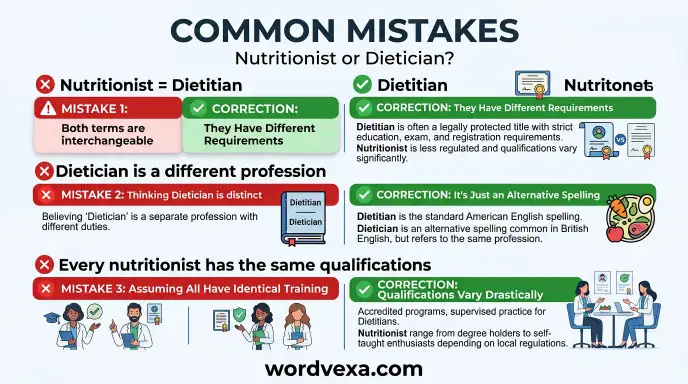
Mistake 1: Treating Nutritionist and Dietitian as Identical
Incorrect:
“Nutritionists and dietitians always have the same qualifications.”
Correct:
“Nutritionists and dietitians may have different qualifications and professional roles.”
Explanation:
The meaning and regulation of nutritionist vary by location.
Memory tip:
Think dietitian = dietetics.
Mistake 2: Thinking Dietician Is a Different Profession
Incorrect:
“A dietician and dietitian are two different professionals.”
Correct:
“Dietician is an alternative spelling of dietitian.”
Explanation:
Both words refer to the same profession.
Memory tip:
Dietician = spelling variant. Dietitian = preferred professional spelling.
Mistake 3: Assuming Every Nutritionist Can Provide Clinical Care
Incorrect:
“Every nutritionist can provide medical nutrition treatment.”
Correct:
“The scope of nutrition practice depends on professional qualifications and local regulations.”
Explanation:
Professional roles and legal scopes differ between jurisdictions.
Everyday Examples
Emails
“I would like to schedule an appointment with a dietitian.”
Business Writing
“Our company invited a registered dietitian to provide nutrition education.”
News Headlines
“Dietitian Explains the Importance of Balanced Meals”
Blogs
“Should you choose a nutritionist or a dietitian?”
Social Media
“Confused about nutritionist vs dietitian? Check the professional’s qualifications.”
Academic Writing
“Dietitians apply nutrition science to dietary assessment and nutrition care.”
Daily Conversation
“I think I should talk to a dietitian about my diet.”
Google Trends & Modern Usage
People search for “nutritionist or dietician” because the terms are easy to confuse. Some searchers want to know which professional to visit, while others simply want to know which spelling is correct.
Modern websites and social media also use nutritionist, dietitian, and dietician in different ways. This can make the distinction harder for readers.
The spelling dietitian is widely used by professional dietetic organizations, making it a strong choice for formal writing.
Search behavior can also vary by region. Professional titles and regulations are not identical in the United States, United Kingdom, Canada, Australia, and other countries.
For writers, the best approach is to consider both meaning and location. If you mean the profession, dietitian is generally the safest spelling. If you are comparing professional roles, explain the distinction between nutritionists and dietitians.
Quick Comparison Table
| Version | Meaning | Correct? | Region | Example |
| Nutritionist | Person working in nutrition; exact meaning varies | Yes | International | She works as a nutritionist. |
| Dietitian | Professional trained in dietetics | Yes | International | He consulted a dietitian. |
| Dietician | Variant spelling of dietitian | Yes, but less preferred professionally | English-speaking regions | She visited a dietician. |
| Registered Dietitian | Credentialed dietetics professional where applicable | Yes | Several countries | Ask a registered dietitian. |
| Registered Dietitian Nutritionist | Established US professional credential | Yes | United States | The RDN provided nutrition counseling. |
Key Takeaways
- Dietitian and dietician refer to the same profession.
- Dietitian is generally preferred in professional writing.
- Nutritionist can have a broader meaning.
- The legal meaning of nutritionist varies by country and jurisdiction.
- Dietitians receive specific training in dietetics.
- Dietitian is a protected title in the UK.
- Registered Dietitian Nutritionist (RDN) is an established US credential.
- When unsure about spelling, choose dietitian.
Frequently Asked Questions
Q1. Is a nutritionist the same as a dietitian?
Not always. A nutritionist works in the field of nutrition, but the title can have different meanings and levels of regulation depending on location.
A dietitian is specifically trained in dietetics and may provide clinical nutrition care within the scope allowed by local regulations. Always check professional qualifications and registration when choosing a nutrition professional.
Q2. Is dietician or dietitian the correct spelling?
Both dietician and dietitian are recognized spellings, but dietitian is generally preferred for professional and formal writing. Major professional organizations commonly use dietitian. If you are writing an academic paper, healthcare article, or business document, dietitian is usually the safer choice.
Q3. What is the difference between a nutritionist and a dietitian?
The main difference involves training, professional scope, and regulation. A nutritionist may work in nutrition education, research, public health, sports, food, or wellness.
A dietitian has specific training in dietetics and may provide individualized or clinical nutrition care. The exact distinction depends on the country and local regulations.
Q4. Can a dietitian be called a nutritionist?
A dietitian can certainly work in nutrition and may describe their work using the term nutritionist. However, someone who calls themselves a nutritionist is not automatically a dietitian.
The title dietitian generally indicates specific professional education and training. Local laws determine the exact requirements for using professional titles.
Q5. Is “dietician” a misspelling?
No. Dietician is an established spelling variant of dietitian. However, dietitian is widely preferred by professional organizations and is the better choice for most formal healthcare, academic, and professional writing.
Using dietitian can also make your terminology more consistent with professional sources.
Q6. Should I use nutritionist or dietitian in an article?
Use the term that matches your intended meaning. If you mean someone specifically trained in dietetics, dietitian is more precise. If you are discussing nutrition professionals generally, nutritionist may be appropriate.
When writing for an international audience, briefly explain the distinction because professional titles and regulations differ across countries.
Q7. Which is better for medical nutrition advice, a nutritionist or dietitian?
For medical nutrition needs, a qualified dietitian is generally the more appropriate professional to consider because dietitians receive specialized training in dietetics and clinical nutrition.
However, scope of practice varies by location. Before seeking care, check the professional’s qualifications, registration, and experience in the relevant area.
Q8. Is “nutritionist” a protected title?
It depends on the country or jurisdiction. In the UK, dietitian is a protected title, while nutritionist has a different regulatory position.
In Canada, rules for nutritionist vary by province. Australia also distinguishes between dietitians and nutritionists. US requirements can vary by state.
Conclusion
The phrase nutritionist or dietician brings together two common sources of confusion: the difference between a nutritionist and a dietitian, and the spelling of dietitian. Understanding both makes it much easier to choose the right word.
A nutritionist generally works in nutrition, but the title can have different meanings depending on the country. A dietitian has specific training in dietetics and may provide specialized nutrition care within the limits of local regulations. Dietician, meanwhile, is an alternative spelling of dietitian, not a separate profession.
For formal, academic, healthcare, and professional writing, dietitian is usually the best spelling. If you are comparing professionals, always consider their qualifications and the rules in the relevant country or jurisdiction.
When choosing a nutrition professional, look beyond the title. Check education, credentials, registration, and relevant experience.
The easiest rule to remember is: dietician and dietitian are spelling variants, but nutritionist and dietitian can describe different professional roles.
You May Also Like:

I’m Claire Morgan, the author behind wordvexa.com, where I write about English grammar, sentence structure, punctuation, and everyday language. My goal is to make grammar simple, clear, and practical, helping readers understand the rules and apply them with confidence in real-world writing.







