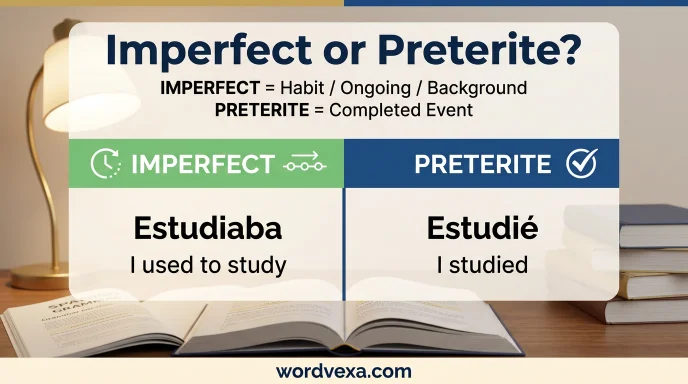
Imperfect or preterite refers to the two main Spanish past tenses used to describe past actions, with the imperfect focusing on ongoing, habitual, or background situations and the preterite focusing on completed events.
Choosing between them can be confusing because both tenses talk about the past, but they present actions from different perspectives.
Spanish learners often search for imperfect or preterite when they are unsure which past tense to use in a sentence. The confusion becomes especially common when an action happened repeatedly, lasted for some time, or occurred while another event took place.
For example, Cuando era niño, jugaba al fútbol means “When I was a child, I used to play soccer.” The imperfect jugaba describes a past habit. In contrast, Ayer jugué al fútbol uses the preterite because the speaker presents the activity as a completed event.
Understanding this difference will help you choose the correct tense more naturally. In this guide, you will learn the key rules, practical examples, common mistakes, and simple ways to remember when to use the imperfect or preterite.
Imperfect or Preterite: Quick Answer
The simplest way to understand the difference is to ask what you want to show about the past.
- Preterite: focuses on a completed event or a specific occurrence.
- Imperfect: focuses on an ongoing, habitual, repeated, or descriptive situation.
- Both: can appear together when one action provides the background and another interrupts it.
For example:
Ayer estudié español.
I studied Spanish yesterday.
The speaker presents the studying as a completed event.
Cuando era estudiante, estudiaba español todos los días.
When I was a student, I used to study Spanish every day.
Here, the speaker describes a past habit.
Another common pattern is:
Yo estudiaba cuando él llamó.
I was studying when he called.
Estudiaba gives the background action. Llamó presents the interrupting event as a completed occurrence.
A useful mental shortcut is:
Preterite = what happened.
Imperfect = what was happening, what used to happen, or what things were like.
This is a useful starting point, but context always matters.
What Does Imperfect or Preterite Mean?
In Spanish, tpreterite he usually describes a completed past event, while the imperfect describes past habits, repeated actions, ongoing situations, descriptions, age, time, or background information. For example, Ayer estudié means “I studied yesterday,” while Cuando era joven, estudiaba mucho means “When I was young, I used to study a lot.”
What Is the Spanish Preterite?
The preterite, often called pretérito perfecto simple or pretérito indefinido, is a Spanish past tense used to present completed events.
It is commonly used for:
- A single completed action
- A sequence of completed events
- An event with a clear endpoint
- A specific number of completed occurrences
- An action that began or ended at a particular point
Examples:
Comí a las ocho.
I ate at eight.
Llegó a casa y abrió la puerta.
He arrived home and opened the door.
Visitamos Madrid tres veces.
We visited Madrid three times.
The preterite helps move a story forward because it presents events as completed happenings.
What Is the Spanish Imperfect?
The imperfect, or pretérito imperfecto, is used to describe past situations without focusing on a definite endpoint.
It commonly expresses:
- Past habits
- Repeated actions
- Ongoing actions
- Descriptions
- Age in the past
- Time in the past
- Weather
- Feelings and mental states
- Background information
Examples:
Cuando era niño, jugaba al fútbol.
When I was a child, I used to play soccer.
Hacía frío.
It was cold.
Eran las ocho.
It was eight o’clock.
Mi profesor era muy amable.
My teacher was very kind.
The imperfect often helps establish the setting or circumstances around another event.
The Most Important Difference
The difference is not simply “short action versus long action.”
Instead, Spanish speakers choose the tense based on how the event is viewed in context.
Compare:
Estudié español durante dos años.
I studied Spanish for two years.
The speaker presents the period as completed.
Estudiaba español cuando vivía en Madrid.
I studied Spanish when I lived in Madrid.
The studying is presented as part of the background or circumstances of that period.
This distinction is why memorizing only a list of signal words is not enough.
The Origin of Imperfect or Preterite
Where Does “Preterite” Come From?
The word preterite comes from a term associated with the idea of something that has gone before or passed. In English-language grammar, “preterite” is used to describe a past tense.
Spanish grammar traditionally uses the term pretérito, with more specific terminology for different past forms. The Royal Spanish Academy lists pretérito imperfecto and pretérito perfecto simple among Spanish verb forms.
Where Does “Imperfect” Come From?
The term imperfect reflects the idea that the past event is not presented as a completed whole from the speaker’s viewpoint.
That does not necessarily mean the real-world action was unfinished.
For example:
Vivía en Londres.
I lived in London.
The person may have eventually left London. The imperfect simply does not focus on that endpoint.
This is an important point for learners. Imperfect does not always mean that something literally remained unfinished. It means the speaker presents the situation without focusing on completion.
British English vs American English
Does British or American English Change the Spanish Rule?
No. The Spanish imperfect and preterite distinction does not change simply because the learner speaks British or American English.
The main difference is usually terminology and the English translation chosen by the writer.
| Spanish Grammar | British English Explanation | American English Explanation |
| Preterite | Completed past event | Completed past event |
| Imperfect | Past habit, background, or ongoing situation | Past habit, background, or ongoing situation |
| Estudié | I studied | I studied |
| Estudiaba | I was studying / I used to study | I was studying / I used to study |
English translations can therefore make the Spanish distinction seem less clear. One Spanish form can have several natural English translations depending on context.
For example:
Cuando era niño, jugaba mucho.
Possible translations include:
- When I was a child, I played a lot.
- When I was a child, I used to play a lot.
- When I was a child, I would play a lot.
The Spanish tense remains the same even though the English translation changes.
What About Canada and Australia?
Canadian and Australian English speakers follow the same basic Spanish tense distinction when learning Spanish.
The important issue is not the variety of English. It is understanding how Spanish presents completed events, ongoing situations, habits, descriptions, and background information.
Which Version Should You Use?
United States
If you are learning Spanish in the United States, learn both forms from the beginning. Spanish-language education commonly requires learners to distinguish completed events from background and habitual situations.
United Kingdom
British English speakers should also learn both forms. Do not assume that the English simple past maps directly onto the Spanish preterite in every sentence.
Canada
Canadian learners can use the same Spanish grammar rules. Pay particular attention to context when translating from English.
Australia
Australian learners should also focus on the Spanish meaning and viewpoint rather than trying to find a one-to-one English equivalent.
International Writing
For international learners, the safest approach is to understand the function of each Spanish tense rather than relying only on English translations.
Academic Writing
In academic Spanish, choose the tense according to the timeline and meaning you want to communicate. Avoid selecting a tense simply because a particular English translation sounds familiar.
Business Writing
In professional Spanish, the same distinction applies. Completed events may require the preterite, while descriptions, ongoing situations, and habitual background information may require the imperfect.
Common Mistakes
Mistake 1: Using the Preterite for Every Past Action
Incorrect:
Cuando era niño, fui al parque todos los días.
Better in the intended habitual sense:
Cuando era niño, iba al parque todos los días.
The imperfect iba presents the repeated activity as a past habit. However, context can allow the preterite for repeated actions when the speaker presents the whole set of events as completed, so the rule is not simply “every repeated action equals imperfect.”
Mistake 2: Thinking “Long Action = Imperfect”
Length alone does not determine the tense.
Estudié durante tres horas.
I studied for three hours.
The action can still be presented as completed, so the preterite is natural.
Mistake 3: Assuming “Was Doing” Always Means Imperfect
The English translation can help, but it should not be the only test.
Look at the Spanish context and ask if the speaker is presenting the action as background, ongoing, habitual, or completed.
Mistake 4: Ignoring the Story Context
Consider:
Caminaba por la calle cuando vi a Ana.
The walking provides the background. Vi presents the completed event of seeing Ana.
Memory Tip
Think of a video camera and a snapshot.
- Imperfect: the camera is showing the background or action in progress.
- Preterite: the camera captures a completed event.
This is only a learning aid, not a complete grammar rule.
Everyday Examples
Emails
Ayer envié el informe.
I sent the report yesterday.
The sending is presented as completed.
Business Writing
Cuando trabajaba en esa empresa, asistía a reuniones cada lunes.
When I worked at that company, I attended meetings every Monday.
The imperfect describes a recurring workplace routine.
News Headlines
A completed event can naturally be presented with a preterite form:
El presidente anunció nuevas medidas.
The president announced new measures.
The announcement is presented as an event.
Blogs
Cuando vivía en España, viajaba mucho.
When I lived in Spain, I traveled a lot.
The writer describes a repeated experience during a past period.
Social Media
Ayer visitamos Barcelona.
Yesterday we visited Barcelona.
The visit is presented as completed.
Academic Writing
Los investigadores analizaron los datos.
The researchers analyzed the data.
The analysis is presented as a completed research action.
Daily Conversation
Estaba cansado cuando llegué a casa.
I was tired when I got home.
Estaba cansado describes the condition, while llegué presents the completed arrival.
Google Trends & Modern Usage
People search for “imperfect or preterite” because English-speaking Spanish learners often encounter two simple Spanish past tenses where English commonly uses the simple past or relies on context and constructions such as “used to” and “was doing.”
Common questions include:
- When should I use the imperfect?
- When should I use the preterite?
- Is a repeated action always imperfect?
- Which tense should I use with “when”?
- How do I know if an action was completed?
- Why do both tenses appear in the same sentence?
There is no need to invent a specific search-volume statistic to explain this confusion. The grammar itself creates a common learning challenge because both forms refer to past time but present events differently. Educational grammar resources consistently describe the preterite in terms of completed events and the imperfect in terms of habits, descriptions, ongoing situations, and background.
One important modern learning point is that signal words are clues, not absolute rules. Words such as ayer often point toward the preterite, while siempre, a menudo, and todos los días often occur with the imperfect. But context can change the interpretation.
Quick Comparison Table
| Version | Meaning | Correct? | Typical Use | Example |
| Preterite | Completed past event | Yes | Finished events | Ayer comí. |
| Imperfect | Past background or ongoing situation | Yes | Habits and descriptions | Comía allí a menudo. |
| Preterite | Completed repeated event | Yes | Specific completed number of events | Fui tres veces. |
| Imperfect | Repeated past habit | Yes | Regular or habitual activity | Iba cada domingo. |
| Imperfect + Preterite | Background + completed event | Yes | Interrupted action | Estudiaba cuando llamó. |
The key is that both forms can be correct. The intended meaning determines the tense.
Key Takeaways
- The preterite generally presents a completed past event.
- The imperfect commonly describes past habits, ongoing situations, and background information.
- The imperfect is frequently used for past age, time, weather, descriptions, and states.
- The preterite can describe a specific completed event or a completed sequence of events.
- The two tenses often work together in storytelling.
- Repetition alone does not automatically require the imperfect.
- English translations can be misleading because one Spanish tense may have several natural English equivalents.
- Always consider the context and viewpoint, not just signal words.
FAQs
Q1. What is the main difference between imperfect and preterite?
The preterite generally presents a past event as completed, while the imperfect presents a past situation as ongoing, habitual, repeated, descriptive, or part of the background.
For example, Ayer estudié focuses on a completed study session, while Estudiaba cuando llamaste presents studying as the background action.
Q2. Is imperfect or preterite used for “used to”?
The imperfect is commonly used for “used to” when describing a past habit. For example, Cuando era niño, jugaba al fútbol means “When I was a child, I used to play soccer.”
However, repeated actions can sometimes appear in the preterite when the speaker views the repeated events as a completed set.
Q3. Is imperfect or preterite used for actions in progress?
The imperfect is commonly used when an action was in progress in the past. For example, Estudiaba cuando sonó el teléfono means “I was studying when the telephone rang.” The imperfect describes the ongoing background action, while the preterite presents the interruption as a completed event.
Q4. Is the preterite always a short action?
No. Duration does not automatically determine the tense. A long action can use the preterite if the speaker presents it as completed. For example, Estudié durante tres horas means “I studied for three hours.” The three-hour period is viewed as a completed event.
Q5. Is imperfect always an unfinished action?
No. The imperfect does not necessarily mean that the real-world action was unfinished. It means the speaker is presenting the past situation without focusing on its endpoint.
Vivía en Madrid can describe a completed period of living in Madrid even though the sentence itself does not focus on when that period ended.
Q6. Can imperfect and preterite be used in the same sentence?
Yes. This is very common in Spanish storytelling. The imperfect can provide background while the preterite introduces a completed event. For example, Caminaba por la calle cuando empezó a llover means “I was walking down the street when it started to rain.”
Q7. Which tense is used for age in the past?
The imperfect is normally used to describe someone’s age in the past. For example, Tenía diez años cuando nos mudamos means “I was ten years old when we moved.” The age describes the person’s state at that time, while nos mudamos presents the move as a completed event.
Q8. What is the easiest way to remember imperfect vs preterite?
Start with this simple idea: preterite tells the completed event, while imperfect describes the background, habit, or ongoing situation. Then look at the entire sentence. Ask if you are moving the story forward with a completed event or describing what was happening around that event.
Conclusion
Understanding imperfect or preterite becomes much easier when you stop treating the two tenses as competing translations of the English past tense. Instead, think about how the speaker wants the listener to view the past.
Use the preterite when you want to present a completed event, a definite occurrence, a completed sequence, or a specific set of actions.
Use the imperfect when you describe habits, repeated activities, background conditions, ongoing situations, age, time, weather, feelings, or characteristics.
The two can also work together. In a sentence such as Estudiaba cuando llamaste, the imperfect establishes what was happening, while the preterite introduces the completed event that occurred during it.
Most importantly, do not rely on one-word rules such as “long equals imperfect” or “short equals preterite.” Context and viewpoint matter.
Keep this simple question in mind:
What was happening or what was the situation? Use the imperfect. What happened as a completed event? Consider the preterite.
With regular practice, this distinction becomes much more natural.
Explore More Articles:
- Stank or Stunk: Which Form of “Stink” Is Correct?
- Drove or Driven: Examples, Rules & Common Mistakes

I’m Sloane Mercer, a U.S.-based English language writer focused on grammar, spelling, vocabulary, and everyday English usage. Through Wordvexa, I provide clear and practical explanations to help readers choose the right words and communicate with confidence.








2 thoughts on “Imperfect or Preterite? A Clear Spanish Guide”