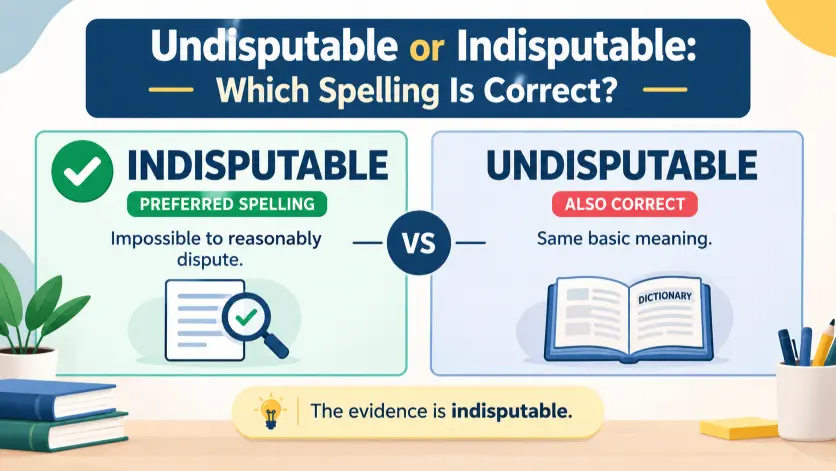
Undisputable or indisputable means impossible to reasonably dispute, deny, or question. Both are recognized English adjectives, but indisputable is the preferred spelling in most modern writing. If you are unsure which word to use in an essay, business report, blog post, or everyday conversation, indisputable is the safest choice.
Have you ever paused while writing because you could not decide if to use undisputable or indisputable? You are not alone. Both spellings look natural, and both contain the familiar word dispute. This makes it easy to assume that one must be incorrect.
The truth is that both words have essentially the same meaning, but they differ in conventional preference. Choosing the more familiar form can make your writing clearer and more consistent.
In this guide, you will learn the meaning of each word, its origin, British and American usage, and the best spelling for academic and professional writing. You will also find practical examples, common mistakes, comparison tables, and answers to frequently asked questions.
Undisputable or Indisputable: Quick Answer
Both spellings are valid, but indisputable is the better default for most readers.
- Indisputable: The more familiar and conventional choice.
- Undisputable: A recognized alternative with the same basic meaning.
- Meaning: Impossible to reasonably dispute or deny.
- Best recommendation: Use indisputable in formal writing, educational content, and professional communication.
Example 1: The report provides indisputable evidence of the change.
Example 2: Her talent as a musician is indisputable.
Example 3: The committee considered the evidence undisputable.
The third example illustrates the alternative spelling. It is not automatically incorrect simply because indisputable is more commonly preferred.
A Simple Decision Guide
| Writing situation | Recommended choice |
| School essay | Indisputable |
| University paper | Indisputable |
| Business report | Indisputable |
| Professional email | Indisputable |
| General website article | Indisputable |
| Direct quotation using the alternative spelling | Preserve the original wording |
Remember: The goal is not to suggest that undisputable is wrong. It is to choose the form that is most familiar and consistent for your audience.
What Does Indisputable Mean?
Indisputable is an adjective that describes something that cannot reasonably be questioned, denied, or challenged. It often refers to facts, evidence, results, or achievements that are strongly supported.
Indisputable Meaning in Simple English
In simple words, indisputable means so well supported that it is difficult to argue against it.
Example: The video provides indisputable evidence of what happened.
This means the video offers strong evidence supporting the statement.
Other examples include:
- The team’s progress is indisputable.
- Her contribution to the project is indisputable.
- It is an indisputable fact that the Earth orbits the Sun.
The word can describe evidence, achievements, facts, or other matters supported by convincing information.
What Does Undisputable Mean?
Undisputable is an adjective with essentially the same meaning as indisputable. Both words describe something that cannot reasonably be disputed or denied.
Example: The committee considered the evidence undisputable.
This sentence means that the committee regarded the evidence as impossible to reasonably challenge.
You can use undisputable in a sentence, but indisputable remains the recommended default if you want the more conventional wording.
Synonyms of Indisputable
Several words have similar meanings, but each carries a slightly different emphasis.
| Synonym | Meaning | Example |
| Undeniable | Impossible to deny | Her influence is undeniable. |
| Unquestionable | Not reasonably open to doubt | His commitment is unquestionable. |
| Irrefutable | Impossible to disprove with a valid argument | The researchers presented irrefutable evidence. |
| Incontestable | Not reasonably open to challenge | They established an incontestable right. |
| Incontrovertible | Not reasonably subject to dispute | The report contains incontrovertible evidence. |
| Certain | Known or accepted as true | We are certain about the date. |
Usage tip: Choose irrefutable when emphasizing evidence that cannot be disproved. Choose undeniable when emphasizing something that cannot reasonably be denied. Use indisputable when you want a familiar term for something beyond reasonable dispute.
Antonyms of Indisputable
Antonyms express the opposite idea.
- Questionable: Open to doubt.
- Debatable: Open to discussion or disagreement.
- Disputable: Capable of being challenged.
- Uncertain: Not known or established with confidence.
Example: The first report was questionable because the evidence was incomplete.
This is the opposite of describing a conclusion as indisputable.
The Origin of Indisputable and Undisputable
Indisputable is the preferred spelling in most modern English writing. It means impossible to reasonably doubt, deny, or argue against. Undisputable is also a recognized English word with the same basic meaning. Neither spelling is exclusive to British or American English. For essays, professional documents, and general content, choose indisputable unless your style guide specifies otherwise.
The history of these words explains why both spellings exist and why one is generally preferred.
Where Does Indisputable Come From?
Indisputable comes from Late Latin indisputabilis, a word formed from the negative prefix in- and a form related to the Latin verb disputare, meaning to discuss, examine, or dispute.
The word entered English in the 16th century and developed around the idea that something cannot be disputed.
Its structure can be understood in three parts:
- In-: A negative prefix meaning “not” in this word.
- Dispute: To question, challenge, or argue about something.
- -able: A suffix that expresses possibility or capability.
Together, these parts help explain why indisputable means not open to reasonable dispute.
Why Does Undisputable Also Exist?
Undisputable developed using the prefix un- with disputable. English uses both in- and un- to form negative words, but the prefixes are not freely interchangeable in every case.
For example:
- Inaccurate
- Unclear
- Incomplete
- Unfinished
These words follow established usage patterns. You cannot always choose a prefix based only on what sounds right.
The important point: Undisputable is a recognized word, but its existence does not make it the preferred spelling. For most modern writing, choose indisputable.
British English vs American English
A common misconception is that indisputable belongs to British English while undisputable belongs to American English, or vice versa.
There is no established British-versus-American spelling rule that separates these two forms. Both spellings are recognized in English, and writers in both regions can use indisputable as their standard default.
| British English | American English | Example |
| Indisputable is the preferred default | Indisputable is the preferred default | The evidence is indisputable. |
| Undisputable is a recognized alternative | Undisputable is a recognized alternative | Her talent is undisputable. |
| Follow the publisher’s style guide | Follow the publisher’s style guide | The report presents indisputable findings. |
| No special regional spelling change is needed | No special regional spelling change is needed | This is an indisputable fact. |
Regional Differences
Some English words have different standard spellings in Britain and the United States. For instance, British English often uses colour, while American English uses color.
The pair undisputable and indisputable works differently. The choice is mainly about conventional preference, not national spelling rules.
Writers in the United Kingdom, United States, Canada, and Australia can generally use indisputable without concern about regional spelling.
What About Style Guides?
A style guide helps writers maintain consistent spelling, grammar, punctuation, and formatting.
If your school, university, employer, or publisher specifies a preferred dictionary or spelling convention, follow it. Otherwise, use indisputable as your default.
Practical rule: Do not change the spelling merely because you are writing for a British or American audience. Use the more familiar form and remain consistent.
Which Version Should You Use?
The easiest solution is to choose indisputable for most writing situations. The word is widely recognized and works naturally in formal and everyday English.
United States
American writers should generally use indisputable in school assignments, news articles, business documents, and online content.
Example: The investigation uncovered indisputable evidence of the error.
United Kingdom
British writers can use indisputable as their default spelling. There is no need to substitute undisputable to make a sentence sound British.
Example: The report provides indisputable evidence of progress.
Canada
Canadian writers can follow the same recommendation. Although Canadian English combines several British and American conventions, this pair does not require a special regional choice.
Example: The committee found indisputable evidence to support its conclusion.
Australia
Australian writers can also use indisputable in formal and informal contexts.
Example: Her contribution to the project is indisputable.
International Writing
If your audience includes readers from different countries, indisputable is the practical choice. It avoids unnecessary variation and helps keep your writing familiar to a broad audience.
Example: The findings provide indisputable evidence of the change.
Academic Writing
Academic writing requires careful claims and reliable evidence. The word indisputable can sound too strong if the research is incomplete or the results remain uncertain.
Example: The repeated measurements provide indisputable evidence that the instrument’s readings changed under the tested conditions.
This sentence links the claim to a specific result. It is more precise than claiming that one small experiment proves a broad theory beyond all doubt.
Business Writing
In business reports, presentations, and professional emails, indisputable can emphasize well-supported information. However, avoid using it to make an uncertain forecast sound like a proven fact.
Example: The audited figures provide indisputable evidence of the recorded sales total.
For a prediction, a more cautious sentence may be better:
“The current figures suggest that sales may increase next quarter.”
Key advice: Choose indisputable as the default, but make sure the strength of your wording matches the strength of your evidence.
Common Mistakes with Undisputable and Indisputable
Knowing both definitions is helpful, but writers can still make mistakes when choosing between the words or using them in a sentence.
Mistake 1: Calling Undisputable Completely Incorrect
Incorrect claim: “Undisputable is not a real English word.”
Correct explanation: Undisputable is a recognized English word with essentially the same meaning as indisputable.
Although indisputable is the more conventional choice, you should not mark undisputable as automatically incorrect.
Memory tip: Both forms are valid, but one is the safer default.
Mistake 2: Assuming the Words Have Different Meanings
Incorrect claim: “Indisputable means true, while undisputable means open to debate.”
Correct explanation: Both words describe something that cannot reasonably be disputed.
Example: Her qualifications are indisputable.
Example: Her qualifications are undisputable.
Both sentences communicate essentially the same meaning.
Mistake 3: Using Indisputable for Weak Evidence
Weak sentence: “One person’s opinion is indisputable proof that the new policy works.”
Better sentence: “One person’s opinion suggests that the new policy may work.”
The first sentence makes a strong claim without enough support. The second more accurately reflects limited evidence.
Memory tip: Strong words require strong support.
Mistake 4: Confusing Indisputable with Indispensable
These words look similar, but their meanings are different.
- Indisputable: Impossible to reasonably dispute.
- Indispensable: Absolutely necessary or essential.
Example: The evidence is indisputable, and the safety equipment is indispensable.
The evidence cannot reasonably be challenged, while the equipment is necessary.
Mistake 5: Using the Adjective Instead of the Adverb
Incorrect: “The findings are indisputable clear.”
Correct: “The findings are indisputably clear.”
Indisputable is an adjective. Indisputably is an adverb.
Compare these sentences:
- Adjective: The conclusion is indisputable.
- Adverb: The conclusion is indisputably correct.
Memory tip: Use indisputable to describe something and indisputably to modify a quality or statement.
Mistake 6: Treating Every Strong Claim as a Fact
A confident sentence is not necessarily an accurate sentence. Calling a claim indisputable does not make the evidence stronger.
Example: “The survey proves that every customer prefers this product.”
If the survey included only a small group, the claim may be too broad.
Better example: “The survey suggests that many participants prefer this product.”
Use words such as suggests, indicates, or supports when the available evidence does not justify absolute certainty.
Everyday Examples of Indisputable and Undisputable

These examples show how both spellings can appear in different kinds of writing.
Emails
Example: The attached records provide indisputable evidence of the completed payment.
Example: The documents offer undisputable proof that the transaction took place.
Both sentences are understandable. For a professional email, indisputable is the recommended default.
Business Writing
Example: The audited figures provide indisputable evidence of the company’s reported revenue.
This sentence works when the records support the claim. If the figures are preliminary, use more cautious wording.
News Headlines
Example: New Records Provide Indisputable Evidence of Change
Example: The Athlete’s Indisputable Impact on the Team
The word can add emphasis to a headline, but journalists should avoid presenting disputed claims as established facts.
Blogs
Example: The learner’s improvement is indisputable after months of consistent practice.
The word emphasizes a visible change. Make sure the surrounding article provides enough context to support the claim.
Social Media
Example: Her dedication to her craft is indisputable!
Example: His contribution to the team’s success is indisputable.
Both sentences sound natural in a caption or short post.
Academic Writing
Example: The repeated measurements provide indisputable evidence that the readings changed under the tested conditions.
Example: The results suggest a possible relationship between the two variables.
The first statement is suitable only if the data justify that level of certainty. The second is more cautious and may be appropriate when further research is needed.
Daily Conversation
Example: Her talent is indisputable.
Example: That is an undisputable fact.
Both forms can appear in conversation. If you are unsure which one to use, choose indisputable.
Google Trends and Modern Usage
The search query “undisputable or indisputable” reflects a common spelling question: when two forms look correct, how can you decide which one to use?
Which Spelling Is More Popular?
Indisputable is the more conventional choice in modern English. Major dictionaries provide established definitions and examples for this form, while also recognizing undisputable as an alternative.
However, an exact numerical comparison of their current search popularity should not be invented without checking Google Trends data directly.
How to Compare Their Search Interest
- Enter indisputable and undisputable as separate search terms.
- Select the same time period for both.
- Choose a region, such as the United States or worldwide.
- Compare their relative search-interest graphs.
- Check if either term has insufficient data.
Google Trends uses a normalized scale from 0 to 100. Its values show relative search interest rather than exact search counts.
Why Do People Search for These Words?
Several reasons explain the confusion:
- Similar appearance: Both words contain disputable.
- Different prefixes: English uses both in- and un- to form negative words.
- Dictionary uncertainty: Readers may assume that only one form can be correct.
- Writing confidence: Students and professionals want to avoid spelling errors.
- Search optimization: Bloggers want to use the spelling readers expect.
Quick Comparison Table
| Version | Meaning | Correct? | Region | Example |
| Indisputable | Impossible to reasonably dispute | Yes | International English | The evidence is indisputable. |
| Undisputable | Impossible to reasonably dispute | Yes | International English | Her talent is undisputable. |
| Indisputably | In a way that cannot reasonably be disputed | Yes | International English | The result is indisputably important. |
| Indisputability | The quality of being indisputable | Yes | International English | The claim’s indisputability was questioned. |
The first two forms are adjectives. Indisputably is an adverb, while indisputability is a noun.
The main takeaway: The difference between indisputable and undisputable is primarily one of conventional preference, not meaning or regional spelling.
Key Takeaways
- Indisputable is the recommended spelling for most modern English writing.
- Undisputable is also a recognized English word, not automatically a spelling mistake.
- Both words mean impossible to reasonably dispute, deny, or question.
- Neither spelling is exclusive to British or American English.
- Use indisputable as your default in academic writing, business documents, emails, and website content.
- Match strong language to the strength of your evidence.
- Indisputably is the adverb form, while indisputability is a noun.
- Check a reputable dictionary or your organization’s style guide when in doubt.
Frequently Asked Questions
Q1. Is undisputable or indisputable correct?
Both spellings are correct. Indisputable is the more conventional choice for most modern English writing, while undisputable is a recognized alternative. Both words have essentially the same meaning. For essays, business reports, and professional content, choose indisputable unless your preferred dictionary or style guide recommends otherwise.
Q2. Is undisputable a real word?
Yes. Cambridge Dictionary recognizes undisputable and defines it as something that cannot be argued about or disagreed with. It also lists indisputable as a synonym. Although undisputable is less commonly preferred, it should not automatically be marked as incorrect.
Q3. What does indisputable mean in simple words?
Indisputable means impossible to reasonably doubt, deny, or argue against. For instance, “The video provides indisputable evidence” means that the video offers strong evidence supporting the claim. The word commonly describes facts, evidence, achievements, and results that are difficult to challenge.
Q4. Do indisputable and undisputable mean the same thing?
Yes. Both words describe something that cannot reasonably be disputed. There is no established difference in meaning that requires you to use them in separate situations. The difference is mainly conventional preference: indisputable is the recommended default for most modern writing, while undisputable remains an acceptable alternative.
Q5. Is indisputable British or American English?
Indisputable is used in both British and American English. It is not exclusive to either country. Undisputable is also recognized in English, so writers do not need to change between these spellings when addressing British or American audiences. Use indisputable as your default for broad readership.
Q6. What is a synonym for indisputable?
Common synonyms include undeniable, unquestionable, irrefutable, incontestable, and incontrovertible. Each has a slightly different emphasis. For example, irrefutable focuses on evidence or reasoning that cannot be disproved, while undeniable emphasizes something that cannot reasonably be denied.
Q7. What is the opposite of indisputable?
Common opposites include questionable, debatable, disputable, and uncertain. The best choice depends on the sentence. If a claim is open to reasonable disagreement, debatable may be appropriate. If its truth is unclear, uncertain may express the meaning more accurately.
Q8. How do you use indisputable in a sentence?
Use indisputable as an adjective to describe a noun or follow a linking verb. For instance, “The researcher presented indisputable evidence” places the adjective before the noun evidence. You can also write, “Her contribution is indisputable.” In both sentences, the word emphasizes that the evidence or contribution cannot reasonably be challenged.
Q9. Is indisputably the same as indisputable?
No. Both words share the same root, but they have different grammatical roles. Indisputable is an adjective, as in “indisputable evidence.” Indisputably is an adverb, as in “The result is indisputably important.” Use the form that fits your sentence structure.
Q10. How can I remember the correct spelling?
Remember the common phrase “indisputable evidence.” It is a familiar expression in formal writing, journalism, and everyday English. When you are unsure, choose indisputable as your default. Keep in mind that undisputable is also a valid word, even though it is less commonly preferred.
Conclusion
The choice between undisputable and indisputable becomes easy once you understand that both words have essentially the same meaning. They describe something that cannot reasonably be disputed, denied, or questioned. The main difference is that indisputable is the more conventional spelling and the better default for most modern English writing.
If you are writing a school assignment, a university essay, a professional email, a business report, or a blog post, indisputable is a safe and familiar choice. Writers in British, American, Canadian, and Australian English can use it without needing a regional spelling change.
However, correct spelling is only part of good writing. The word itself expresses a strong level of certainty, so use it only when the evidence supports that claim. If the information is incomplete or the conclusion remains open to debate, words such as suggests, likely, or debatable may be more accurate.
For more explanations of confusing English words, explore other grammar guides on Wordvexa.com.
Remember: Both spellings are valid, but when in doubt, choose indisputable.
You May Also Like:
- 13rd or 13th? Learn the Easy Rule for Using 13th
- Drily or Dryly: Which Spelling Is Correct?
- Stolen or Stollen: One Is a Crime, One Is a Cake

I’m Claire Morgan, the author behind wordvexa.com, where I write about English grammar, sentence structure, punctuation, and everyday language. My goal is to make grammar simple, clear, and practical, helping readers understand the rules and apply them with confidence in real-world writing.