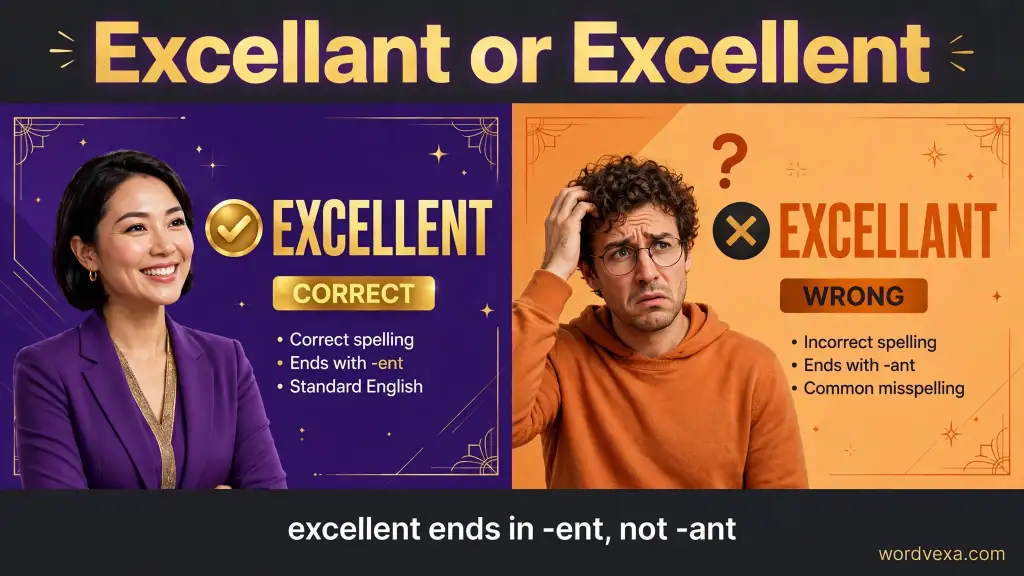
Excellent is the correct spelling, and it means very good or extremely high in quality. Excellant is a common spelling mistake that you should avoid in school, work, emails, and formal writing.
Many people search for “excellant or excellent” because both spellings sound similar when spoken. However, only one is the standard English spelling.
The word excellent is used to praise a person, describe great work, or show that something is better than expected. For example, you can say, “She did an excellent job” or “The food was excellent.” In both sentences, the word shows a high level of quality.
The confusion often happens because English words do not always follow simple spelling rules. People may add an “a” before the final letters because they are unsure how to spell the word.
In this guide, you will learn the meaning, origin, and correct use of excellent. You will also see common spelling mistakes, easy examples, and the difference between British and American English. By the end, you will know how to spell and use this useful word with confidence.
Excellant or Excellent: Quick Answer
Excellent is the correct spelling in both British and American English. Excellant is incorrect.
- Correct: Your work is excellent.
- Incorrect: Your work is excellant.
- Correct: She received excellent marks.
- Incorrect: She received excellant marks.
Use excellent when you want to describe something as very good, outstanding, or of a very high standard.
Quick Comparison
| Word | Correct or Incorrect? | Meaning |
| Excellent | Correct | Extremely good |
| Excellant | Incorrect | No standard English meaning |
Easy tip: Remember the ending -ent in excellent, not -ant.
Definition and Meaning of Excellant or Excellent
What Does Excellent Mean?
Excellent is an adjective that describes someone or something of very high quality. It can refer to great work, strong performance, good service, or outstanding results.
Simple meaning: Very good or outstanding.
Examples:
- She is an excellent teacher.
- The restaurant offers excellent service.
- He gave an excellent answer.
- We had an excellent day.
In each example, excellent tells us that the person, service, answer, or experience is very good.
How Is Excellent Used?
The word excellent can describe many things in everyday English.
1. People and skills
Use excellent to describe someone who performs a task very well.
Example: He is an excellent football player.
2. Work and results
Use it to praise good work or strong results.
Example: You did an excellent job on this project.
3. Products and services
Use it when something has a very high standard.
Example: This phone has excellent battery life.
4. Experiences and situations
Use it to describe a very enjoyable or positive experience.
Example: We had an excellent holiday.
Is Excellant Ever Correct?
No. Excellant is not the standard spelling of this word in modern English. It is a misspelling of excellent.
If you see excellant in a message, essay, website, or document, change it to excellent.
The Origin of Excellant or Excellent
The correct word excellent has a long history. It comes from the Latin word excellere, which means to rise above, surpass, or stand out.
The word entered English through Old French and developed into the form we use today. Over time, excellent became a common way to describe people, actions, and things that stand above an ordinary standard.
Its spelling reflects its historical development. The ending -ent is part of the established English form.
The incorrect spelling excellant may occur because people confuse the endings -ent and -ant. Both endings appear in English words, such as different, important, assistant, and pleasant. However, they are not interchangeable.
For example:
- Excellent is correct.
- Excellant is incorrect.
- Important is correct.
- Importent is incorrect.
The main lesson is simple: English spelling depends on the accepted form of each word, not only on how it sounds.
British English vs American English Spelling
There is no spelling difference between British and American English for this word. Both use excellent.
Some English words have different spellings across regions. For example, British English often uses colour, while American English uses color. However, excellent keeps the same spelling in both varieties.
British and American Spelling Comparison
| Feature | British English | American English |
| Correct spelling | Excellent | Excellent |
| Incorrect spelling | Excellant | Excellant |
| Meaning | Very good | Very good |
| Pronunciation | Similar | Similar |
| Example | An excellent result | An excellent result |
Examples in Both Varieties
British English: The students achieved excellent results in their exams.
American English: The students achieved excellent results on their exams.
Notice that the spelling of excellent stays the same. Other words in a sentence may vary by region, but this word does not.
Which Spelling Should You Use?
You should always use excellent, regardless of your audience or location.
For American Readers
Use excellent in school assignments, business emails, reports, and everyday writing.
Example: Your presentation was excellent.
For British and Commonwealth Readers
Use the same spelling in the United Kingdom and other countries that follow British English conventions, including Pakistan.
Example: She provided excellent customer service.
For Global and Online Writing
Use excellent for websites, blogs, social media posts, product descriptions, and international business communication.
Example: Discover excellent tips for improving your English.
For Students and English Learners
Learn the spelling as a complete word rather than guessing its ending.
A helpful memory trick is:
EXCELL + ENT = EXCELLENT
Remember the final three letters: E-N-T.
This simple method can help you avoid the common mistake of writing excellant.
Common Mistakes with Excellant and Excellent
Many writers make spelling errors when two words or letter patterns sound similar. Here are common mistakes and ways to correct them.
Mistake 1: Writing Excellant
Incorrect: She is an excellant student.
Correct: She is an excellent student.
Always use excellent when describing someone or something as very good.
Mistake 2: Using the Wrong Ending
Some people write excellant because they confuse -ant with -ent.
Incorrect: The company provides excellant support.
Correct: The company provides excellent support.
Remember that the correct ending is -ent.
Mistake 3: Typing Too Quickly
Typing quickly can lead to spelling errors, especially in emails and social media posts.
Incorrect: Thank you for your excellant service.
Correct: Thank you for your excellent service.
Check your writing before sending an important message.
Mistake 4: Trusting Every Spell-Checker Suggestion
Spell-checking tools are helpful, but you should still understand the correct spelling. A tool may miss an error in some situations or fail to explain why a word is wrong.
Read the sentence carefully and confirm that excellent is the word you intend to use.
Mistake 5: Confusing Excellent with Excellently
These words are related, but they serve different grammatical roles.
- Excellent: An adjective. She is an excellent writer.
- Excellently: An adverb. She writes excellently.
Use excellent to describe a noun. Use excellently to describe an action.
Excellent or Excellant in Everyday Examples
The word excellent is common in many types of writing. Here is how to use it correctly in daily life.
In Emails
Use excellent to praise work, thank someone, or respond positively.
Example:
“Thank you for your help. You provided excellent support throughout the project.”
In News and Reports
Writers may use excellent to describe strong performance or high standards.
Example:
“The team delivered an excellent performance in the final match.”
On Social Media
The word can express excitement, approval, or praise.
Example:
“Had an excellent weekend with friends!”
In Formal Writing
Use excellent when describing quality, results, or professional performance.
Example:
“The candidate demonstrated excellent communication skills during the interview.”
In School Assignments
Students can use the word to describe strong work or positive results.
Example:
“Ali received excellent marks in mathematics.”
In Product Reviews
Use excellent to explain why a product or service deserves praise.
Example:
“This laptop offers excellent performance for everyday tasks.”
These examples show that excellent works in both formal and informal contexts. In every case, the spelling remains the same.
Excellant or Excellent: Google Trends and Usage Data
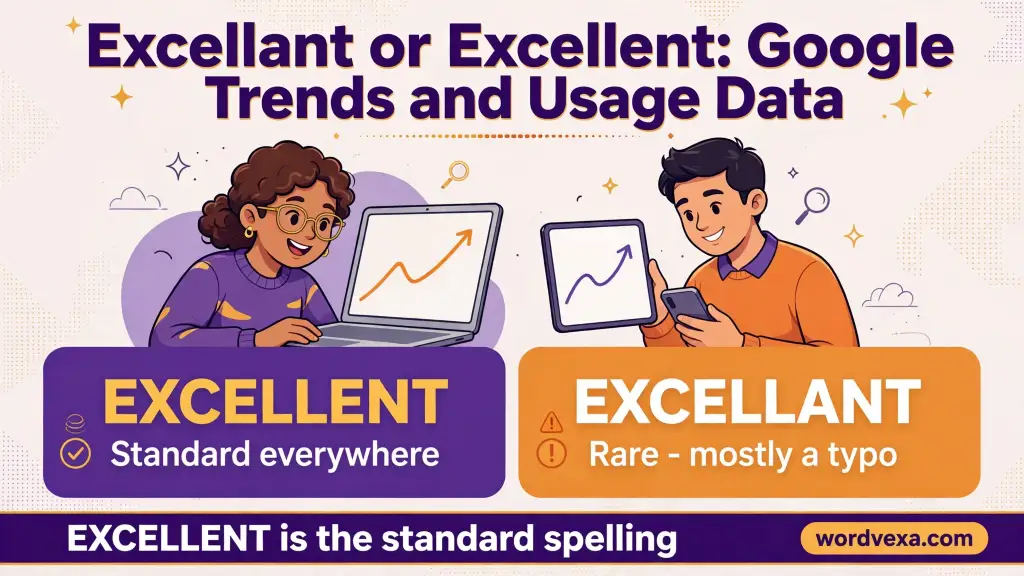
People search for “excellant or excellent” because they want to confirm which spelling is correct. Similar searches often happen when a word has a familiar sound but an uncertain spelling.
However, exact search popularity can change over time and across countries. Without a current Google Trends comparison, it would not be accurate to claim exact search volumes or rank countries by popularity.
Why Do People Search for This Keyword?
1. Spelling confusion
The endings -ant and -ent can sound similar, making the correct form difficult to remember.
2. School and exam preparation
Students often check spelling when writing essays, answering questions, or preparing assignments.
3. Professional communication
Employees and business owners want to avoid spelling mistakes in emails, reports, and customer messages.
4. English learning
People learning English may search for two similar spellings to understand which one is accepted.
Which Countries May Search for This Term?
English spelling questions can come from users in the United States, the United Kingdom, Pakistan, India, Canada, Australia, and other English-speaking or English-learning communities. This list describes possible audiences, not a verified ranking of search interest.
How to Check Current Google Trends Data
You can compare the search terms using google trends. Select a country, choose a time range, and compare the two spellings.
Remember that Google Trends reports relative search interest, not exact monthly search counts. A spelling question may receive searches even when one option is clearly incorrect.
The practical takeaway is that excellent is the accepted spelling worldwide.
Excellant vs Excellent: Comparison Table
The table below summarizes the key differences between the two spellings.
| Feature | Excellant | Excellent |
| Spelling status | Incorrect | Correct |
| Standard English word | No, not in this intended sense | Yes |
| Meaning | No standard meaning intended here | Very good or outstanding |
| Part of speech intended | Adjective | Adjective |
| British English | Incorrect | Correct |
| American English | Incorrect | Correct |
| Suitable for formal writing | No | Yes |
| Example | Excellant work | Excellent work |
Remember: When you want to praise someone or describe something as very good, write excellent.
Frequently Asked Questions
Q1. Is excellant or excellent correct?
Excellent is correct. Excellant is a misspelling. Use excellent in all standard English writing.
Q2. Why do people spell excellent as excellant?
People may confuse the endings -ent and -ant because they can sound similar. Remember that excellent ends in -ent.
Q3. Is excellent spelled differently in British and American English?
No. Both British and American English use excellent. There is no regional spelling difference.
Q4. What does excellent mean in simple words?
Excellent means very good, outstanding, or of a very high quality.
Example: The teacher gave an excellent lesson.
Q5. How do you use excellent in a sentence?
Use excellent before a noun or after a linking verb.
Examples:
- She is an excellent doctor.
- The food was excellent.
- They delivered excellent results.
Q6. Is excellant a real English word?
Excellant is not the standard English spelling of the adjective meaning very good. The correct word is excellent.
Q7. What is an easy way to remember excellent?
Remember the final letters E-N-T. You can also practise the word in a sentence: “Excellent work deserves praise.”
Conclusion: Excellant or Excellent?
When choosing between excellant and excellent, always use excellent. It is the correct spelling in British English, American English, and standard international English. The spelling excellant is a common mistake and should not be used in formal or professional writing.
The word excellent means very good, outstanding, or of a high standard. You can use it to describe people, skills, work, services, products, results, and experiences. For example, “She is an excellent teacher” and “The service was excellent” are both correct sentences.
Remember that the word ends in -ent, not -ant. This small spelling detail can help you avoid errors in school assignments, business emails, website content, and everyday messages.
There is no need to learn separate British and American spellings for this word because both varieties use the same form. If you are unsure, check the word in a trusted dictionary or use a spell-checking tool.
The key takeaway is simple: Excellent is correct; excellant is incorrect. Learn the right spelling, practise it in sentences, and use it with confidence whenever you want to describe something as very good.
Explore More Articles:
- Realy or Really? The Spelling Mistake Everyone Makes
- Barista or Barrista: The Double-Letter Trap to Remember
- Pidgeon or Pigeon: The Silent Letter Trap to Remember

I’m Sloane Mercer, a U.S.-based English language writer focused on grammar, spelling, vocabulary, and everyday English usage. Through Wordvexa, I provide clear and practical explanations to help readers choose the right words and communicate with confidence.



1 thought on “Excellent or Excellant: The One-Vowel Mistake to Avoid ”