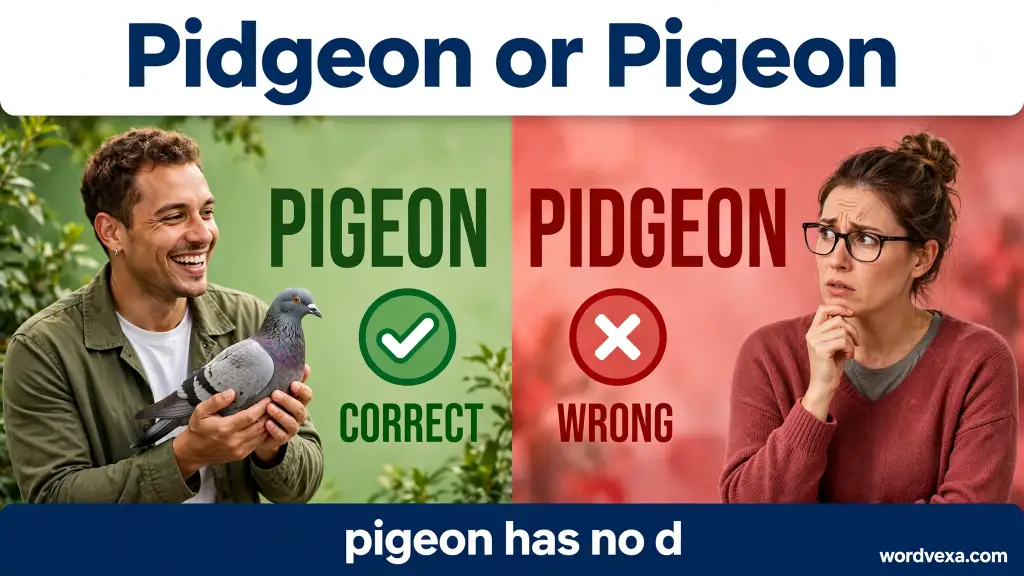
Pidgeon or pigeon is a common spelling question, and pigeon is the correct spelling for a bird often seen in parks, streets, and gardens.
The word pigeon means a bird belonging to the family Columbidae, which also includes doves. The spelling pidgeon is incorrect when referring to this bird.
Many people search for pidgeon or pigeon because English spelling can be confusing. The sound of the word may remind learners of words such as bridge and judge, leading them to add an unnecessary “d.” However, the correct spelling is always pigeon, in both British and American English.
Knowing the right spelling helps you avoid mistakes in school assignments, emails, website articles, and everyday writing. It also makes your content clearer and more professional. If you are a student, teacher, writer, or English learner, remembering this simple rule can improve your spelling skills.
In this guide, you will learn the meaning, origin, correct usage, common mistakes, and examples of pigeon so you can confidently use the word in any context.
Pidgeon or Pigeon: Quick Answer
Pigeon is the correct spelling in standard English. Pidgeon is a misspelling of the bird’s name.
Examples:
- Correct: A pigeon sat on the roof.
- Incorrect: A pidgeon sat on the roof.
- Correct: We saw a group of pigeons in the park.
- Incorrect: We saw a group of pidgeons in the park.
Remember this simple rule: Pigeon has no “d.”
The correct plural form is pigeons, and the word is spelled the same way in both American and British English.
Definition and Meaning of Pidgeon or Pigeon
What Does Pigeon Mean?
A pigeon is a bird belonging to the bird family Columbidae, which also includes doves. Pigeons live in many parts of the world. Some live in cities, while others live in forests, fields, and other natural areas.
Simple Meaning
In simple words, a pigeon is a bird that is often seen walking on the ground or flying around buildings.
Examples:
- A pigeon landed near my window.
- The children fed the pigeons in the park.
- A white pigeon flew over the garden.
Context and Usage
The word pigeon is used in different settings.
1. Everyday conversation: People use the word when talking about birds they see around them.
Example: There is a pigeon on our balcony.
2. Nature and science: The word can describe a bird species or a group of related birds.
Example: Pigeons can find their way home over long distances.
3. Figurative language: The phrase “stool pigeon” can refer to an informer, especially in crime-related contexts. The word can also appear in expressions such as “pigeonhole,” which means to place someone or something into a fixed category.
Example: Do not pigeonhole people based on their jobs.
These meanings show that pigeon can be used in both literal and figurative ways.
The Origin of Pigeon
The word pigeon has a long history in the English language. It came into English through Old French, where the word pijon was used for a young bird. The French form developed from the Latin word pipio, which referred to a young bird or a bird’s chirping sound.
Over time, the spelling changed as the word became established in English. The modern spelling is pigeon, and it has been used for centuries.
Why Do People Write Pidgeon?
The spelling pidgeon is likely influenced by the way people hear and pronounce the word. English has many words in which the letters “dge” represent the sound /j/, as in bridge, judge, and badge.
Because of this pattern, some writers mistakenly add a “d” to pigeon. However, the correct spelling does not follow that pattern.
Remember: The word is pigeon, not pidgeon. The pronunciation may sound similar to other words, but the spelling must be learned as it is.
British English vs American English Spelling
There is no spelling difference between British and American English for this word. Both varieties use pigeon.
Some English words have different spellings in the United States and the United Kingdom. For example, Americans often write color, while British writers use colour. However, pigeon follows the same spelling rule in both countries.
Comparison Table
| Feature | American English | British English |
| Correct spelling | Pigeon | Pigeon |
| Incorrect spelling | Pidgeon | Pidgeon |
| Singular | Pigeon | Pigeon |
| Plural | Pigeons | Pigeons |
| Example | A pigeon is on the roof. | A pigeon is on the roof. |
Examples in Both Varieties
American English: I saw a pigeon outside my school.
British English: I saw a pigeon outside my school.
Both sentences are correct. You do not need to change the spelling for a British or American audience.
Pidgeon and Pigeon: Which Spelling Should You Use?
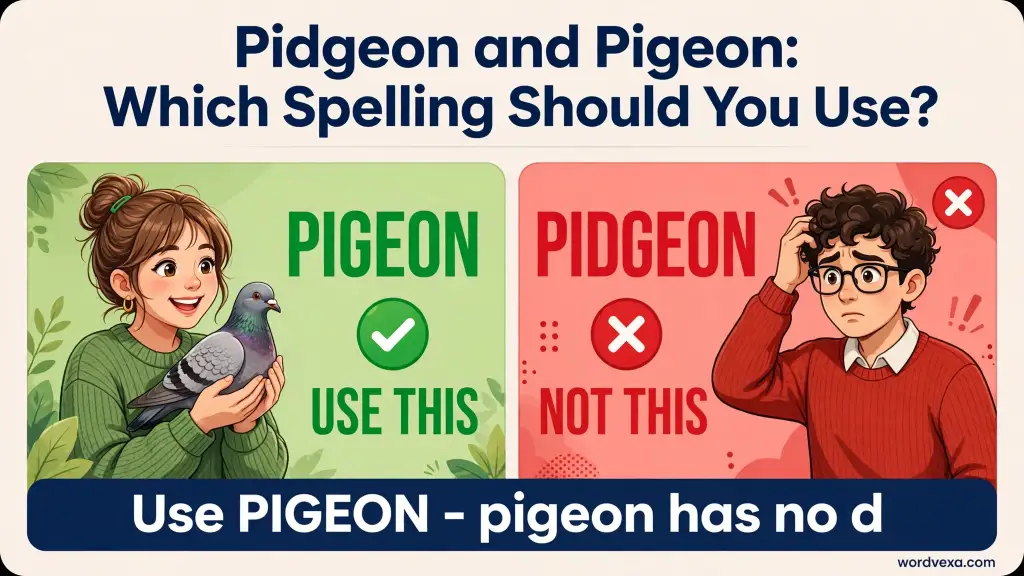
The answer is simple: use pigeon in every type of standard English writing.
For American Readers
If you are writing for readers in the United States, use pigeon. The spelling is standard in school assignments, newspapers, websites, and professional documents.
Example: The pigeon flew across the street.
For British and Commonwealth Readers
Readers in the United Kingdom and other Commonwealth countries also use pigeon. There is no regional spelling change to remember.
Example: A pigeon landed on the garden wall.
For Global English
If your audience comes from different countries, pigeon is the correct choice. It is recognized in standard English around the world.
This makes the word easy to use in international articles, educational resources, emails, and social media posts.
Professional advice: If you are unsure about the spelling, check a trusted dictionary. Do not add a “d” simply because another word has a similar sound.
Common Mistakes with Pidgeon or Pigeon
Writers often make spelling errors when a word does not match the spelling pattern they expect. Here are some common mistakes and ways to avoid them.
1. Writing Pidgeon Instead of Pigeon
Incorrect: A pidgeon is sitting on the wall.
Correct: A pigeon is sitting on the wall.
The incorrect form adds an unnecessary “d.”
2. Using Pidgeons as the Plural
Incorrect: Many pidgeons live in the city.
Correct: Many pigeons live in the city.
To form the plural, add “s” to pigeon.
3. Assuming British English Uses Pidgeon
Incorrect: Pidgeon is the British spelling.
Correct: Pigeon is used in both British and American English.
There is no regional spelling difference.
4. Confusing Pigeons with Doves
Pigeons and doves belong to the same bird family. Their names can overlap in everyday use, and there is no strict scientific rule that always separates the two terms by size.
Example: The dove rested beside the pigeon.
Both words are correctly spelled, but they may refer to different kinds of birds.
5. Forgetting the Correct Spelling in Formal Writing
Incorrect: I noticed a pidgeon near the office.
Correct: I noticed a pigeon near the office.
In formal writing, spelling errors can make your work look less polished. Always proofread your text before sending or publishing it.
Pigeon in Everyday Examples
The word pigeon appears in daily conversations, news reports, emails, and educational writing. These examples show how to use it correctly.
1. In Emails
Example:
Subject: Birds Near the Office
Hello,
I noticed a pigeon near the office entrance this morning. Please be careful when opening the main door because the bird may be resting nearby.
Thank you.
2. In News Writing
Example: Several pigeons gathered in the city square as visitors walked through the area.
News writers use pigeon when reporting on birds, wildlife, city life, or animal-related events.
3. On Social Media
Example: A beautiful pigeon visited my balcony today!
Example: Watching pigeons fly across the sky is a peaceful way to start the morning.
The word is common in captions, posts, and casual conversations.
4. In Schoolwork
Example: A pigeon is a bird with feathers, wings, and a beak.
Students can use this simple sentence in school assignments about animals.
5. In Formal Writing
Example: The study examined the movement patterns of urban pigeons.
This sentence is suitable for an educational or scientific context.
6. In Everyday Conversation
Example: Did you see the pigeon sitting near the bus stop?
This is a natural way to use the word when speaking with friends or family.
Pigeon and Pidgeon: Google Trends and Usage Data
People may search for pidgeon or pigeon when they are unsure about the correct spelling. However, the misspelling does not become correct simply because people use it in searches.
Which Spelling Is More Common?
Pigeon is the standard dictionary spelling and the appropriate form for published writing. Pidgeon is a spelling error when someone intends to refer to the bird.
Search interest can vary by country, language background, and context. For example, students learning English may search for spelling comparisons, while bird enthusiasts may search for information about pigeon species.
Popularity by Country
English-language searches may come from the United States, the United Kingdom, Canada, Australia, Pakistan, and other countries. However, the amount of search interest can change over time.
Without a current Google Trends comparison, it would be misleading to give exact search volumes, percentages, or country rankings.
Why Do People Search for Both Spellings?
There are several likely reasons:
- They hear the word but are unsure how to spell it.
- They confuse pigeon with words such as bridge and judge.
- They want to correct a spelling mistake.
- They are writing a school assignment, article, or social media post.
- They want to check if British and American English use different forms.
For content writing, the best approach is to include the exact search phrase pidgeon or pigeon in the title and explain the correct spelling early in the article. This answers the reader’s question without suggesting that both forms are correct.
Pidgeon vs Pigeon: Comparison Table
The following table summarizes the key differences between the two forms.
| Feature | Pidgeon | Pigeon |
| Spelling status | Misspelling | Correct spelling |
| Meaning | No standard meaning as the bird’s name | A type of bird |
| Dictionary form | Not the standard form | Standard English word |
| American English | Incorrect for the bird | Correct |
| British English | Incorrect for the bird | Correct |
| Plural form | Pidgeons is incorrect | Pigeons is correct |
| Formal writing | Avoid | Use |
| Example | A pidgeon sat outside. | A pigeon sat outside. |
Key takeaway: Always use pigeon when referring to the bird. The spelling pidgeon should be corrected in standard English writing.
Frequently Asked Questions
Q1. Is it spelled pidgeon or pigeon?
The correct spelling is pigeon. The form pidgeon is a common misspelling.
Q2. Is pidgeon ever correct?
Not as the standard spelling of the bird’s name. If you mean the bird, use pigeon. A similar spelling might appear in a proper name, but that does not make it the standard word.
Q3. Why do people spell pigeon as pidgeon?
People may add a “d” because they associate the sound with words such as bridge and judge. However, the correct spelling is pigeon.
Q4. Is pigeon spelled differently in British and American English?
No. Both British and American English use pigeon. There is no regional spelling difference.
Q5. What is the plural of pigeon?
The plural is pigeons.
Example: Three pigeons were sitting on the roof.
Q6. How do you pronounce pigeon?
It is commonly pronounced PIJ-un, with the first syllable stressed. Pronunciation may vary slightly by accent.
Q7. Is pigeon a bird or a dove?
A pigeon is a bird in the family Columbidae, which also includes doves. The terms overlap, and their everyday use varies by species and context.
Conclusion
When choosing between pidgeon or pigeon, always use pigeon. It is the correct spelling in standard English, while pidgeon is a common spelling mistake. The word refers to a bird found in many parts of the world, especially in towns, cities, parks, and gardens.
The good news is that you do not need to learn separate British and American spellings. Both varieties use pigeon for the singular and pigeons for the plural. This rule applies to schoolwork, emails, social media posts, news articles, and formal writing.
The spelling error often happens because people expect a “d” before the “g,” as seen in words such as bridge. However, the correct form contains no “d.” Remembering this small detail can help you avoid mistakes and improve your writing.
If you are writing for a website, proofreading an assignment, or preparing a professional document, choose pigeon every time. When in doubt, consult a trusted dictionary and check the spelling before publishing.
Learning small spelling rules like this one can make your English clearer, more accurate, and easier to understand.
Discover More Articles:
- Realy or Really? The Spelling Mistake Everyone Makes
- Barista or Barrista: The Double-Letter Trap to Remember
- Excellent or Excellant: The One-Vowel Mistake to Avoid

I’m Sloane Mercer, a U.S.-based English language writer focused on grammar, spelling, vocabulary, and everyday English usage. Through Wordvexa, I provide clear and practical explanations to help readers choose the right words and communicate with confidence.