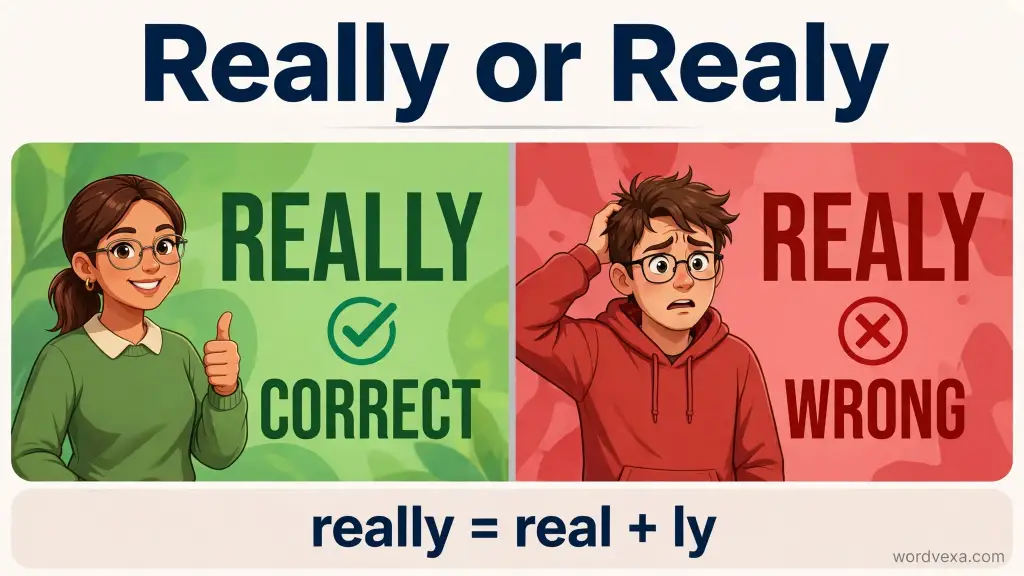
The correct spelling is really, which means truly, very, or in fact; realy is a misspelling. People often search for “really or realy” because the word sounds like it may need only one l at the end.
However, standard English always uses two ls in really. Knowing the correct spelling helps you write clear emails, school assignments, social media posts, and professional documents.
The word really is common in daily English. You can use it to show that something is true, add emphasis, or express surprise. For example, “I really like this book” shows a strong feeling, while “Is that really true?” asks if something is true. These uses make the word useful for both casual and formal communication.
The spelling can seem tricky because the word comes from real, which has one l. When we add the suffix -ly, the final l in real stays, and the suffix adds another l. This creates really, not realy. The same pattern appears in words such as usually and finally, although each word follows its own spelling pattern. In this guide, you will learn the meaning, origin, spelling rules, common mistakes, and practical uses of really so you can write it correctly every time.
Really or Realy: Quick Answer
Really is the correct spelling in standard English. Realy is incorrect and should not be used in formal or informal writing.
- Correct: I really enjoyed the movie.
- Incorrect: I realy enjoyed the movie.
- Correct: Are you really coming today?
- Incorrect: Are you realy coming today?
Easy rule: Always write really with two ls.
Definition and Meaning of Really or Realy
What Does Really Mean?
Really is an adverb that means truly, actually, or very. It can describe how strongly someone feels about something or ask if something is true.
Simple Meaning
In simple words, really means truly, in fact, or very much, depending on the sentence.
Examples:
- I really need your help. (I need your help very much.)
- She is really kind. (She is very kind.)
- Did he really say that? (Did he actually say that?)
Context and Usage
The word really has several common uses.
1. To show truth
Use really when you want to say that something is true.
Example: I really live near the school.
2. To add emphasis
Use it to make an adjective or feeling stronger.
Example: This cake is really good.
3. To express surprise
Use it when something is unexpected or hard to believe.
Example: You won the prize? Really?
4. To ask for confirmation
Use it when you want to check if something is true.
Example: Are you really leaving tomorrow?
Is Realy Ever Correct?
No. Realy is not a standard English spelling. It may appear in typing errors, spelling mistakes, or unedited online posts, but the correct form is always really.
The Origin of Really
The word really comes from the word real, which developed through French from the Latin word realis, meaning “actual” or “relating to a thing.”
The word real describes something that exists or is true. English speakers form the adverb really by adding the suffix -ly. This changes the word so it can describe an action, quality, or statement.
For example:
- Real → a real story
- Really → a really good story
The spelling keeps the final l in real and adds the l from -ly. As a result, the word has two ls.
The spelling difference between really and realy does not reflect two different historical forms. Instead, realy is a common error caused by leaving out one letter.
British English vs American English Spelling
British and American English use the same spelling: really.
Unlike words such as colour and color, this word does not change between the two major forms of English.
| Feature | British English | American English |
| Correct spelling | Really | Really |
| Incorrect spelling | Realy | Realy |
| Meaning | Truly, actually, or very | Truly, actually, or very |
| Example | I really like this book. | I really like this book. |
| Pronunciation | Similar standard pronunciation | Similar standard pronunciation |
Why Is the Spelling the Same?
The spelling of really is stable in both British and American English. Differences between these varieties often involve words ending in -our/-or or -ise/-ize, but really is not one of them.
Tip: If you write for a British, American, Canadian, Australian, or international audience, use really.
Which Spelling Should You Use?
The choice is simple because only one spelling is correct.
For American Readers
Use really in schoolwork, business emails, reports, and everyday writing.
Example: I really appreciate your support.
For British and Commonwealth Readers
Use really in essays, letters, websites, and professional documents. The spelling does not change in British English.
Example: The new library is really useful.
For a Global Audience
Use really in international communication, online articles, educational content, and social media posts.
Example: This guide is really helpful for English learners.
For Formal Writing
Although really is correct, words such as very, truly, or indeed may sometimes sound more precise, depending on the sentence.
Example: The results are truly impressive.
However, there is no need to avoid really simply because you are writing formally. Choose the word that best fits your meaning and tone.
Common Mistakes with Really or Realy
Writers often make spelling mistakes when a word’s pronunciation does not make every letter clear. Here are common errors and how to fix them.
Mistake 1: Writing Realy
Incorrect: I realy like your idea.
Correct: I really like your idea.
Why: Really needs two ls.
Mistake 2: Thinking British English Uses Realy
Incorrect: The British spelling is realy.
Correct: Both British and American English use really.
Why: This word has no regional spelling difference.
Mistake 3: Confusing Real and Really
Incorrect: This is a really problem.
Correct: This is a real problem.
Why: Real is an adjective that describes a noun. Really is an adverb that often describes an adjective, verb, or statement.
Compare these sentences:
- This is a real opportunity.
- This is a really good opportunity.
Mistake 4: Using Really Too Often
Less effective: The movie was really good, really funny, and really exciting.
Better: The movie was funny, exciting, and very enjoyable.
Why: Repeating really too often can make writing less clear or less varied.
Mistake 5: Missing a Letter While Typing
Incorrect: I am realy happy to help.
Correct: I am really happy to help.
Why: Fast typing can cause missing letters. Read your work again or use a spellchecker before sending it.
Really in Everyday Examples
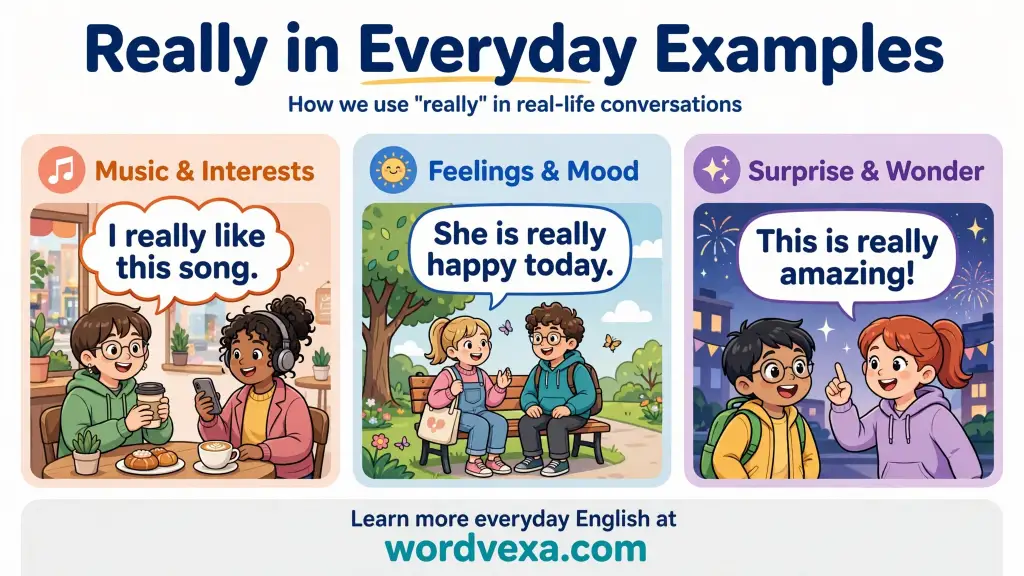
The word really works in many types of writing. The key is to spell it correctly and use it in a way that fits the situation.
1. In Emails
Example:
Dear Sarah,
Thank you for your help. I really appreciate the time you spent on this project.
Best regards,
Alex
Here, really adds warmth and shows sincere thanks.
2. In News Writing
Example:
The new report raises questions about how the policy will really affect local families.
Here, really emphasizes the actual effect of the policy.
3. On Social Media
Example:
I really enjoyed this trip! I cannot wait to go back.
This use is natural in casual posts and personal updates.
4. In Formal Writing
Example:
The findings are really important for future research.
This sentence is correct. However, in a highly formal report, you could write:
The findings are highly important for future research.
Choose the wording that best matches your audience and purpose.
5. In Everyday Conversation
Example:
“Did you really finish the whole book?”
“Yes, I really enjoyed it.”
These sentences show how really can express surprise, confirm information, and add emphasis.
Really: Google Trends and Usage Data
The spelling really is widely used in English because it appears in everyday conversations, online searches, emails, articles, and educational content.
However, an exact ranking of really versus realy by country requires current search data. Without a verified Google Trends comparison, it would be misleading to give specific percentages, search volumes, or country rankings.
Why Is Really More Common?
There are several clear reasons:
- Standard spelling: Dictionaries and English writing guides use really.
- Daily communication: People use it to express truth, surprise, and emphasis.
- Education: Students encounter the word in reading, writing, and grammar lessons.
- Online searches: People may search for both spellings when checking which one is correct.
How Can You Compare Search Interest?
Google Trends can help you explore interest in really and realy.
To investigate the terms:
- Open Google Trends.
- Enter really and realy as separate search terms.
- Select a country, such as the United States, United Kingdom, Pakistan, Canada, or Australia.
- Choose a time range.
- Compare the results and check if the data represents search terms or broader topics.
Remember that Google Trends shows relative search interest, not exact search volume. Low-volume misspellings may also have limited or incomplete data.
Practical takeaway: Use really regardless of which spelling people may type into a search engine.
Really vs Realy: Comparison Table
| Feature | Really | Realy |
| Spelling status | Correct | Incorrect |
| Standard English | Yes | No |
| Meaning | Truly, actually, or very | No standard meaning |
| British English | Correct | Incorrect |
| American English | Correct | Incorrect |
| Formal writing | Acceptable | Avoid |
| Everyday example | I really like it. | I realy like it. |
| Recommended use | Always use | Do not use |
The main difference is spelling. These are not two words with different meanings. Realy is simply a misspelling of really.
Frequently Asked Questions (FAQs)
Q1. Is it really or realy?
Really is correct. Realy is a misspelling and should be avoided in standard English.
Q2. Why does really have two l’s?
The word comes from real plus the suffix -ly. The final l in real remains, and the suffix contributes another l, forming really.
Q3. Is realy ever accepted in English?
No. Realy is not an accepted standard spelling. It may appear in informal messages or online text as a typo.
Q4. Is really spelled differently in British and American English?
No. Both British and American English use really. There is no regional spelling difference.
Q5. What does really mean?
Really can mean truly, actually, or very. For example, “I really like this song” means that you like the song very much.
Q6. Can I use really in formal writing?
Yes. Really is a correct English word and can appear in formal writing. Depending on the context, truly, indeed, or highly may provide a more precise or formal tone.
Q7. How can I remember the correct spelling of really?
Remember that really comes from real plus -ly. Keep the original l and add the suffix: real + ly = really.
Conclusion
When choosing between really and realy, always use really. It is the correct spelling in standard English, while realy is a spelling mistake. The word really means truly, actually, or very, depending on the sentence. It can express strong feelings, emphasize a point, ask for confirmation, or show surprise.
The spelling stays the same in British, American, Canadian, Australian, and other varieties of English. You do not need to learn separate regional forms, which makes this word easy to use once you remember the two ls. The simplest way to understand its spelling is to start with real and add -ly: the result is really.
Use the word naturally in emails, school assignments, articles, conversations, and social media posts. In formal writing, consider if truly, indeed, or highly would express your meaning more precisely, but remember that really is still correct.
Before publishing or sending your work, check for missing letters and other typing errors. With this simple rule in mind, you can confidently choose really every time and avoid the common mistake of writing realy.
Read More Articles:
- Barista or Barrista: The Double-Letter Trap to Remember
- Pidgeon or Pigeon: The Silent Letter Trap to Remember
- Excellent or Excellant: The One-Vowel Mistake to Avoid

I’m Claire Morgan, the author behind wordvexa.com, where I write about English grammar, sentence structure, punctuation, and everyday language. My goal is to make grammar simple, clear, and practical, helping readers understand the rules and apply them with confidence in real-world writing.



2 thoughts on “Realy or Really? The Spelling Mistake Everyone Makes ”