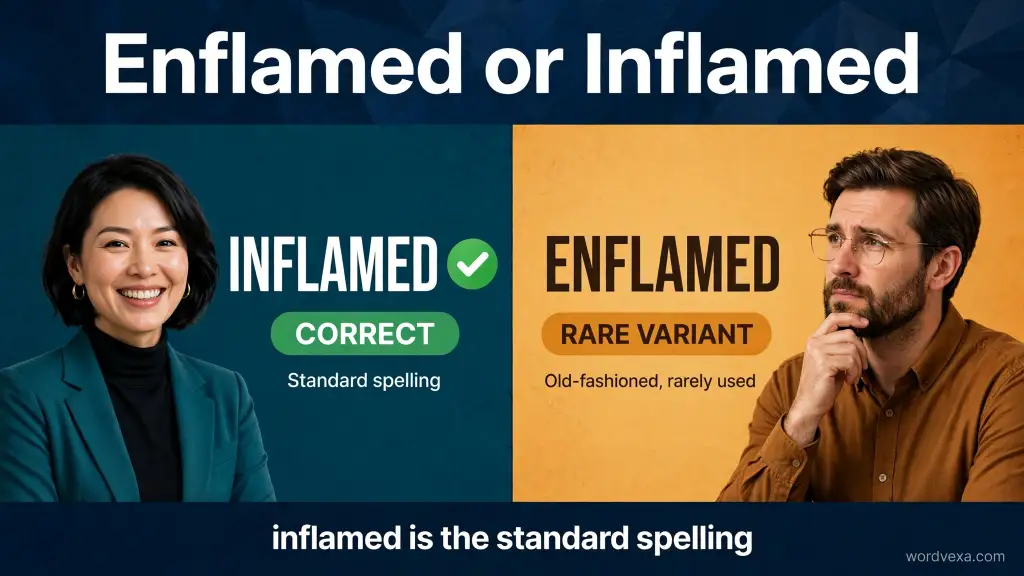
Enflamed or inflamed refers to two similar English word forms, with inflamed being the standard modern spelling for something that is swollen, irritated, or made more intense.
Although both words exist, inflamed is the preferred choice in most everyday, academic, medical, and professional writing.
The confusion often arises because the two words look and sound similar. Writers may also encounter enflamed in older books or literary texts and wonder if it is incorrect. Understanding their usage will help you choose the right word for your audience and purpose.
In this guide, you will learn the meanings of enflamed and inflamed, explore their origins, and discover how they are used in American and British English. You will also find practical examples, common mistakes, and answers to frequently asked questions.
If you are writing a school assignment, a medical article, a professional email, or a blog post, this guide will help you use the correct form with confidence. As a general rule, choose inflamed for clear, natural, and modern English.
Enflamed or Inflamed: Quick Answer
The main difference between enflamed and inflamed is their frequency and standard usage, rather than a clear difference in meaning.
- Inflamed: The usual modern spelling. It is common in medicine, everyday writing, and figurative expressions.
- Enflamed: A less common variant associated with older, literary, or expressive language.
- Best choice: Use inflamed in most cases, especially in formal, academic, medical, and business writing.
For example, write “The skin around the wound is inflamed,” not “The skin around the wound is enflamed,” when following standard modern usage.
What Does Inflamed Mean?
Definition of Inflamed
Inflamed is the past tense and past participle of the verb inflame. It can also function as an adjective.
The word has two main uses:
- Medical meaning: A body part becomes irritated or develops inflammation. This may involve swelling, redness, warmth, or pain.
- Figurative meaning: A feeling, disagreement, or situation becomes more intense.
Examples of Inflamed in Different Contexts
Medical example: The patient’s inflamed gums needed treatment.
Emotional example: The unfair decision inflamed public anger.
Social example: The misleading post inflamed tensions between the two groups.
In each example, inflamed describes something that has become irritated or more intense.
What Does Enflamed Mean?
Enflamed is a less common variant of inflamed. It may appear in literary writing, older texts, or expressive descriptions of strong passion and emotion.
For example:
- Her heart was enflamed with love.
- The writer described an enflamed imagination.
- The old poem spoke of an enflamed spirit.
These examples show the word’s expressive use. However, modern writers generally prefer inflamed, even in figurative contexts.
Are Enflamed and Inflamed Synonyms?
Yes, they can be synonyms when enflamed is used in the sense of becoming inflamed or intensely stirred. However, they are not equally common.
Inflamed is the more familiar and widely accepted choice in modern writing. The less common form may suit a historical quotation or a deliberate literary style, but it is usually unnecessary in ordinary prose.
The Origin of Enflamed and Inflamed

Where Does Inflamed Come From?
Inflamed comes from the verb inflame, which entered English through French and ultimately derives from the Latin inflammare, meaning to set on fire or kindle.
The Latin word combines elements associated with setting something alight. Over time, the English verb developed both literal and figurative uses.
The connection to fire remains clear in expressions such as “inflamed passions.” In medicine, the word developed a specialized sense referring to the body’s inflammatory response.
How Did Enflamed Develop?
Enflamed is a variant formed with the prefix en-, which can express the idea of causing something to enter a state or condition. English has many words formed with this prefix, although not every such form becomes the preferred modern spelling.
Both forms have appeared in English, but inflamed became the standard choice in most contemporary contexts.
Why Is Inflamed More Common Today?
Modern medical writing, dictionaries, and general editorial practice favor inflamed. It is familiar to readers and is the established form in common expressions such as:
- Inflamed tonsils
- Inflamed joints
- Inflamed skin
- Inflamed emotions
- Inflamed public opinion
The practical lesson is simple: use the established modern form unless a source or stylistic purpose requires the alternative.
British English vs American English
There is no major British-versus-American spelling difference between enflamed and inflamed. Both varieties generally use inflamed as the standard modern form.
| British English | American English | Example |
| Inflamed | Inflamed | The doctor examined the inflamed tissue. |
| Inflamed | Inflamed | His comments inflamed public anger. |
| Enflamed, less common | Enflamed, less common | The literary passage described an enflamed passion. |
Regional Differences
British and American English differ in many spellings, such as colour/color and organise/organize. The choice between enflamed and inflamed is not a comparable regional distinction.
In both countries, inflamed is the recommended choice for ordinary modern writing.
What Do Style Guides Prefer?
General editorial practice favors familiar, standard forms that readers can understand quickly. For medical content, use the spelling established in the relevant medical dictionary or institutional style guide.
If you are editing a historical quotation, retain the original wording when accuracy requires it. Otherwise, choose inflamed for consistency and clarity.
Which Version Should You Use?
In the United States
Use inflamed in schoolwork, workplace documents, news articles, medical writing, and everyday communication.
Example: “The patient reported pain in the inflamed joint.”
In the United Kingdom
Use inflamed for the same reasons. British English does not generally require enflamed as a regional alternative.
Example: “The pharmacist advised her about the inflamed skin.”
In Canada
Use inflamed in both formal and informal writing. Canadian English often follows conventions shared with British and American English, but this word does not present a meaningful regional spelling choice.
In Australia
Choose inflamed for essays, workplace writing, medical information, and published content.
Example: “The doctor treated the inflamed area.”
In International Writing
If your readers come from several countries, inflamed is the clearest option. It is widely recognized and works in both literal and figurative contexts.
In Academic and Business Writing
Use inflamed in research papers, reports, professional emails, presentations, and business documents.
Avoid switching between the two spellings without a clear reason. Consistent wording makes your writing look more polished and professional.
In Creative Writing
You may encounter enflamed in poetry, historical fiction, or deliberately archaic prose. It can contribute to a particular voice, but it should be a conscious stylistic choice rather than an accidental spelling variation.
Common Mistakes with Inflamed and Enflamed
Mistake 1: Using Enflamed in Medical Writing
Less preferred: The patient’s throat was enflamed.
Recommended: The patient’s throat was inflamed.
Why: Inflamed is the standard modern form in medical contexts.
Memory tip: When writing about swelling, irritation, or inflammation, choose inflamed.
Mistake 2: Assuming Enflamed Is Always a Typographical Error
Incorrect assumption: Enflamed is never a real English word.
Better understanding: Enflamed is a documented variant, although it is much less common in modern usage.
Why: English contains historical and literary variants that remain understandable without being the usual choice.
Memory tip: A word can exist without being the best option for everyday writing.
Mistake 3: Confusing Inflamed with Infected
Incorrect: The wound is inflamed, so it must be infected.
More accurate: The wound is inflamed, but further assessment may be needed to determine if an infection is present.
Why: Inflammation is the body’s response to injury or irritation and can occur with or without infection.
Memory tip: Inflammation does not automatically mean infection.
Mistake 4: Using Inflamed Only for Physical Conditions
Limited usage: The doctor treated the inflamed tissue.
Broader usage: The speech inflamed public anger.
Why: Inflamed can describe both physical inflammation and heightened emotions or conflict.
Memory tip: Think of something becoming irritated, intensified, or stirred up.
Mistake 5: Changing the Spelling Without a Reason
Inconsistent: The article uses inflamed in one paragraph and enflamed in another for the same meaning.
Better: Use inflamed consistently throughout the article.
Why: Unnecessary variation may distract readers and weaken editorial consistency.
Memory tip: When in doubt, follow the standard form used by your chosen dictionary or style guide.
Everyday Examples of Enflamed and Inflamed
The following examples show how the two spellings appear in different contexts. Notice that inflamed is the recommended choice for most modern writing.
In Emails
Example: “I will arrange a follow-up appointment to check the inflamed area.”
Example: “Let’s address the issue calmly before the discussion becomes further inflamed.”
In Business Writing
Example: “The manager used clear language to prevent an already inflamed dispute from escalating.”
Example: “The report describes how the announcement inflamed concerns among employees.”
In News Headlines
Example: “New Comments Inflame Debate Over City Policy”
Example: “Officials Seek to Calm Inflamed Public Tensions”
These examples use inflame and inflamed to describe conflict becoming more intense.
In Blogs
Example: “Five Common Causes of Inflamed Skin”
Example: “How Online Arguments Become Inflamed”
Both uses are natural in modern blog writing.
On Social Media
Example: “That post inflamed the discussion instead of helping people understand the issue.”
Example: “Avoid sharing claims that could inflame tensions.”
In Academic Writing
Example: “The study examined the biological processes involved in inflamed tissue.”
Example: “The researcher argued that emotionally charged language inflamed the public debate.”
In academic work, make sure the intended meaning is clear and that medical claims are supported by appropriate evidence.
In Daily Conversation
Example: “My gums are inflamed, so I need to see a dentist.”
Example: “His response inflamed the situation.”
In Literary Writing
Example: “The poet described an enflamed heart consumed by longing.”
This last example illustrates a possible literary use of the less common variant. In ordinary modern prose, inflamed would usually be more natural.
Google Trends and Modern Usage
Which Spelling Is More Popular?
Inflamed is the more familiar and widely used form in contemporary English. It appears frequently in medical information, educational resources, journalism, and everyday communication.
Enflamed is comparatively uncommon and is more likely to appear in literary, historical, or specialized contexts.
Why Do People Search for Enflamed or Inflamed?
People may search for this comparison for several reasons:
- They are unsure which spelling is correct.
- They have encountered enflamed in a book or older text.
- They want to describe a medical condition accurately.
- They need to edit an essay, article, or professional document.
- They want to understand if the two words have different meanings.
Does Google Trends Prove Which Form Is Correct?
No. Google Trends measures relative search interest, not grammatical correctness. A word may receive more searches because people are confused about it, not because it is the preferred form.
Without a verified, current comparison of search data, it would be misleading to give exact search volumes or percentages for these spellings.
For practical writing, the strongest guidance comes from established dictionaries, contemporary usage, and the conventions of your field. These support inflamed as the standard choice.
Quick Comparison Table: Enflamed vs Inflamed
| Version | Meaning | Correct? | Region | Example |
| Inflamed | Physically irritated or emotionally intensified | Yes, standard modern form | US, UK, Canada, Australia, international | The doctor examined the inflamed tissue. |
| Enflamed | A variant with a similar meaning | Yes, but uncommon | Not a standard regional preference | The poem described an enflamed heart. |
The main distinction is modern frequency and suitability, not a strict difference between British and American English.
Key Takeaways
- Inflamed is the standard and preferred spelling in modern English.
- Enflamed is a less common variant that may appear in literary or historical writing.
- Both words can express the idea of becoming inflamed or intensely stirred.
- Use inflamed when describing swollen or irritated body tissue.
- Use inflamed for emotions, arguments, and public tensions that have become more intense.
- There is no major US-versus-UK spelling distinction between these forms.
- Do not assume that inflammation always means infection.
- When editing modern content, choose inflamed unless the original wording or intended style calls for enflamed.
Frequently Asked Questions
Q1. Is enflamed a real word?
Yes. Enflamed is a documented English variant of inflamed. However, it is much less common in modern writing. You may encounter it in older texts, poetry, or expressive prose. For everyday communication, medical descriptions, academic assignments, and professional documents, inflamed is generally the better choice.
Q2. Is inflamed the correct spelling?
Yes. Inflamed is the standard modern spelling and the preferred form in most contexts. It can describe body tissue that is swollen or irritated, as well as emotions or conflicts that have become more intense. If you are unsure which form to use, choosing inflamed will usually be the clearest and safest option.
Q3. What is the difference between enflamed and inflamed?
The main difference is how commonly the words are used today. Both can express a similar idea, but inflamed is the standard modern form. Enflamed is a less common variant that may suit historical or literary writing. The choice is generally about convention and style rather than a strict difference in meaning.
Q4. Is enflamed a British spelling?
No. Enflamed is not the standard British alternative to American inflamed. Both British and American English generally prefer inflamed. The difference between these words should not be treated like regional pairs such as colour/color. Use inflamed in either variety unless a specific quotation or stylistic reason calls for the other form.
Q5. Should I write inflamed skin or enflamed skin?
Write inflamed skin. This is the usual modern expression for skin affected by inflammation. Depending on the cause, the skin may appear red, swollen, warm, or sore.
The word itself does not identify the cause, and inflammation does not always mean infection. For medical concerns, seek advice from a qualified healthcare professional.
Q6. Can inflamed describe emotions?
Yes. Inflamed is often used figuratively to describe emotions, arguments, or tensions that have become stronger. For example, “The comments inflamed public anger” means that the comments made people angrier.
This figurative use is well established in modern English and is suitable for news writing, essays, reports, and everyday conversation.
Q7. What is the past tense of inflame?
The past tense of inflame is inflamed. The past participle is also inflamed. For example, you can write, “The remark inflamed the debate,” or “The debate has been inflamed by the remark.” The same spelling is used in the adjective “inflamed tissue.”
Q8. Does inflamed mean infected?
No. Inflamed and infected do not mean the same thing. Inflammation is a response to injury, irritation, or other triggers, while infection involves harmful microorganisms entering and multiplying in the body.
An infection can cause inflammation, but inflammation can also occur without infection. A healthcare professional can assess symptoms and determine appropriate treatment.
Conclusion: Inflamed vs Enflamed?
When choosing between enflamed and inflamed, the best option for modern English is usually clear: use inflamed. It is the standard spelling in medical writing, academic work, business communication, journalism, and everyday conversation.
The word has both literal and figurative meanings. It can describe irritated body tissue, such as inflamed skin or gums, and it can describe emotions or disagreements that have become more intense. Enflamed is a less common variant that may appear in literary or historical writing, but it is not the usual spelling in contemporary prose.
The distinction is not a matter of choosing British English over American English. Both varieties generally prefer inflamed. If you are writing for a broad audience, consistency and familiarity are more useful than choosing a rare variant.
Before publishing an article or submitting an assignment, check that you have used the same standard form throughout your work. For specialized or medical content, consult a trusted dictionary and follow the relevant editorial guidance.
Memorable takeaway: When in doubt, choose inflamed for clear, correct, modern English. Explore more grammar and spelling guides on Wordvexa to make your writing clearer and more confident.
Read More Articles:
- Attach or Attatch: How to Spell It Correctly
- Agast or Aghast: Which Spelling Is Correct?
- Don’ts or Dont’s: Correct Usage and Apostrophe Rules

I’m Sloane Mercer, a U.S.-based English language writer focused on grammar, spelling, vocabulary, and everyday English usage. Through Wordvexa, I provide clear and practical explanations to help readers choose the right words and communicate with confidence.








4 thoughts on “Enflamed or Inflamed: Meaning, Difference, and Examples”