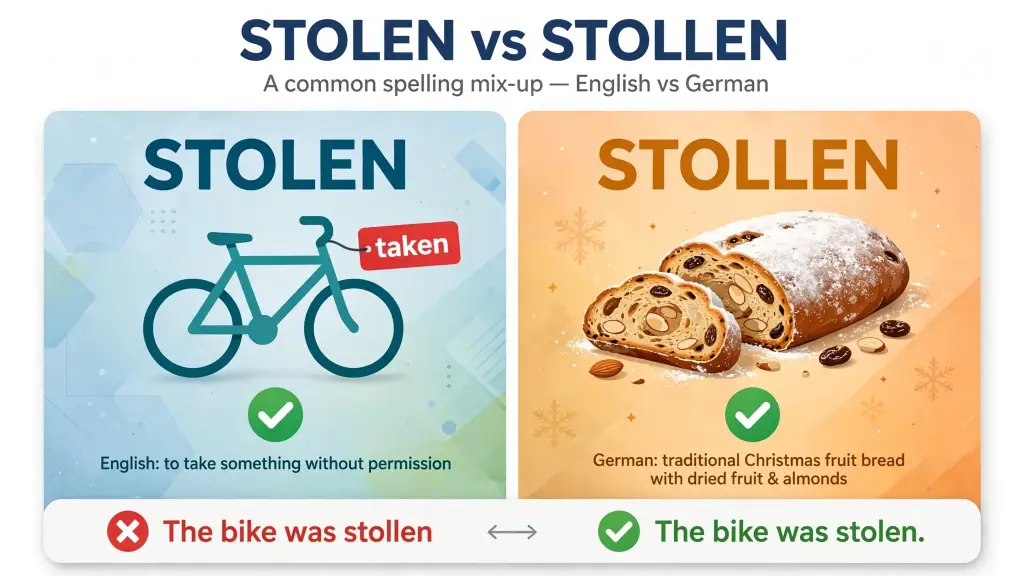
Stolen or stollen is a common spelling confusion: stolen means taken without permission, and stollen means a sweet German fruit bread eaten at Christmas.
The two words sound almost the same, so your ear gives you no help. The spelling differs by just one letter, a double “l.” That one small letter turns a police report into a bakery order. One word belongs to the verb steal.
The other belongs to the Christmas table. It is no surprise that students, writers, and English learners search for this pair every day. Even careful writers make this slip when they type fast.
In this guide, you will learn what each word means and where each word came from. You will see how British and American English treat both words.
You will also get real examples, the most common mistakes, and one simple memory trick. By the end, you will pick the right word in seconds, every time.
Stolen or Stollen: The Short Answer
Stolen or stollen? Use stolen when something has been taken without permission, as in “My phone was stolen.” Stolen is a form of the verb steal. Use stollen only for the sweet German fruit bread eaten at Christmas, as in “We sliced the stollen.” If no food is involved, the answer is almost always stolen.
Stolen or Stollen: Quick Answer
The rule is simple. Ask one question: is food involved?
If something was taken, lost, or used without permission, write stolen.
If you can eat it with coffee at Christmas, write stollen.
Example: “The stolen car was found near the station.”
Example: “She bought a stollen at the Christmas market.”
Both words are real English words. The error is picking the wrong one for your sentence.
What Does Stolen Mean?
Stolen is the past participle of the verb steal. Steal means to take something that does not belong to you, without permission and without plans to return it.
The verb has three main forms:
steal (present): “Thieves steal bikes in this area.”
stole (past simple): “Someone stole my bag yesterday.”
stolen (past participle): “My bag has been stolen.”
Use stolen with helping verbs like has, have, had, was, and were. It also works as an adjective, as in “stolen goods” or “a stolen base” in baseball.
Stolen can also work in a softer, figurative way. Writers talk about a “stolen glance” or “stolen moments.” Nothing was taken by force. The word means the moment was brief or secret.
The word is pronounced STOH-luhn, with the stress on the first syllable.
What Does Stollen Mean?
Stollen is a noun. It is a rich, sweet yeast bread from Germany, filled with dried fruit, candied peel, nuts, and warm spices. Many loaves hold a ribbon of marzipan in the middle.
The finished loaf is dusted with powdered sugar. Its white coat and long shape are said to look like a baby wrapped in cloth, which links it with Christmas. You may also see it called Christstollen.
The most famous version comes from Dresden. Bakers there have made stollen for centuries, and the city still holds a stollen festival each December.
In German, the word starts with a “sht” sound, like SHTOH-luhn. In English, most people say STOH-luhn, the same way they say stolen. That shared sound is a big part of the confusion.
The Origin of Stolen and Stollen
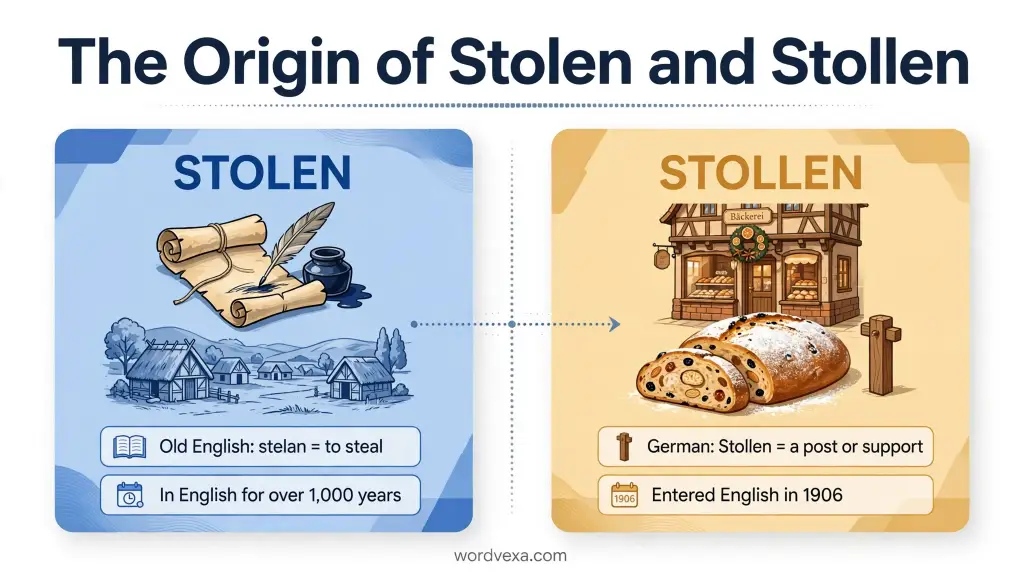
The two words come from two different languages. They are not related at all. They only met by chance, because they sound alike.
Stolen is true English stock. It comes from the Old English verb “stelan,” to steal. The past participle was “stolen” or “gestolen,” so the modern form has barely changed in a thousand years.
Stollen arrived much later. English borrowed it from German; Merriam-Webster gives the first known use as 1906. In German, “Stollen” meant a post or support, from the Old High German “stollo.” The bread took its name from its long, firm shape.
One more detail adds to the mix. The German word for “stolen” is “gestohlen.” Learners hear that word, meet the bread called stollen, and the two spellings blur.
British English vs American English
Good news: the spelling of both words is the same in Britain and America. Stolen is stolen, and stollen is stollen, on both sides of the Atlantic.
The real differences are sound and habit, not spelling.
| Term | British English | American English | Example |
| Stolen (spelling) | stolen | stolen | The keys were stolen. |
| Stolen (sound) | STUH-luhn, with a shorter “o” | STOH-luhn, with a rounder “o” | She reported it as stolen. |
| Stollen (spelling) | stollen | stollen | He baked a stollen. |
| Stollen (use) | Common at Christmas markets | Sold as a holiday import in many stores | We bought stollen for Christmas. |
Style guides in both countries treat stollen as a normal English noun with a small letter. No style guide lists a special rule for stolen. It is a plain verb form in both systems.
Which Version Should You Use?
United States
Write stolen for anything taken without permission, and stollen only for the bread. American readers meet stollen in bakeries and holiday gift guides.
United Kingdom
The same rule applies. British Christmas markets sell stollen in most large towns, so readers know the bread well. For theft, stolen is the only choice.
Canada
Follow the American pattern: stolen for theft, stollen for the bread.
Australia
Use stolen for theft, as everywhere else. Stollen shows up in delis and Christmas food features, even in the middle of an Australian summer.
International Writing
Pick the word that matches your topic. If your text is not about food, stolen is safe. If you mention the bread, a short note like “a German fruit bread” helps new readers.
Academic Writing
Use stolen in formal work about crime, law, or history. If you write about food history, stollen is correct, with a brief definition on first use.
Business Writing
In reports, emails, and insurance claims, stolen is the word you will need: “The laptop was stolen from the office.” Save stollen for the office party menu.
Common Mistakes: Stolen or Stollen
Mistake 1: Using Stollen for Theft
Incorrect: “The stollen car was found by the police.”
Correct: “The stolen car was found by the police.”
Why: Theft always takes stolen, with one “l.”
Mistake 2: Using Stole After Has or Was
Incorrect: “She has stole my seat.”
Correct: “She has stolen my seat.”
Why: After has, have, had, was, or were, you need the past participle, stolen. Stole works on its own: “She stole my seat.”
Mistake 3: Using Stolen for the Bread
Incorrect: “We ate stolen with coffee after dinner.”
Correct: “We ate stollen with coffee after dinner.”
Why: The bread needs the double “l.” If it goes with coffee and powdered sugar, it is stollen.
Mistake 4: A Capital Letter in the Middle of a Sentence
Incorrect: “He ordered a Stollen at the cafe.”
Correct: “He ordered a stollen at the cafe.”
Why: German capitalizes all nouns. English does not, so stollen takes a small letter mid-sentence.
Memory tip: Think of the letter count. One “l” for loss, because something was lost to a thief. Two “l”s for loaf, because the bread is a loaf. Loss or loaf. That one check settles the word in a second.
Everyday Examples
Emails
Please note that a delivery van was stolen last night, so some orders will arrive late.
Business Writing
The audit found that funds had been stolen over a period of two years.
News Headlines
Painting Stolen From Museum Found in Attic After 20 Years
Blogs
I still dream about the stollen we ate at the Dresden Christmas market.
Social Media
“He stole my fries. You know who you are.” “First stollen of the season, and yes, I ate two slices.”
Academic Writing
“The archive holds letters that were stolen during the war and returned in 1998.” “Stollen offers a clear case of a food that kept its foreign name in English.”
Daily Conversation
“My umbrella was stolen at the gym again.” “Try a slice of this stollen. My grandmother sent it from Germany.”
Google Trends and Modern Usage
This section is based on general usage patterns, not on exact search data.
Stolen is an all-year word. People search for it after thefts, in news and insurance texts, and in school grammar lessons. The “stole or stolen” question drives steady searches from English learners too.
Stollen follows the calendar. Interest climbs in late autumn and peaks near Christmas, as shops and recipe sites push the word in front of readers. Then it fades until the next season.
That seasonal clash is why the confusion keeps coming back. A reader meets stollen in a December recipe, then writes about a stolen bike a week later, and the double “l” slips in. Autocorrect does not help, because both words are real.
On social media, stolen is also a joke label for copied posts and memes. The playful use is common, but the spelling rule stays the same.
Quick Comparison Table
| Version | Meaning | Correct? | Region | Example |
| stolen | Taken without permission | Yes, for theft | All regions | The wallet was stolen. |
| stollen | German fruit bread with nuts and spices | Yes, for the bread | All regions | She baked a stollen. |
| stollen (used for theft) | Wrong word for stolen | No | None | Incorrect: The bike was stollen. |
| stole | Past simple of steal | Yes, without a helping verb | All regions | He stole the wallet. |
Key Takeaways
- Stolen means taken without permission. It is a form of the verb steal.
- Stollen is a sweet German fruit bread eaten at Christmas.
- Both words are real. The mistake is picking the wrong one.
- The verb forms are steal, stole, and stolen. After has or was, use stolen.
- Spelling is the same in British and American English.
- Memory check: one “l” for loss, two “l”s for loaf.
- If your sentence has no food in it, the answer is stolen.
Frequently Asked Questions
Q1. Is it stolen or stollen?
It depends on your meaning. Write stolen when something has been taken without permission, as in “My bike was stolen.” Write stollen only when you mean the German fruit bread, as in “We ate stollen at Christmas.” If your sentence is not about food, stolen is the safe and correct choice almost every time.
Q2. What does stolen mean in simple words?
Stolen means taken away without the owner’s permission. It is a form of the verb steal. You use it after words like has, was, or were: “The car was stolen.” People also use it in a soft way for brief, secret moments, as in “a stolen glance.” The core idea is always the same: something was taken, not given.
Q3. What is stollen bread made of?
Stollen is a sweet yeast bread from Germany. Bakers mix the dough with dried fruit, candied citrus peel, nuts, and spices like cardamom and cinnamon. Many loaves hold marzipan in the center. After baking, the loaf is brushed with butter and coated in powdered sugar. It is dense, rich, and made to last for weeks, which suits the Christmas season well.
Q4. Is stollen a real English word?
Yes. Stollen is a real English word, borrowed from German. English dictionaries list it as a noun for the German fruit bread. It entered English in the early 1900s and is now common in food writing and holiday recipes. It is not a wrong spelling of stolen.
Q5. How do you pronounce stolen and stollen?
In English, most people pronounce both words the same way: STOH-luhn. British speakers often use a shorter first vowel, while American speakers use a rounder one. In German, stollen starts with a “sht” sound, like SHTOH-luhn. Because the English sounds match so closely, your listener cannot tell which word you mean from sound alone. Context does that job.
Q6. Is the past tense of steal “stole” or “stolen”?
Both forms are correct, but they do different jobs. Stole is the past simple, and it stands on its own: “He stole the car.” Stolen is the past participle, and it needs a helping verb: “He has stolen the car” or “The car was stolen.” A common learner error is “has stole.” After has, have, had, was, or were, always choose stolen.
Q7. Can stolen describe ideas or time, not just things?
Yes. English often uses stolen in a figurative way. People speak of stolen ideas, a stolen identity, stolen moments, and a stolen glance. In these cases, nothing physical was taken by a thief. The word signals that something was taken unfairly, used without credit, or enjoyed in secret for a short time. This softer use is common in stories, songs, and daily speech.
Q8. Is it Christstollen or Christmas stollen?
Both forms appear, and both are fine. Christstollen is the German compound word, and English food writers often keep it as one word. Other writers use “Christmas stollen” for clarity. Dresden stollen is a named type from the city of Dresden, and some of those loaves carry protected status in the European Union. In plain English text, “stollen” on its own is clear enough.
Conclusion
The stolen or stollen question looks tricky, but the answer is short. Stolen is about taking. Stollen is about baking. One word reports a loss. The other names a loaf.
For daily writing, stolen is the word you will use most. It covers theft in news, reports, emails, and plain conversation, and it stays the same in every variety of English. Stollen has a narrow job: it names one beloved German bread, mostly in the weeks before Christmas.
When you feel unsure, run the simple check from this guide. Ask if food is involved. If it is not, choose stolen. Then count the letters: one “l” for loss, two “l”s for loaf.
Save this page for the next time the pair slows you down. Share it with a friend, a student, or a coworker who mixes the two words up. One clear rule, learned once, will save you from the error for good.
You May Also Like:
- 13rd or 13th? Learn the Easy Rule for Using 13th
- Dining or Dinning: Which Spelling Is Correct?
- Undisputable or Indisputable? Avoid This Common Spelling Mistake

I’m Sloane Mercer, a U.S.-based English language writer focused on grammar, spelling, vocabulary, and everyday English usage. Through Wordvexa, I provide clear and practical explanations to help readers choose the right words and communicate with confidence.