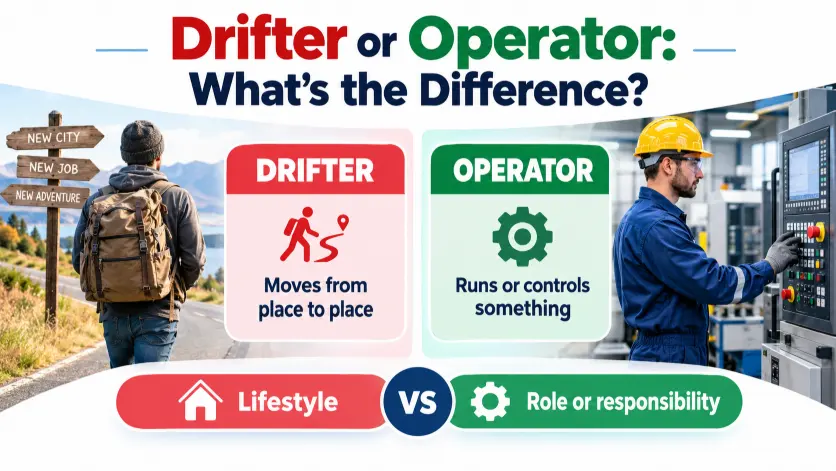
A drifter is usually someone who moves from place to place or job to job without a clear direction, while an operator is someone who runs, controls, or manages a machine, system, service, or business.
People search for “drifter or operator” because they want to understand the difference between these words and choose the right one for a sentence.
The confusion can also arise in stories, workplace discussions, news reports, and everyday conversations. In some contexts, operator has a special meaning, such as a person who controls equipment or someone who handles situations skillfully. The word can even describe a person who uses clever or dishonest methods to get what they want.
In this guide, you will learn the definitions, origins, and practical uses of both words. You will also find comparison tables, common mistakes, and examples from daily life. By the end, you will know exactly when to use drifter and when operator is the better choice.
Drifter or Operator: Quick Answer
The correct word depends on what you want to describe. Drifter and operator are both standard English nouns, but they are not interchangeable.
- Drifter: A person who moves around without a stable home, job, or clear direction.
- Operator: A person who operates machinery, manages a service, or controls a system.
- Informal operator: A person who is skilled at dealing with people or situations, sometimes in a manipulative or dishonest way.
Examples
- After leaving several jobs, he became a drifter.
This describes someone who moves between jobs without settling down. - The machine operator checked the equipment before starting work.
This describes a worker responsible for operating machinery. - Everyone knew her as a clever operator who could negotiate almost any deal.
This describes someone who handles situations skillfully.
Easy rule: Use drifter to describe an unsettled person and operator to describe someone who runs or controls something.
What Does Drifter or Operator Mean?
What Does Drifter Mean?
A drifter is a person who moves from one place to another, often without a permanent home, steady employment, or a clear long-term plan. The word can also describe someone who changes jobs frequently or seems unsure about the direction of their life.
The term often carries a negative or disapproving tone, especially when it suggests that a person lacks stability or purpose. However, context matters. In a story, a drifter might be presented as an independent traveler rather than someone who has failed to settle down.
Examples:
- The drifter arrived in town with only a backpack.
- He spent years moving between temporary jobs.
- The novel follows a young drifter searching for a place to belong.
The word can also have specialized meanings, including a fishing boat used with drift nets.
What Does Operator Mean?
An operator is a person who operates, controls, or manages something. The exact meaning depends on the situation.
Common uses include:
- Machine operator: Someone who runs industrial equipment.
- Telephone operator: Someone who connects or assists telephone calls.
- Business operator: A person or company that runs a business or service.
- Tour operator: A company that organizes travel packages and related services.
- Skilled operator: A person who handles people or situations effectively.
- Manipulative operator: An informal description of someone who uses others to achieve personal goals.
Examples:
- The crane operator lifted the heavy materials safely.
- The tour operator arranged our hotel and transport.
- He is a smooth operator who knows how to persuade people.
Unlike drifter, the word operator does not automatically suggest an unstable lifestyle. It usually points to a person’s function, control, or ability.
Are Drifter and Operator Synonyms?
No. Although both words can describe people, their meanings differ.
A drifter is usually identified by a pattern of movement or an unsettled way of life. An operator is identified by something the person does or controls.
Depending on the context, alternatives for drifter include wanderer, roamer, and itinerant. Alternatives for operator include controller, manager, technician, and organizer. These words are not perfect substitutes in every sentence.
The Origin of Drifter and Operator
Origin of Drifter
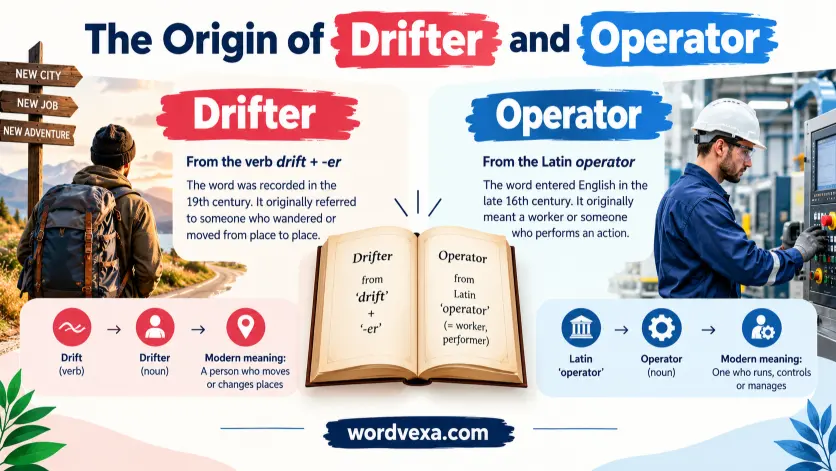
The word drifter comes from the verb drift combined with the suffix -er. The suffix often identifies a person or thing associated with an action.
The word was recorded in the nineteenth century. Early uses included specialized occupational meanings, such as a miner working in underground passages. The meaning associated with a person who wanders or follows an aimless lifestyle developed later.
Today, drifter is commonly used in descriptions of people who move between places or jobs without settling down. It also appears in novels, films, and news writing when a character’s unsettled lifestyle is important to the story.
Origin of Operator
The word operator entered English in the late sixteenth century. It comes from the Latin operator, meaning a worker or someone who performs an action, and is related to the verb operate.
Over time, its meaning expanded. It became associated with people performing practical tasks, operating machinery, handling communications, managing businesses, and carrying out specialized work.
The word also developed informal meanings. Describing someone as a smooth operator, for example, can suggest that the person is charming, persuasive, or skilled at handling situations.
The histories of these words help explain their modern meanings: a drifter is associated with drifting, while an operator is associated with performing or controlling an operation.
Operator or Drifter: British English vs American English
Drifter and operator are standard words in both British and American English. Neither pair represents a British-versus-American spelling difference. The spellings stay the same, although pronunciation may vary.
| British English | American English | Example |
| Drifter | Drifter | The drifter moved from town to town. |
| Operator | Operator | The operator controlled the machine. |
| Drifters | Drifters | Several drifters arrived at the station. |
| Operators | Operators | The operators checked the system. |
Regional Differences
The main differences involve pronunciation, context, and word choice rather than spelling.
In British English, the final r in drifter and operator is usually not pronounced when it comes before a pause. In most American accents, the r is pronounced.
Both words are understood in the United States, United Kingdom, Canada, Australia, and other English-speaking regions.
What About Style Guides?
General English dictionaries and editorial style guides treat both words as standard English vocabulary. Writers should follow the spelling and usage rules of their chosen publication or organization.
For example, a British newspaper and an American newspaper can both correctly write, “The machine operator stopped the equipment.”
The choice between drifter and operator is about meaning, not regional spelling preferences.
Which Version Should You Use?
Choose the word that accurately describes the person or situation. Your location does not determine which word is correct.
United States
Use drifter for someone who wanders or moves between jobs without settling down. Use operator for someone who controls equipment, manages a service, or handles a task.
Example: The factory operator reported a problem with the machine.
United Kingdom
The same distinction applies in British English.
Example: The drifter had no permanent address.
Canada
Both words are correct in Canadian English. Choose operator for a job or business role and drifter for an unsettled lifestyle.
Example: The bus operator announced a change in service.
Australia
Both words are also used in Australian English.
Example: The equipment operator followed the safety instructions.
International Writing
For an international audience, use drifter when discussing a person’s lifestyle and operator when describing their role or actions.
Avoid assuming that a drifter is necessarily lazy or that an operator is necessarily dishonest. Those implications depend on context.
Academic Writing
Define the terms clearly if they are important to your research. In sociology, literature, or cultural studies, drifter may describe a social pattern or a character type. In engineering or mathematics, operator may have a technical meaning.
Use a relevant specialist dictionary when a term has a precise technical definition.
Business Writing
Use operator for a person or organization that runs a service, facility, or system.
Example: The airport operator introduced new passenger procedures.
Avoid using drifter as a casual label for an employee who changes jobs. If you mean that someone changes jobs frequently, a more neutral phrase such as “frequent job changer” may be more appropriate.
Common Mistakes
Mistake 1: Using Drifter for Someone Operating Equipment
Incorrect: The drifter started the factory machine.
Correct: The machine operator started the factory machine.
Explanation: The sentence describes a specific job responsibility, so operator is the appropriate word.
Mistake 2: Using Operator for Someone Who Wanders
Incorrect: The operator traveled from town to town without a permanent home.
Better: The drifter traveled from town to town without a permanent home.
Explanation: The second sentence emphasizes an unsettled lifestyle rather than a work role.
Mistake 3: Assuming Operator Always Means a Technician
Incorrect assumption: An operator must work with machinery.
Correct understanding: An operator can run machinery, manage a service, handle communications, or describe someone who deals skillfully with people.
Explanation: The word has several meanings, so context determines its precise sense.
Mistake 4: Assuming Every Drifter Has No Job
Incorrect assumption: A drifter can never have a job.
Correct understanding: A drifter may work temporarily but move frequently between jobs or places.
Explanation: The word usually suggests instability or a lack of settled direction, not necessarily permanent unemployment.
Memory Tip
Remember these simple associations:
- Drifter = drifts from place to place.
- Operator = operates or manages something.
If the sentence focuses on movement and instability, drifter may fit. If it focuses on control, work, or management, operator is usually the better choice.
Everyday Examples of Drifter and Operator
In Emails
Operator:
Subject: Equipment Maintenance
Please contact the machine operator before scheduling the maintenance inspection.
Drifter:
The article describes a drifter who moved between several towns before finding a permanent home.
In Business Writing
- The railway operator announced a revised timetable.
- The company hired an experienced equipment operator.
- The report discusses workers who move frequently between temporary jobs.
In News Headlines
- Local Drifter Questioned During Investigation
- Airport Operator Announces New Security Procedures
The first headline uses drifter to describe a person. The second uses operator to identify an organization responsible for running a service.
A news report should not use drifter merely to make a person sound suspicious. The word must be supported by the facts and context.
In Blogs
- What Life on the Road Teaches a Drifter
- How a Tour Operator Plans a Successful Trip
These titles demonstrate the difference between a lifestyle and a professional role.
On Social Media
- A little like a drifter, always searching for a new place to explore.
- The operator explained how the new machine works.
The first example uses the word creatively. The second uses its ordinary professional meaning.
In Academic Writing
- The novel presents the drifter as a symbol of isolation.
- The system operator monitors the performance of the network.
The first word describes a character or social role, while the second identifies a technical responsibility.
In Daily Conversation
- “He has lived in five cities in three years. He seems like a drifter.”
- “Who is the operator responsible for this control panel?”
- “She is a smooth operator when it comes to negotiating.”
- “The drifter eventually decided to settle in a quiet village.”
The final two examples show that operator can also describe social skill, while drifter can appear in a personal story.
Operator and Drifter: Google Trends and Modern Usage
People may search for “drifter or operator” when they encounter these words in a book, film, job description, online discussion, or sentence they want to write. They may also want to understand if the words are synonyms or if one is more suitable for a particular context.
Both terms remain useful in modern English, but they serve different purposes.
Drifter commonly appears in descriptions of travel, unstable employment, fictional characters, and people who move frequently between places. Depending on the context, it can sound critical, sympathetic, or descriptive.
Operator appears across many professional and technical fields. It is used for people who operate machinery, run businesses, manage transport services, or control systems. Informally, it can describe someone who is persuasive or manipulative.
Is One Word More Popular Than the Other?
The words are used in different contexts, so their overall search or usage frequency would not tell the whole story. A reliable comparison would require a defined region, time period, and data source.
No exact Google Trends figures are presented here. Without a verified comparison, it would be misleading to claim that one word is more popular worldwide or in a particular country.
Why Does the Confusion Continue?
The confusion mainly comes from both words referring to people. However, the defining feature is different:
- A drifter is described by a pattern of movement or lifestyle.
- An operator is described by a role, activity, or way of handling a situation.
Understanding the context is more useful than memorizing the words in isolation.
Quick Comparison Table: Drifter vs Operator
| Version | Meaning | Correct? | Region | Example |
| Drifter | Person who moves around without settling | Yes | International English | The drifter left town. |
| Operator | Person who runs or controls something | Yes | International English | The operator checked the machine. |
| Drifters | Plural of drifter | Yes | International English | The drifters traveled together. |
| Operators | Plural of operator | Yes | International English | The operators tested the equipment. |
| Drifter used for a machine controller | Usually incorrect for this meaning | No, unless a special context applies | All regions | Use machine operator. |
| Operator used for an aimless wanderer | Usually incorrect for this meaning | No, unless another meaning fits | All regions | Use drifter. |
Key Takeaways
- Drifter and operator are both correct English words.
- A drifter usually moves from place to place or job to job without settling down.
- An operator runs, controls, or manages a machine, service, system, or business.
- Operator can also describe a skilled or manipulative person.
- Both words have the same spelling in British and American English.
- Context determines which word fits a sentence.
- A drifter may hold temporary jobs, so the word does not always mean unemployed.
- Choose precise, neutral language in professional and academic writing.
FAQs About Drifter and Operator
Q1. What is the main difference between a drifter and an operator?
A drifter is someone who moves from place to place or job to job without a settled routine or clear direction. An operator is someone who controls equipment, manages a service, runs a business, or handles a task. The key difference is that drifter usually describes a lifestyle, while operator describes a role or behavior.
Q2. Is drifter a negative word?
Drifter often has a negative or disapproving tone because it can suggest instability or a lack of purpose. However, the meaning depends on context. A novelist might use the word to describe a free-spirited traveler, while a news report might use it to describe someone without a permanent home. Consider the tone before using it to describe a real person.
Q3. What does operator mean in simple English?
An operator is someone who runs or controls something. For example, a machine operator uses equipment, a tour operator organizes travel services, and a network operator manages a communications system. In informal speech, an operator can also be someone who is skilled at influencing people or handling difficult situations.
Q4. Can a drifter have a job?
Yes. A drifter may work temporary jobs, change employers often, or move between locations for short periods. The word does not necessarily mean the person is unemployed. Instead, it usually suggests that the person has not settled into a stable place or routine. The exact meaning depends on the sentence and the situation being described.
Q5. Is operator a synonym for manager?
Sometimes, but not always. An operator may manage a business or service, yet the word can also refer to someone who physically controls a machine or performs a technical task. A manager generally has responsibility for people, decisions, or operations. Choose the word that best describes the person’s actual duties.
Q6. Is there a difference between drifter and operator in British and American English?
There is no spelling difference between the two words in British and American English. Both regions use drifter and operator with broadly similar meanings. Pronunciation differs because many British accents do not pronounce the final r in the same way as American accents. Context, rather than regional spelling, determines the correct word.
Q7. What does smooth operator mean?
A smooth operator is someone who handles situations with confidence, charm, and skill. The phrase can describe a persuasive negotiator or a person who is good at winning others over. Depending on the context, it may be a compliment or a warning that someone is overly clever or manipulative.
Q8. Can drifter and operator be used for the same person?
Yes, if the person fits both descriptions in different ways. For example, someone may move between towns without settling down and also operate heavy machinery for temporary employers. In that case, drifter describes the person’s lifestyle, while operator describes their job. The words are not synonyms, but they can describe the same individual.
Conclusion: Drifter or Operator?
The difference between drifter and operator becomes simple once you focus on the meaning of each word. A drifter is usually a person who moves between places or jobs without establishing a stable routine. An operator is someone who runs, controls, or manages equipment, a service, a system, or a business.
Both words are correct in British and American English, and neither is a regional spelling variant of the other. The right choice depends on what you want to communicate. Use drifter when an unsettled lifestyle matters to the sentence. Use operator when you are talking about a job, responsibility, or someone’s ability to handle a situation.
Remember that context also affects tone. Drifter can sound critical, while operator can be neutral, positive, or negative depending on how it is used. In professional writing, choose clear and fair descriptions that accurately reflect the facts.
The easiest way to remember the difference is this: a drifter drifts, while an operator operates.
Enjoyed this guide? Explore more English word comparisons on Wordvexa.com to improve your vocabulary and write with greater confidence.
Read More Articles:
- Upward vs Upwards: The Simple Difference Explained
- Form or Forum: Meaning, Spelling, and Examples
- Yey or Yay: The Right Way to Express Happiness

I’m Claire Morgan, the author behind wordvexa.com, where I write about English grammar, sentence structure, punctuation, and everyday language. My goal is to make grammar simple, clear, and practical, helping readers understand the rules and apply them with confidence in real-world writing.