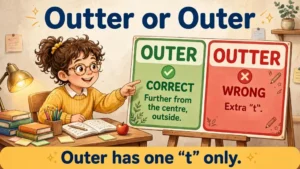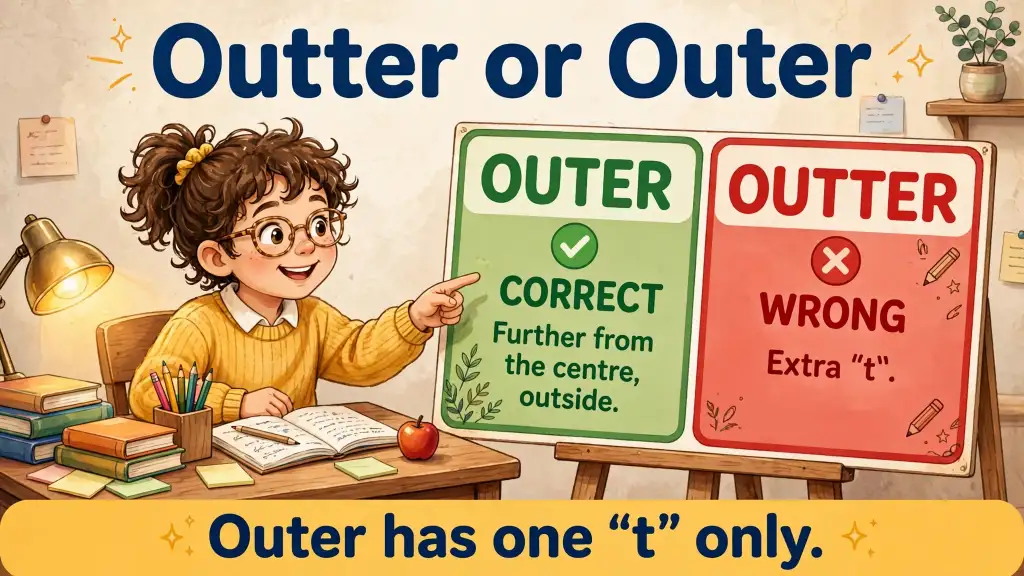
Outter or outer: Outer is the correct spelling, meaning located on the outside of something or farther from its center. Outter is a misspelling and should not be used in standard English.
Many people search for “outter or outer” because English spelling can be confusing. Some words use double consonants, so writers may think that outter follows the same pattern. However, the correct word has only one t.
You can use outer to describe many things. For example, an outer wall is the wall on the outside of a building. The outer layer is the part that covers something. Similarly, outer space refers to the region beyond Earth’s atmosphere.
Knowing the correct spelling helps you write clearly in school assignments, emails, reports, and online content. It also helps you avoid spelling mistakes that can make your writing look less professional.
In this guide, you will learn the meaning of outer, its origin, the difference between British and American English, and common mistakes to avoid. You will also find simple examples, spelling comparisons, and answers to frequently asked questions.
Outter or Outer: Quick Answer
Outer is correct. Outter is incorrect in standard English.
The word outer describes something on the outside or away from the center of another thing.
Examples:
- The outer wall needs a fresh coat of paint.
- She removed the outer layer of the onion.
- Astronauts study outer space.
- Please check the outer pocket of your bag.
In each example, outer refers to an outside part or area.
Remember this simple rule: Write outer with one “t.” The spelling does not change between British and American English.
Definition and Meaning of Outer
What Does Outer Mean?
Outer is an adjective that means situated on the outside, farther from the center, or forming the outside part of something.
It helps describe the position or location of an object in relation to another object.
Simple meaning: Outside or farther away from the center.
For example, an outer door is a door that leads to the outside of a building. An outer ring is a ring located around the outside of another shape.
Different Uses of Outer
The word outer can be used in several contexts.
1. Physical objects
It describes the outside part of something.
Example: The outer cover of the book is damaged.
2. Buildings and places
It refers to the outside area, wall, or part of a structure.
Example: Workers painted the outer walls of the house.
3. Space and science
The phrase outer space refers to the region beyond Earth’s atmosphere.
Example: Scientists continue to explore outer space.
4. Clothing
It can describe clothes worn over other clothes for protection or warmth.
Example: Take your outer coat because it is cold outside.
5. Shapes and positions
It describes something located around the edge rather than near the center.
Example: The outer circle is larger than the inner circle.
In all these cases, the correct spelling is outer, never outter.
The Origin of Outer
Where Does the Word Outer Come From?
The word outer developed from out, an old English word related to the idea of being outside or away from something.
The Old English word ūte meant “out” or “outside.” Over time, English developed related forms that expressed position, direction, and location.
The word outer came to describe something situated on the outside. It is related to words such as out, outside, and outermost.
Why Do People Write Outter?
The incorrect spelling outter may result from confusion about English consonant patterns.
English has many words with double consonants, such as:
- Better
- Letter
- Bitter
- Butter
Because these words contain double letters, some writers may assume that outer should also have two t’s.
However, spelling patterns do not work the same way for every word. Outer is the established standard spelling, and adding another t makes it incorrect.
Outter or Outer: British English vs American English Spelling

Is Outer British or American English?
Outer is correct in both British and American English. There is no spelling difference between these two varieties.
Some English words have different British and American spellings. For example, colour is common in British English, while color is standard in American English. However, outer keeps the same spelling in both.
British and American Spelling Comparison
| Feature | British English | American English |
| Correct spelling | Outer | Outer |
| Incorrect spelling | Outter | Outter |
| Meaning | Outside or farther from the center | Outside or farther from the center |
| Outer wall | Correct | Correct |
| Outer space | Correct | Correct |
| Outer layer | Correct | Correct |
Examples in Both Varieties
British English: The outer door must remain closed.
American English: The outer door must remain closed.
Both sentences use the same spelling and meaning.
The word outer does not follow the spelling differences seen in words such as centre/center or organise/organize. Therefore, you do not need to change its spelling for a British or American audience.
Outer or Outter:Which Spelling Should You Use?
For American Readers
Use outer in essays, business emails, articles, and everyday writing.
Example: The outer surface of the device is made of plastic.
Writing outter would be considered a spelling mistake.
For British and Commonwealth Readers
Use outer in the United Kingdom and other English-speaking regions that commonly follow British spelling conventions.
Example: The outer walls of the school need repairs.
The spelling remains the same in British English, Australian English, and other varieties that use the word.
For Global and Online Content
If you write blog posts, educational articles, product descriptions, or website content for an international audience, always use outer.
This spelling is widely understood and accepted across standard English varieties.
For website owners and content writers, correct spelling also supports readability and professional presentation. It is best to proofread articles before publishing them.
Professional advice: Choose outer every time you mean the outside part of something. There is no regional spelling variation to remember.
Common Mistakes with Outter and Outer
Mistake 1: Adding an Extra T
Incorrect: The outter layer protects the product.
Correct: The outer layer protects the product.
The word requires only one t after the letters ou.
Mistake 2: Using Outter in Formal Writing
Incorrect: Please clean the outter surface before use.
Correct: Please clean the outer surface before use.
In formal writing, use the accepted spelling to keep your message clear and professional.
Mistake 3: Assuming British English Uses Outter
Some writers believe that British English uses outter while American English uses outer. This is false.
Correct in both: Outer
Incorrect in both: Outter
Mistake 4: Confusing Outer with Outside
The words outer and outside are related, but they do not always fit into the same sentence structure.
Example with outer: The outer door is locked.
Example with outside: Please wait outside.
Use outer mainly before a noun to describe its position. Use outside to refer to an external area or location, depending on the sentence.
Mistake 5: Missing the Error During Proofreading
A spell-checking tool may catch outter, but writers should not rely on technology alone. Read your work carefully, especially when preparing school assignments, professional documents, or website content.
Quick tip: If you are unsure, remember that outer is the same word used in the common phrase outer space.
Outer and Outter in Everyday Examples
Examples in Emails
Professional emails should use correct spelling to communicate clearly.
Incorrect: Please inspect the outter packaging before shipping.
Correct: Please inspect the outer packaging before shipping.
Another example:
Correct: The outer door will remain locked after office hours.
Examples in News Writing
News reports often use outer to describe locations, structures, and areas.
Example: Officials inspected the outer wall of the damaged building.
Example: Researchers shared new findings about objects in outer space.
Examples in Social Media
Writers can use outer in captions, posts, and comments.
Example: The outer design of this phone looks simple and elegant.
Example: A strong outer layer can help protect your belongings.
Examples in Formal Writing
In academic and professional writing, outer can describe physical features or scientific concepts.
Example: The outer layer of the Earth is known as the crust.
Example: The researchers measured the outer diameter of the circular object.
More Example Sentences
- The outer gate was closed at sunset.
- A thin outer shell protects the seed.
- She placed the documents in the outer pocket.
- The outer walls were covered with stone.
- The outer edge of the circle was clearly marked.
- The spacecraft traveled through outer space.
Each sentence uses outer correctly because the word describes an outside part, position, or region.
Outter vs Outer: Google Trends & Usage Data
Which Spelling Is More Popular?
Outer is the established standard spelling, while outter is a spelling error.
Google Trends can help users explore how often people search for different words over time and across regions. However, search interest is not the same as proof that a spelling is correct.
Without a current, verified Google Trends comparison, it would be misleading to provide exact search volumes, percentages, or country rankings for outter and outer.
How Search Interest May Differ
Searches for “outter or outer” often come from people who want to check a spelling before using it. Other users may search for outer because they want its definition or examples.
The phrase outer space also appears in science, education, entertainment, and astronomy. This broader use can affect search interest in the word outer.
What Writers Should Learn from This
- State the correct spelling near the beginning.
- Explain why outter is incorrect.
- Include simple examples.
- Answer related questions naturally.
- Avoid presenting unverified search data as fact.
SEO tip: A clear answer to “outter or outer” helps readers solve their problem quickly while providing enough detail for those who want to understand the word.
Outer vs Outter: Spelling Comparison Table
| Word or phrase | Correct? | Meaning or explanation |
| Outer | Yes | Located on the outside |
| Outter | No | Common misspelling of outer |
| Outer wall | Yes | A wall on the outside |
| Outter wall | No | Incorrect spelling |
| Outer space | Yes | Space beyond Earth’s atmosphere |
| Outter space | No | Incorrect spelling |
| Outer layer | Yes | The outside layer of something |
| Outter layer | No | Incorrect spelling |
| Outer edge | Yes | The outside boundary or edge |
| Outter edge | No | Incorrect spelling |
The main difference is simple: outer is correct, and outter is incorrect in standard English. Neither American nor British English uses outter as the standard spelling of this word.
Frequently Asked Questions
Q1. Is outter or outer correct?
Outer is correct. It means located on the outside or farther from the center. Outter is a common spelling mistake and should be avoided in standard English.
Q2. Why is outer spelled with one T?
The accepted spelling of outer follows its established word form. Although many English words contain double consonants, that pattern does not apply to every word. The correct spelling is outer.
Q3. Is outter ever a correct English word?
In standard modern English, outter is not the accepted spelling of outer. Unless you are reproducing a specific name, quotation, or deliberate spelling error, use outer.
Q4. Is outer the same in British and American English?
Yes. Both British and American English use outer. There is no regional spelling difference between the two varieties.
Q5. What does outer mean in simple words?
Outer means on the outside or away from the center. For example, the outer layer of an apple is its skin, and an outer wall is a wall on the outside of a building.
Q6. How do you use outer in a sentence?
You can use outer before a noun to describe its outside position.
Example: The outer door was painted blue.
Here, outer tells us that the door is on the outside.
Q7. How can I remember the correct spelling of outer?
Remember the common phrase outer space. The word outer has one t. You can also check your writing with a dictionary or spell-checking tool to avoid adding an extra letter.
Conclusion
The spelling question “outter or outer” has a clear answer: outer is correct, while outter is a misspelling in standard English. The word outer describes something on the outside, farther from the center, or forming the outside part of an object.
You can use it in many situations, including descriptions of walls, clothing, packaging, shapes, and outer space. For example, outer layer, outer wall, and outer edge are all correct expressions.
It is also important to remember that British English and American English use the same spelling. Unlike words such as colour/color and centre/center, outer does not change according to regional spelling rules.
If you are writing an email, preparing an assignment, publishing a blog post, or creating professional content, choose outer every time. Avoid outter unless you are intentionally reproducing a specific spelling from a source.
The easiest way to remember the rule is to think of outer space: one word, one correct spelling, and only one t. With this simple rule, you can use outer confidently in everyday and formal writing.
You May Also Like:
- Enflamed or Inflamed: Meaning, Difference, and Examples
- Helped or Helpped: The Double-Letter Mistake to Avoid
- Womens or Women’s: The Simple Grammar Fix You Need

I’m Sloane Mercer, a U.S.-based English language writer focused on grammar, spelling, vocabulary, and everyday English usage. Through Wordvexa, I provide clear and practical explanations to help readers choose the right words and communicate with confidence.