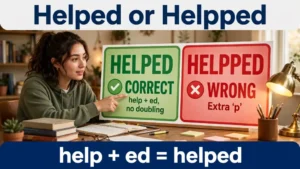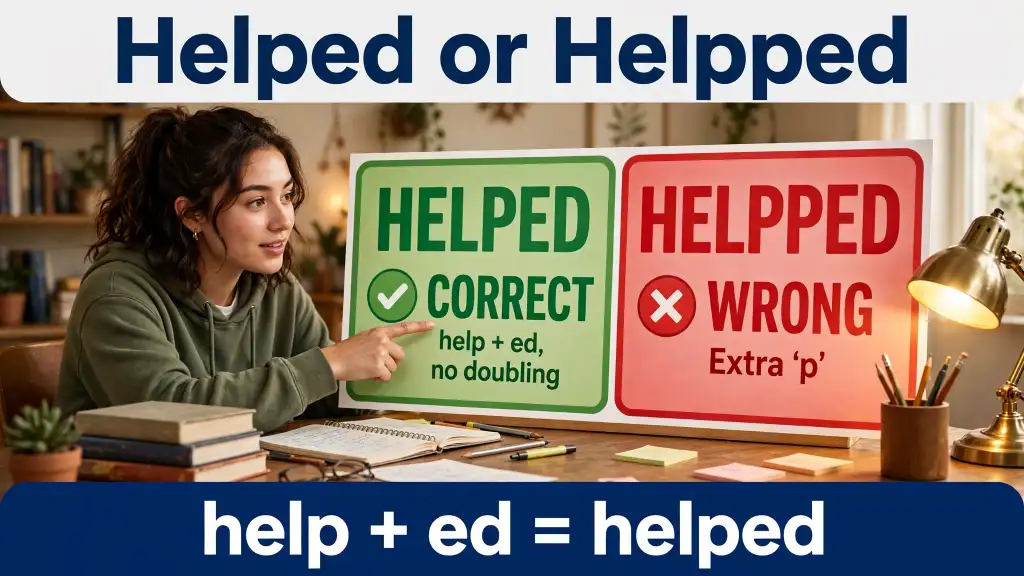
Helpped or helped is a spelling question in which helped is the correct spelling, meaning gave support, assistance, or aid to someone in the past.
“Helpped” is an incorrect spelling that often confuses English learners because some verbs double their final consonant before adding “-ed.” However, the verb “help” does not follow this pattern.
Choosing the correct spelling is important when writing school assignments, professional emails, blog posts, or everyday messages.
For example, you should write “She helped me with my homework,” not “She helpped me with my homework.” The difference is simple, but this common mistake can affect the clarity and accuracy of your writing.
In this guide, you will learn why “helped” is correct, what the word means, and how to use it in different sentences.
You will also discover the spelling rules behind the word, explore British and American English usage, and review common mistakes. By the end, you will know how to spell and use “helped” correctly in any writing situation.
Helpped or Helped: Quick Answer
Helped is the correct spelling. Helpped is incorrect in standard English.
The word “helped” is the past tense and past participle of “help.” It describes giving someone support or making a task easier.
Examples:
- Correct: She helped me with my homework.
- Incorrect: She helpped me with my homework.
- Correct: They have helped many people.
- Incorrect: They have helpped many people.
Quick rule: Add “-ed” to “help” to form “helped.” Do not double the letter “p.”
Definition and Meaning of Helpped or Helped
What Does Helped Mean?
Helped means gave assistance, offered support, or made something easier for another person.
It is the past tense and past participle of the verb “help.”
For example:
- My brother helped me carry the bags.
- The teacher helped the students understand the lesson.
- She has helped many families in her town.
In each example, someone provided support or made a task easier.
What Does Helpped Mean?
Helpped is a misspelling of “helped.” It is not accepted as the standard spelling in modern English.
If you are writing an essay, email, article, school assignment, or business report, always use helped.
Different Uses of Helped
The word “helped” can describe several kinds of assistance.
1. Giving practical support
Example: My friend helped me move the furniture.
2. Supporting learning
Example: The tutor helped me learn English.
3. Improving a situation
Example: Regular practice helped her improve her writing.
4. Contributing to a result
Example: Good planning helped the team finish on time.
In all these cases, the correct spelling remains “helped.”
The Origin of Helped
Where Does the Word Help Come From?
The word “help” has a long history in the English language. It comes from Old English helpan, which meant to help, support, or assist.
Over time, the word developed into the modern English verb “help.” Its basic meaning has stayed much the same: to provide aid or make something easier.
Why Is Helped Spelled With One P?
English forms the past tense of many regular verbs by adding “-ed” to the base form.
For example:
- Help → Helped
- Walk → Walked
- Talk → Talked
- Clean → Cleaned
- Open → Opened
The final consonant is not doubled in “helped” because the verb does not meet the usual consonant-doubling pattern.
Some verbs do double their final consonant before adding “-ed.” For example:
- Stop → Stopped
- Plan → Planned
- Drop → Dropped
These differences explain why people may mistakenly write “helpped.” However, the standard form is always “helped.”
British English vs American English Spelling
Is Helped British or American English?
Helped is correct in both British and American English. There is no difference in the spelling of this word between the two varieties.
British and American English sometimes use different spellings, such as “colour” and “color.” However, the past tense of “help” stays the same in both.
| Word or phrase | British English | American English |
| Help (base form) | Help | Help |
| Helped (past tense) | Helped | Helped |
| Helped (past participle) | Helped | Helped |
| Helpped | Incorrect | Incorrect |
| Colour / Color | Colour | Color |
Examples in Both Varieties
British English: The teacher helped the children with their work.
American English: The teacher helped the children with their work.
Both sentences are correct. The spelling and meaning of “helped” do not change based on the country.
Which Spelling Should You Use?
For American English
Use helped in school assignments, emails, reports, articles, and everyday conversations written in English.
Example: My colleague helped me prepare the presentation.
For British English
Use helped in the same situations. British spelling does not require an extra “p.”
Example: The volunteers helped the local community.
For Commonwealth Countries
Writers in Pakistan, India, Australia, Canada, and other English-speaking communities should also use “helped.”
Example: The students helped their teacher organize the event.
For Global and Online Writing
If you write blog posts, website content, social media captions, or international business emails, choose “helped.”
Professional tip: Keep your spelling consistent throughout your writing. For this word, there is no regional variation to worry about.
Common Mistakes with Helpped and Helped
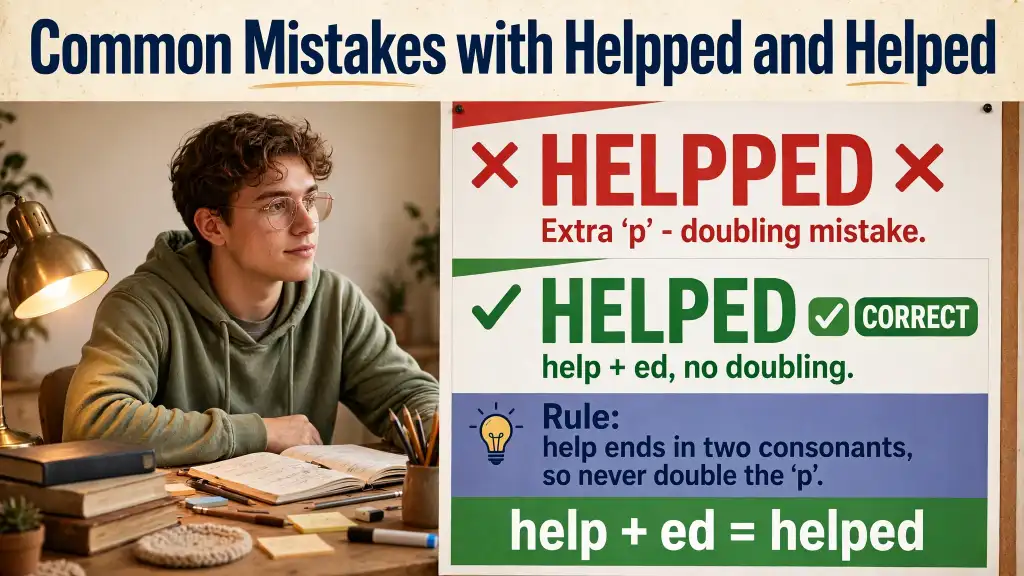
Mistake 1: Doubling the Letter P
Incorrect: She helpped her younger sister.
Correct: She helped her younger sister.
Why? The word “help” takes “-ed” without doubling the final consonant.
Mistake 2: Using Helpped in Formal Writing
Incorrect: Our team helpped the customer solve the problem.
Correct: Our team helped the customer solve the problem.
Why? “Helpped” is not the standard spelling and may make professional writing look careless.
Mistake 3: Confusing Helped With Helping
Incorrect: He helped me yesterday and helping me today.
Correct: He helped me yesterday and is helping me today.
Why? “Helped” describes a past action, while “helping” is used in continuous verb forms.
Mistake 4: Using Help Instead of Helped for a Finished Past Action
Incorrect: She help me last week.
Correct: She helped me last week.
Why? Regular verbs usually take “-ed” when describing a completed past action.
Mistake 5: Assuming Every Short Verb Doubles Its Final Letter
Incorrect: I helpped him because I stopped at the wrong spelling rule.
Correct: I helped him because I remembered the spelling rule.
Why? Consonant doubling depends on the verb’s spelling pattern. It does not apply to every verb.
Helped in Everyday Examples
Helped in Emails
In professional emails, “helped” is useful when describing support, teamwork, or completed tasks.
Example:
Subject: Thank You for Your Support
Dear Sarah,
Thank you for your assistance with the project. Your advice helped us complete the work on time.
Best regards,
James
Helped in News Writing
News reports often use “helped” to explain how a person, group, or action contributed to a result.
Example: Local volunteers helped residents recover after the storm.
Helped on Social Media
The word is also common in casual posts and comments.
Examples:
- Your advice helped me a lot!
- This guide helped me understand the topic.
- Thanks to everyone who helped make this event possible.
Helped in Academic Writing
Students and researchers can use “helped” to describe how a method or action supported a result.
Examples:
- The experiment helped researchers understand the process.
- Regular revision helped students prepare for the exam.
- The study helped explain the changes in reading habits.
Helped in Formal Writing
Examples:
- The new system helped improve workplace efficiency.
- The training program helped employees develop new skills.
- Community support helped the organization reach its goal.
These examples all use the same correct spelling: helped.
Helped vs Helpped: Google Trends and Usage Data
Is Helped More Popular Than Helpped?
“Helped” is the standard English spelling, while “helpped” is a spelling error. Therefore, “helped” is the form you should expect to see in edited books, professional articles, news reports, and other standard English writing.
People may search for both spellings because they want to check which version is correct. Such searches often reflect spelling uncertainty rather than equal usage.
How Does Usage Differ by Country?
The spelling of “helped” is the same in the United States, the United Kingdom, Canada, Australia, Pakistan, and India.
There is no established regional spelling difference between “helped” and “helpped.”
What About Google Trends?
Google Trends can help compare search interest in “helpped” and “helped” over a selected time period and region. However, search interest is not the same as the number of times a word is correctly used in writing.
No specific live Google Trends figures are provided here, so exact search volumes or country rankings should not be assumed.
For writers and editors, the practical conclusion is clear: use “helped” regardless of your target audience.
Helpped vs Helped: Comparison Table
| Feature | Helped | Helpped |
| Spelling status | Correct | Incorrect |
| Base word | Help | Intended to be help |
| Part of speech | Verb form | Misspelling |
| Past tense | Yes | No |
| Past participle | Yes | No |
| British English | Accepted | Not standard |
| American English | Accepted | Not standard |
| Formal writing | Recommended | Avoid |
| Example | She helped her friend. | She helpped her friend. |
Remember: The correct spelling is “helped,” with one “p” before “-ed.”
Frequently Asked Questions
Q1. Is it helpped or helped?
Helped is correct. “Helpped” is a common spelling error. For example, write “He helped his friend,” not “He helpped his friend.”
Q2. Why is helped spelled with one p?
The base verb “help” already ends in “p.” When you add “-ed,” you get “helped.” The spelling rule does not require doubling the final consonant.
Q3. Is helpped ever correct?
No. “Helpped” is not an accepted standard spelling in modern English. Use “helped” in formal and informal writing.
Q4. Is helped correct in British English?
Yes. “Helped” is correct in both British and American English. There is no spelling difference between the two varieties.
Q5. What is the past tense of help?
The past tense of “help” is helped.
Example: She helped me yesterday.
Q6. Is helped a past tense or a past participle?
It can be both. Use it as a past-tense verb in “She helped me.” Use it as a past participle in “She has helped me.”
Q7. How can I remember the correct spelling of helped?
Remember the simple pattern: help + ed = helped. Do not add another “p.” You can also check your writing with a spellchecker if you are unsure.
Conclusion
When choosing between helpped or helped, always use “helped.” It is the correct past tense and past participle of the verb “help,” which means to support someone, provide assistance, or make a task easier. “Helpped” is a common spelling mistake caused by confusion about English consonant-doubling rules.
The key point is simple: add “-ed” to “help” without doubling the letter “p.” This rule applies to British English, American English, and standard English writing around the world. If you are writing a school assignment, a professional email, a news report, or a blog post, “helped” is the spelling you need.
You can remember it by breaking the word into two parts: help + ed = helped. Compare it with words such as “stopped” and “planned” to see why not every verb follows the same spelling pattern.
Before publishing or submitting your work, check for common errors like “helpped,” especially in important documents. Using the correct spelling makes your writing clearer, more accurate, and more professional. When in doubt, choose helped every time.
Explore More Articles:
- Womens or Women’s: The Simple Grammar Fix You Need
- Enflamed or Inflamed: Meaning, Difference, and Examples
- Outter or Outer: Don’t Let This Spelling Trip You Up

I’m Claire Morgan, the author behind wordvexa.com, where I write about English grammar, sentence structure, punctuation, and everyday language. My goal is to make grammar simple, clear, and practical, helping readers understand the rules and apply them with confidence in real-world writing.