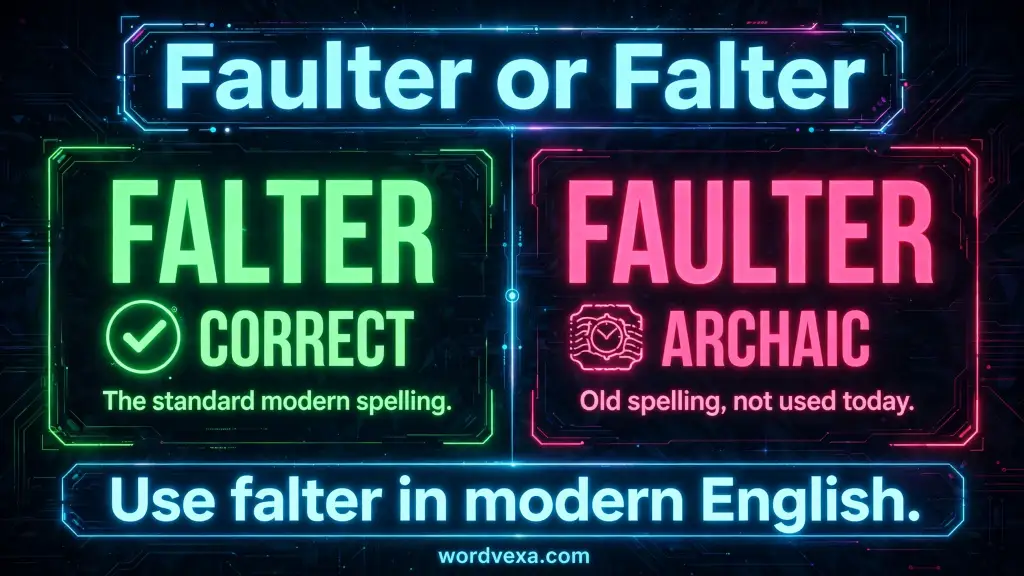
Faulter or falter is a spelling comparison in which falter means to hesitate, lose confidence, become weaker, or struggle to continue, while faulter is an archaic spelling that is generally avoided in modern English.
Many people search for “falter or faulter” because English spelling can be confusing. The word faulter may seem correct because it resembles fault, but the two words follow different spelling patterns. You may also encounter the older form in historical texts, which can add to the confusion.
Understanding the correct spelling helps you write more clearly in school assignments, professional emails, academic papers, and everyday conversations.
In this guide, you will learn the meaning of falter, explore its origin, compare its usage across English-speaking countries, and discover practical examples that show how to use it correctly.
Falter or Faulter: Quick Answer
Falter is the correct standard spelling in modern English. It means to hesitate, become weaker, lose confidence, or move unsteadily. Faulter is an obsolete or archaic spelling of the verb and should generally be avoided in contemporary writing.
Examples:
- Correct: Her confidence did not falter during the interview.
- Incorrect in modern usage: Her confidence did not faulter during the interview.
- Correct: The team’s performance began to falter in the second half.
Remember that falter is used in American, British, Canadian, and Australian English. It does not have a regional spelling variation like color and colour.
What Does Falter Mean?
Definition of Falter
Falter is a verb that means to lose strength, confidence, stability, or determination. It can describe a person who hesitates, a voice that becomes unsteady, a person who struggles while walking, or a process that begins to lose momentum.
The word is useful in both literal and figurative situations.
Common Meanings of Falter
1. To lose confidence or hesitate
When someone is unsure about what to say or do, they may falter.
Example: She began to falter when the interviewer asked a difficult question.
2. To become weaker or less effective
The word can describe a business, economy, plan, or performance that starts to struggle.
Example: Sales began to falter after the company raised its prices.
3. To move unsteadily
A person may falter when walking because of weakness, tiredness, or a loss of balance.
Example: The exhausted runner began to falter near the finish line.
4. To speak with hesitation
A person’s voice may falter when they feel nervous, emotional, or uncertain.
Example: His voice faltered as he thanked his family.
Synonyms of Falter
The best synonym depends on the context.
- Hesitate: To pause before acting or speaking.
- Waver: To become uncertain or less determined.
- Stumble: To lose balance or make a mistake while speaking.
- Weaken: To lose strength or effectiveness.
- Stagger: To move unsteadily.
- Flinch: To react with fear or hesitation.
These words have related meanings, but they are not always interchangeable. For example, stumble often refers to a physical misstep, while falter can describe a loss of confidence or momentum.
The Origin of Falter
Where Does the Word Falter Come From?
The word falter has a long history in English. It dates back to Middle English, with early uses referring to stumbling, moving unsteadily, or speaking with difficulty.
Its exact origin remains uncertain. One possibility connects it with Old Norse words associated with being troubled, burdened, or hesitant. Another theory links it to an older English verb related to folding or giving way. These explanations are theories rather than proven facts.
The word later developed broader meanings. It came to describe not only physical instability but also uncertainty in speech, purpose, and action.
You can read more about its history in the Oxford Advanced Learner’s Dictionary and Online Etymology Dictionary.
Why Do People Write Faulter?
The spelling faulter has appeared in older English texts. It is an archaic form of falter, rather than a new spelling adopted by a particular modern English-speaking country.
Its appearance may also seem logical to people who associate the word with fault. However, the modern verb falter does not require the letters “au.”
For present-day writing, use falter, faltered, faltering, and unfaltering.
Falter or Faulter: British English vs American English
Is Falter Different in British and American English?
No. Both British and American English use falter as the standard spelling. The spelling does not change according to the country, and faulter is not a standard regional alternative.
| British English | American English | Example |
| Falter | Falter | Her courage did not falter. |
| Faltered | Faltered | His voice faltered during the speech. |
| Faltering | Faltering | The company faced faltering sales. |
| Unfaltering | Unfaltering | She showed unfaltering support. |
What Do Style Guides Recommend?
Modern dictionaries, educational resources, and professional editing practices support falter as the normal spelling.
In professional writing, consistency and standard spelling matter. Use falter in:
- Academic essays and research papers.
- Business reports and presentations.
- News articles and blog posts.
- Emails and workplace communication.
- Books and educational materials.
If you are quoting a historical document that uses faulter, preserve the original spelling when appropriate. Do not change a historical quotation simply to make it match modern spelling conventions.
Faulter and Falter: Which Version Should You Use?
United States
Use falter in all ordinary contexts. It is the accepted spelling for school assignments, professional documents, websites, and everyday communication.
Example: The project began to falter because of poor planning.
United Kingdom
British writers also use falter. There is no British spelling rule that requires faulter.
Example: Her determination never faltered.
Canada
Use falter in Canadian English. Although Canadian spelling includes a mixture of British and American conventions, this word is spelled the same way in both.
Australia
Australian English follows the same spelling: falter.
Example: The team’s progress started to falter after several injuries.
International Writing
For websites, educational materials, and international audiences, falter is the safest choice. Readers across English-speaking regions will recognize it.
Academic and Business Writing
Use falter in formal writing. Avoid faulter unless you are discussing historical spelling or reproducing a source that uses the older form.
The practical rule is simple: use falter unless you have a specific historical reason to preserve faulter.
Falter and Faulter: Common Mistakes
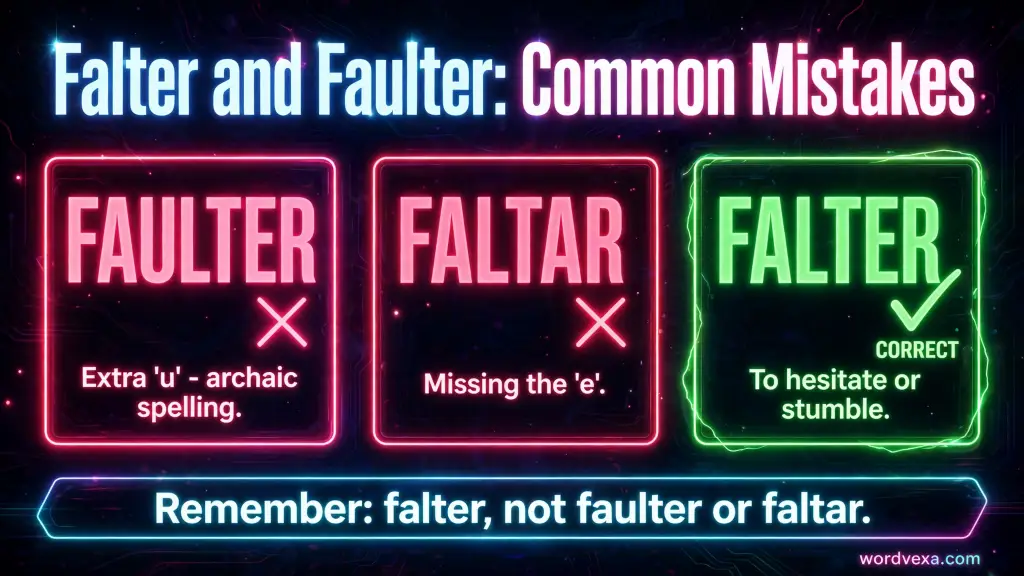
Mistake 1: Writing Faulter in a Modern Sentence
Incorrect: The speaker did not faulter during the presentation.
Correct: The speaker did not falter during the presentation.
Why: Falter is the standard modern spelling of the verb.
Mistake 2: Confusing Falter With Fault
Incorrect: The economy began to fault during the recession.
Correct: The economy began to falter during the recession.
Why: Fault can mean a defect or an error. Falter means to weaken, hesitate, or lose momentum. The correct choice depends on the intended meaning.
Mistake 3: Misspelling Faltered
Incorrect: Her voice faultered when she became emotional.
Correct: Her voice faltered when she became emotional.
Why: The past tense is formed by adding -ed to falter, producing faltered.
Mistake 4: Misspelling Faltering
Incorrect: The company is faultering under pressure.
Correct: The company is faltering under pressure.
Why: The present participle is faltering, not faultering.
A Simple Memory Tip
Remember this sentence:
When confidence starts to falter, do not add a “u.”
The correct spelling has seven letters: F-A-L-T-E-R.
Everyday Examples of Falter and Faulter
The following examples show how to use falter naturally in different types of writing.
1. Emails
Example: I appreciate your continued support, even when progress begins to falter.
Example: Our plans should not falter because of a minor delay.
In professional emails, falter can describe a project losing momentum or a plan becoming less effective.
2. Business Writing
Example: Revenue began to falter during the final quarter.
Example: The company maintained its growth despite faltering market demand.
The word works well in business reports because it describes declining performance without necessarily suggesting complete failure.
3. News Headlines
Example: Economic Growth Begins to Falter Amid Rising Costs
Example: Team Refuses to Falter After a Difficult Start
In headlines, falter is concise and helps describe a setback, slowdown, or loss of confidence.
4. Blogs
Example: Your motivation may falter when you face repeated setbacks, but a clear routine can help you continue.
Example: Even a well-planned strategy can falter without regular review.
Blog writers can use the word to discuss productivity, learning, business, fitness, and personal development.
5. Social Media
Example: Progress may be slow, but do not let your determination falter.
Example: A difficult day does not mean your goals have to falter.
These examples sound natural in motivational posts and short captions.
6. Academic Writing
Example: The study’s findings suggest that student engagement may falter when feedback is delayed.
Example: The argument begins to falter when the author introduces unsupported claims.
In academic writing, the word can describe weaknesses in an argument, research process, or performance.
7. Daily Conversation
Example: My confidence started to falter before the interview.
Example: The runner’s pace began to falter near the end of the race.
These sentences show that falter is useful in everyday English, not just formal writing.
Faulter vs Falter: Google Trends and Modern Usage
Which Spelling Is More Common?
Falter is the standard spelling used in modern English. It appears in established dictionaries and is appropriate in contemporary writing across major English-speaking regions.
Faulter is associated with older or archaic usage. Some people may search for it because they have encountered it in a historical text, assumed it follows the spelling of fault, or are unsure which form is correct.
Why Do People Search for Falter or Faulter?
The search usually reflects one of three questions:
- Which spelling is correct?
- What does falter mean?
- Is faulter an acceptable alternative?
The spelling difference is especially confusing because the words look similar and faulter has historical usage.
What Does Google Trends Tell Us?
Google Trends can help compare search interest across regions and periods. However, no verified numerical comparison is provided here, so it would be misleading to claim a specific search-volume figure or percentage difference.
The practical language recommendation does not depend on a particular Trends score: use falter in modern writing and treat faulter as an archaic form.
For a live comparison, visit Google Trends and compare the search terms “falter” and “faulter.” Check the selected region, time range, and search type before drawing conclusions. Trends data measures relative search interest, not the percentage of writers who spell a word correctly.
Quick Comparison Table
| Version | Meaning | Correct? | Region | Example |
| Falter | To hesitate, weaken, or lose confidence | Yes, standard modern spelling | Worldwide English | Her confidence did not falter. |
| Faulter | Historical or archaic form of falter | Generally avoid in modern writing | Older English texts | The old text uses the spelling faulter. |
| Faltered | Past tense of falter | Yes | Worldwide English | His voice faltered. |
| Faltering | Present participle of falter | Yes | Worldwide English | The business faced faltering demand. |
| Unfaltering | Steady and determined | Yes | Worldwide English | She showed unfaltering courage. |
Key Takeaways
- Falter is the standard modern English spelling.
- Faulter is an archaic spelling and is generally unsuitable for contemporary writing.
- Falter means to hesitate, weaken, move unsteadily, or lose confidence.
- The spelling is the same in British, American, Canadian, and Australian English.
- The correct related forms are faltered, faltering, and unfaltering.
- Do not confuse falter with fault, which has a different meaning.
- Historical quotations may retain faulter when the original spelling matters.
- For essays, emails, articles, and professional documents, choose falter.
FAQs About Falter or Faulter
Q1. Is falter or faulter correct?
Falter is correct for standard modern English. It means to hesitate, lose confidence, become weaker, or move unsteadily. Faulter is an archaic spelling that appears in older texts, but it is not the normal spelling used in modern writing. Use falter in schoolwork, emails, business documents, and published articles.
Q2. What does falter mean in simple words?
To falter means to hesitate, struggle, or become less strong or confident. For example, if a student begins to falter during a difficult presentation, the student may lose confidence or struggle to continue speaking. The word can also describe a business that loses momentum or a person who walks unsteadily.
Q3. Is faulter ever a correct word?
Faulter has historical uses and is recorded as an archaic form of falter. Older literature may contain it, so it is not simply an invented spelling. However, modern writers should normally use falter. If you are quoting an old source, you may preserve its original spelling when accuracy requires it.
Q4. Is falter spelled the same in British and American English?
Yes. British and American English both use falter. There is no standard regional difference in this spelling. The same is true of its common forms, including faltered, faltering, and unfaltering. Writers in Canada and Australia also use falter.
Q5. What is the past tense of falter?
The past tense and past participle of falter are both faltered. For example, “Her voice faltered during the speech” describes a past event. The spelling does not change to faultered. To form the present participle, add -ing to make faltering.
Q6. What is the difference between falter and fault?
Falter is a verb that means to hesitate, weaken, or lose momentum. Fault is usually a noun referring to a defect, mistake, or responsibility for something wrong. For example, “His confidence began to falter” describes declining confidence, while “The mistake was my fault” identifies responsibility for an error.
Q7. What are synonyms for falter?
Common synonyms include hesitate, waver, weaken, stumble, and stagger. The best synonym depends on the sentence. Use hesitate for uncertainty before acting, weaken for a loss of strength, and stagger for unsteady movement. Falter is especially useful when describing a loss of confidence or momentum.
Q8. How do you use falter in a sentence?
You can use falter to describe speech, confidence, movement, or progress. For example, “She did not falter under pressure” means she remained determined. “The company’s growth began to falter” means its progress slowed or weakened. The word usually appears as a verb and can be used in both formal and informal writing.
Conclusion: Falter or Faulter?
The choice between falter or faulter is simple once you understand their history and modern usage. Falter is the correct standard spelling in contemporary English. It means to hesitate, lose confidence, become weaker, or struggle to maintain progress.
Although faulter appears in older English texts, it is not the spelling you should normally use in a modern article, school assignment, email, or business report. The same spelling rule applies in American, British, Canadian, and Australian English.
Remember the related forms: faltered for the past tense, faltering for an ongoing action, and unfaltering for something steady and determined. Learning these forms will help you avoid common spelling errors and use the word with confidence.
When editing your writing, focus on both spelling and meaning. Choose falter when describing hesitation or weakness, and use fault when referring to a mistake or defect.
The easiest rule to remember is this: confidence may falter, but the spelling never needs a “u.”
For more practical English spelling guides and word comparisons, explore related articles on Wordvexa.com and keep building your vocabulary one word at a time.
You May Also Like:
- Enflamed or Inflamed: Meaning, Difference, and Examples
- Agast or Aghast: Which Spelling Is Correct?
- Womens or Women’s: The Simple Grammar Fix You Need

I’m Sloane Mercer, a U.S.-based English language writer focused on grammar, spelling, vocabulary, and everyday English usage. Through Wordvexa, I provide clear and practical explanations to help readers choose the right words and communicate with confidence.