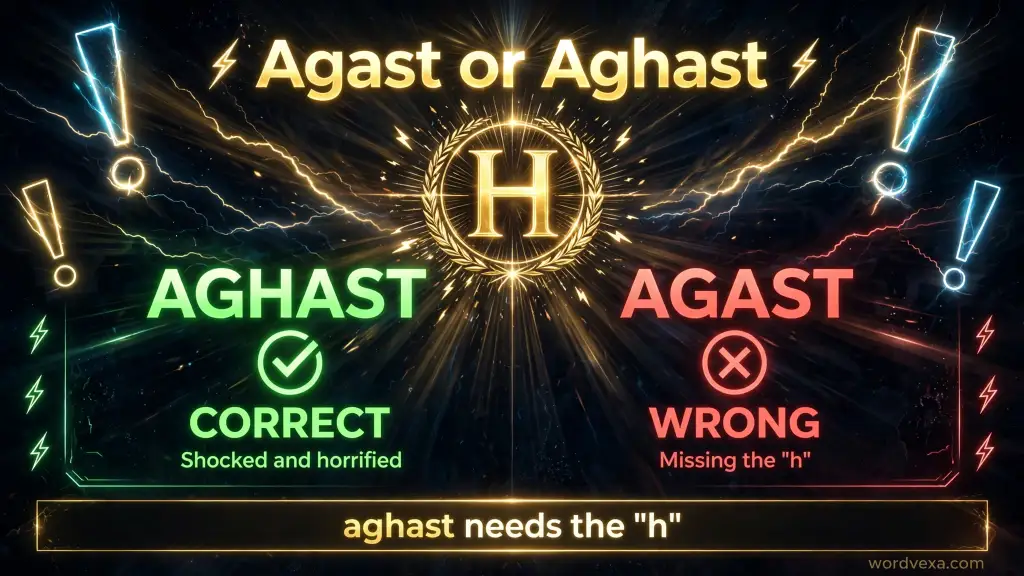
Agast or aghast: Aghast means shocked, horrified, or filled with sudden fear and surprise. In modern English, aghast is the standard spelling, while agast is an older spelling that is now obsolete or uncommon in ordinary writing.
Although both forms have appeared in English history, modern readers should generally use aghast in essays, emails, articles, and everyday communication.
Have you ever read a sentence and wondered the letter h belongs in a word? This is a common reason people search for agast or aghast. The letter combination gh can be confusing because it is silent in many English words, including night, light, and thought.
However, the difference between these two spellings is not a matter of British versus American English. Both varieties use aghast as the standard modern form. The word describes a strong emotional reaction to something shocking, frightening, or disturbing.
In this guide, you will learn the meaning, pronunciation, origin, and correct usage of aghast. You will also discover common spelling mistakes, practical sentence patterns, differences between related words, and examples for academic, professional, and everyday writing.
Agast or Aghast: Quick Answer
Aghast is the spelling you should use in modern English. It describes someone who feels intense shock, horror, or disbelief after seeing, hearing, or discovering something unexpected.
| Word | Meaning or status | Recommended usage |
| Aghast | Shocked, horrified, or deeply alarmed | Standard modern English |
| Agast | Older historical form with a related meaning | Historical discussion or original quotations |
Example 1: She was aghast at the amount of damage caused by the storm.
Example 2: The teacher looked aghast when she discovered that the exam papers were missing.
The important point is that agast is not simply a random spelling error in every context. It is a documented older form. However, aghast is the appropriate choice for modern general writing.
What Does Aghast Mean?
Aghast means filled with shock, horror, or sudden alarm. It is an adjective that describes a person’s emotional reaction to something disturbing, frightening, or difficult to believe.
The Cambridge Dictionary and Oxford Learner’s Dictionaries describe the word in terms of horror, surprise, and shock. It often appears when a person reacts strongly to an unexpected event.
Definition and Part of Speech
- Word: Aghast
- Part of speech: Adjective
- Simple definition: Shocked or horrified
- Pronunciation: /əˈɡæst/ in many American accents; /əˈɡɑːst/ in many British accents
- Common construction: Aghast at something
- Related words: Horrified, appalled, stunned, dismayed, and flabbergasted
Example: The family was aghast at the news of the accident.
In this sentence, aghast describes the family’s strong emotional response.
When Should You Use Aghast?
Use aghast when a situation causes more than ordinary surprise. The word is particularly suitable for events involving fear, horror, disbelief, or serious disappointment.
Compare these sentences:
- Mild surprise: I was surprised to see my old friend.
- Strong shock: I was aghast to discover that someone had stolen my laptop.
The second sentence communicates a much stronger reaction.
Synonyms of Aghast
Several words have meanings close to aghast, but each has a slightly different use.
| Word | Meaning | Best use |
| Horrified | Filled with horror or fear | Frightening or disturbing events |
| Appalled | Shocked by something unacceptable | Bad behaviour or serious wrongdoing |
| Stunned | Unable to react immediately because of surprise | Unexpected news or events |
| Dismayed | Upset, worried, or disappointed | Unwelcome results or setbacks |
| Flabbergasted | Extremely surprised or amazed | Informal conversation |
Example: The manager was appalled by the dishonest behaviour of the employee.
This sentence is similar to one using aghast, but appalled places more emphasis on disapproval.
The Origin of Agast and Aghast
The history of these spellings explains why both forms appear in older English texts.
According to the Oxford Learner’s Dictionaries and the Online Etymology Dictionary, aghast developed from Middle English forms such as agast and agasted. These forms were connected with the older verb agasten, meaning to frighten or terrify.
The spelling with gh became more widely established over time, probably influenced by words such as ghost and related forms. The spelling aghast became general around the eighteenth century.
How Did the Spelling Change?
The historical development can be summarised as follows:
- Early English: Forms related to frightening or terrifying were used.
- Middle English: Agast and agasted appeared in written texts.
- Later historical usage: The spelling aghast became established.
- Modern English: Aghast became the standard spelling used in ordinary writing.
This history shows why spelling rules sometimes preserve letters that do not have a separate sound in modern pronunciation.
Is Agast a Real Word?
Yes, agast is a historical English form. It appears in older texts and historical dictionaries, where it is associated with being frightened, terrified, or shocked.
However, the fact that a form existed historically does not mean it is the preferred spelling today. Modern dictionaries identify aghast as the normal form for contemporary writing.
Example: A writer studying an old poem may preserve agast if that is the spelling used in the original edition.
For a new article, school assignment, email, or business report, use aghast.
Agast or Aghast: British English vs American English
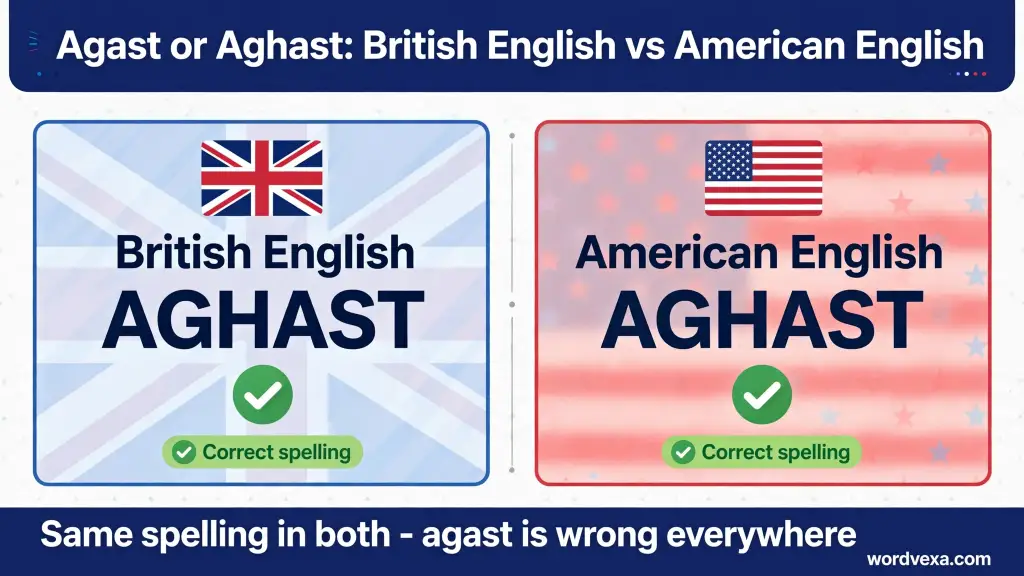
There is no standard British-American spelling difference between aghast and agast. British and American writers both use aghast in modern English.
| British English | American English | Example |
| Aghast | Aghast | She was aghast at the news. |
| Aghast | Aghast | He looked aghast at the damage. |
| Aghast | Aghast | They stood aghast in disbelief. |
Regional Pronunciation Differences
Although the spelling remains the same, pronunciation can vary by accent.
Many American speakers pronounce aghast with a vowel similar to the one in cat. Many British speakers use a vowel similar to the one in father. Other regional accents may differ.
The gh does not have a separate sound in the standard pronunciations shown above.
What Do Editors and Style Guides Recommend?
For modern publishing, follow the spelling in a reputable current dictionary and the style guide used by your publication.
- United States: Use aghast.
- United Kingdom: Use aghast.
- Canada: Use aghast.
- Australia: Use aghast.
- Academic publishing: Use aghast, except when reproducing historical spelling.
- Online writing: Use aghast for consistency and clarity.
Unlike color and colour, these forms are not competing regional spellings in modern general English.
Aghast or Agast: British English vs American English
Which Version Should You Use?
Use aghast whenever you are writing for a modern English-speaking audience. Your country, audience, or writing style does not normally change this recommendation.
United States
American writers should use aghast in school assignments, emails, news articles, and professional documents.
Example: The committee was aghast at the unexpected financial loss.
United Kingdom
British writers use the same spelling.
Example: The residents were aghast at the damage to the historic building.
Canada and Australia
Canadian and Australian English also use aghast. There is no need to replace it with agast.
Example: The audience was aghast at the shocking announcement.
International Writing
For international readers, aghast is the clearest standard choice. It is recognised across major varieties of English.
Academic Writing
Use aghast when describing a character’s reaction, a historical event, or a response to troubling information. If you quote an older text, preserve the original spelling when appropriate and explain it if necessary.
Business Writing
The word is grammatically correct in professional communication, but its emotional strength matters. In a formal report, concerned, alarmed, or shocked may sound more measured.
Example: The directors were aghast at the scale of the unexpected losses.
Common Mistakes with Agast and Aghast
The most common mistake is leaving out the h. Other mistakes involve using the word for a weak reaction or choosing an unnatural sentence structure.
Mistake 1: Leaving Out the H
Incorrect in modern writing: The parents were agast at the news.
Correct: The parents were aghast at the news.
Explanation: Aghast is the standard modern spelling. Agast may be encountered in historical sources, but it is not the usual form for contemporary writing.
Mistake 2: Treating the Words as Regional Variants
Incorrect claim: Americans write agast, while British people write aghast.
Correct rule: Both American and British English use aghast.
Explanation: This is a spelling-history issue, not a regional spelling difference.
Mistake 3: Using Aghast for Mild Surprise
Less suitable: I was aghast when I found my favourite pen.
More natural: I was surprised when I found my favourite pen.
Explanation: Aghast usually expresses a strong reaction. Use it when the event causes shock, horror, alarm, or disbelief.
Mistake 4: Using the Wrong Preposition
Less natural: She was aghast with the announcement.
Correct: She was aghast at the announcement.
Explanation: The common construction is aghast at something. You can also use aghast that something happened or aghast to discover something.
A Simple Memory Tip
Remember this phrase:
Aghast has an H, just like ghost.
This memory tip can help you recall the spelling. The historical connection is more complex, but the reminder is useful for everyday writing.
Everyday Examples of Aghast
The following sentences show how aghast can be used in different situations. Notice how each sentence describes a strong reaction.
Emails
Example: I was aghast to learn that the meeting had been cancelled without notice.
This sentence communicates shock at unexpected information.
Business Writing
Example: The leadership team was aghast at the unexpected increase in operating costs.
This wording conveys a strong reaction to a serious business problem. For a neutral report, concerned may be more appropriate.
News Headlines
Example: Residents Aghast After Historic Building Is Demolished
This headline uses the word to express public shock. In actual news reporting, the headline should reflect verified reactions.
Blogs
Example: I was aghast when I discovered how much food our household wasted each week.
The word communicates a personal reaction and adds emotional emphasis.
Social Media
Example: I was aghast at the final bill. I had no idea the repairs would cost so much!
This is suitable for an informal post describing a genuinely shocking expense.
Academic Writing
Example: The characters were aghast at the consequences of their decision.
This sentence works well in literary analysis because it describes an intense emotional reaction.
Daily Conversation
Example: “You paid that much for a broken phone?” she asked, aghast.
The word shows that the speaker is shocked and perhaps disapproving.
Describing a Facial Expression
Example: He stared at the damaged painting with an aghast expression.
Here, the adjective helps readers picture a face showing shock or horror.
Using Aghast with That
Example: We were aghast that nobody had reported the safety problem.
The word introduces a clause explaining the reason for the reaction.
Using Aghast with To Discover
Example: The family was aghast to discover that their home had been flooded.
This pattern links the emotion directly to an unexpected discovery.
Aghast and Agast: British English vs American English
Google Trends and Modern Usage
Searches for agast or aghast are likely to reflect a need for spelling help, a definition, or a quick explanation of the difference between the two forms. This is a natural informational search intent, but it does not establish exact search volumes.
Which Spelling Is More Common?
Aghast is the standard spelling used in modern English. The form agast is mainly relevant to historical texts, older dictionary entries, and discussions of spelling history.
Why Do People Search for This Keyword?
Common reasons include:
- They have heard the word but are unsure how to spell it.
- They are confused by the silent h.
- They have encountered agast in an older text.
- They want to check a sentence before submitting an assignment.
- They are improving their English vocabulary or editing online content.
How to Interpret Google Trends Data
Google Trends can help researchers compare search interest over time and by region. However, it does not automatically combine spelling variants, and its interest scores should not be treated as exact search-volume figures.
No verified numerical trend data is presented here. Therefore, this article does not claim that one spelling receives a particular percentage of searches or is more popular in a specific country.
For practical writing, the recommendation is straightforward: use aghast in modern English, regardless of your audience.
Quick Comparison Table: Agast vs Aghast
| Version | Meaning | Correct? | Region or context | Example |
| Aghast | Shocked or horrified | Yes, standard modern spelling | British English | She was aghast at the news. |
| Aghast | Shocked or horrified | Yes, standard modern spelling | American English | He looked aghast at the damage. |
| Agast | Historical form with a related meaning | Obsolete or uncommon in ordinary modern writing | Historical English | The old text preserves the form agast. |
| Agast | Intended as the usual modern adjective | Not the recommended spelling | Modern general English | Write “She was aghast,” not “She was agast.” |
The central distinction is historical rather than regional. For current writing, aghast is the safe and standard choice.
Key Takeaways
- Aghast is the standard modern English spelling.
- Agast is a documented historical form.
- Aghast means shocked, horrified, or deeply alarmed.
- British and American English use the same standard spelling.
- The h does not have a separate sound in common pronunciations.
- Common patterns include aghast at something, aghast that something happened, and aghast to discover something.
- Use the word for strong emotional reactions, not ordinary surprise.
- Remember the spelling tip: aghast has an H, like ghost.
Frequently Asked Questions
Q1. Is it agast or aghast?
Aghast is the standard spelling in modern English. It means shocked, horrified, or suddenly filled with fear and surprise. Although agast is an older form documented in English history, it is not the normal spelling used in contemporary articles, emails, school assignments, or professional documents. When writing for a modern audience, choose aghast.
Q2. What does aghast mean in simple words?
Aghast means very shocked or horrified by something unexpected or upsetting. For example, if someone discovers that an important family photograph has been destroyed, they might feel aghast. The word describes a strong emotional reaction, often involving disbelief, fear, or dismay. It is stronger than simply feeling surprised.
Q3. Is agast a real word?
Yes, agast is a historical English form associated with the older verb agasten, meaning to frighten or terrify. Historical dictionaries record its use in older texts. However, it is obsolete or uncommon in ordinary modern writing. If you are writing a contemporary article, email, assignment, or report, use aghast instead.
Q4. Is aghast correct in British English?
Yes. Aghast is the standard spelling in British English. British writers do not normally remove the h to write agast. Although pronunciation varies among British accents, the spelling remains the same. Use aghast in British essays, books, newspaper articles, professional correspondence, and everyday writing.
Q5. Is aghast correct in American English?
Yes. American English also uses aghast. There is no standard American spelling agast for this meaning. For example, an American writer might say, “The team was aghast at the unexpected result.” The spelling is the same in British, American, Canadian, and Australian English.
Q6. How do you use aghast in a sentence?
Use aghast to describe a strong reaction to something shocking or disturbing. For example, “She was aghast at the amount of damage caused by the storm.” Other natural constructions include “He looked aghast,” “They were aghast that it happened,” and “I was aghast to discover the truth.” The word functions as an adjective.
Q7. What is the difference between aghast and shocked?
Both words describe reactions to unexpected events, but aghast often suggests a stronger feeling of horror, alarm, or disbelief. Shocked is more general and can describe positive or negative surprises. You might be shocked by an unexpected gift, but aghast is more suitable for a disturbing discovery or deeply upsetting event.
Q8. How do you pronounce aghast?
Aghast is commonly pronounced /əˈɡæst/ in American English and /əˈɡɑːst/ in many British accents. The first syllable is unstressed, and the gh does not have a separate sound. Because pronunciation varies by accent, listening to a reputable dictionary’s audio recording is a helpful way to learn the word.
Q9. What is a synonym for aghast?
Common synonyms include horrified, appalled, stunned, dismayed, and flabbergasted. The best choice depends on context. Horrified suggests fear or horror, appalled often expresses shock at something unacceptable, and stunned focuses on being overwhelmed by surprise. Aghast often combines shock with horror or disbelief.
Q10. Is aghast formal or informal?
Aghast is suitable for both formal and informal English. You can use it in literature, news writing, essays, conversations, and personal blogs. In a formal business report, however, a more neutral word such as concerned or alarmed may be better if you want to avoid an overly emotional tone.
Conclusion
The correct choice in agast or aghast is aghast for modern general English. The word describes someone who feels shocked, horrified, or deeply alarmed by an unexpected or disturbing event.
Although agast appears in historical English, it is not the usual modern spelling. This difference is not a matter of British versus American English. Writers in both regions use aghast, as do writers in Canada and Australia.
To use the word naturally, remember common sentence patterns such as aghast at the news, aghast to discover the truth, and aghast that something happened. Also, consider the strength of the emotion. The word works best when the situation calls for more than mild surprise.
For students, ESL learners, bloggers, and professional writers, the simplest rule is to remember the h in aghast. When in doubt, consult a reputable dictionary for spelling, meaning, and pronunciation.
Memorable takeaway: When the news leaves someone shocked or horrified, spell it aghast, not agast in ordinary modern writing.
Explore more spelling and grammar guides on Wordvexa.com to build confidence in your English writing.
You May Also Like:
- Attach or Attatch: How to Spell It Correctly
- Don’ts or Dont’s: Correct Usage and Apostrophe Rules
- Enflamed or Inflamed: Meaning, Difference, and Examples

I’m Claire Morgan, the author behind wordvexa.com, where I write about English grammar, sentence structure, punctuation, and everyday language. My goal is to make grammar simple, clear, and practical, helping readers understand the rules and apply them with confidence in real-world writing.




2 thoughts on “Agast or Aghast: Which Spelling Is Correct?”