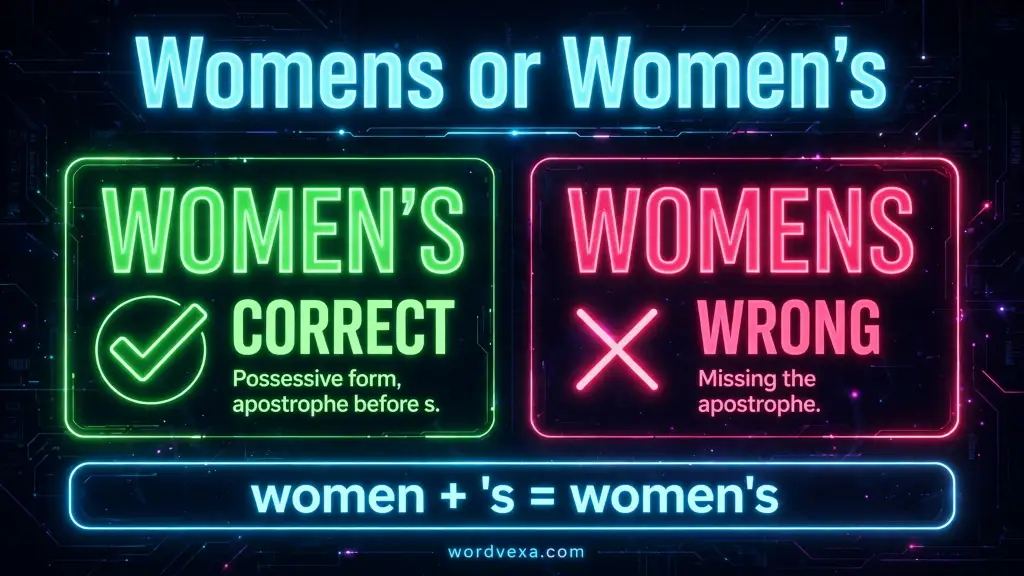
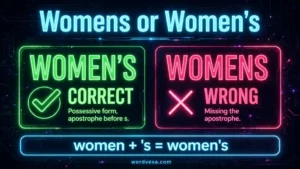
The correct spelling is women’s, the possessive form of women used to show ownership, association, or a connection with women. For example, “women’s clothing” means clothing designed for women, while “women’s rights” refers to the rights of women.
Many people search for “womens or women’s” because the word women is already plural. They wonder if adding an apostrophe and another letter s is necessary.
The answer comes from a simple grammar rule: irregular plural nouns that do not end in s usually form their possessive by adding ’s.
Understanding this rule helps you avoid common mistakes in everyday writing, product descriptions, website menus, business communication, and academic work. It also helps you distinguish between woman’s, women, and women’s, which have different meanings.
In this guide, you will learn the correct spelling, the grammar behind it, the difference between singular and plural possessives, and practical examples you can use in your writing.
Womens or Women’s: The Quick Answer
Women’s is the correct possessive form of women. Use it when referring to something belonging to, associated with, or intended for women. Womens without an apostrophe is generally incorrect in standard English in this context.
Examples:
- Correct: The store sells women’s shoes.
- Correct: Women’s health is an important topic.
- Incorrect in standard prose: The store sells womens shoes.
Remember that women is already the plural of woman. Because it does not end in the letter s, you add an apostrophe followed by s to form the possessive: women’s.
Womens vs Women’s: Quick Answer
The main difference is punctuation and grammatical function.
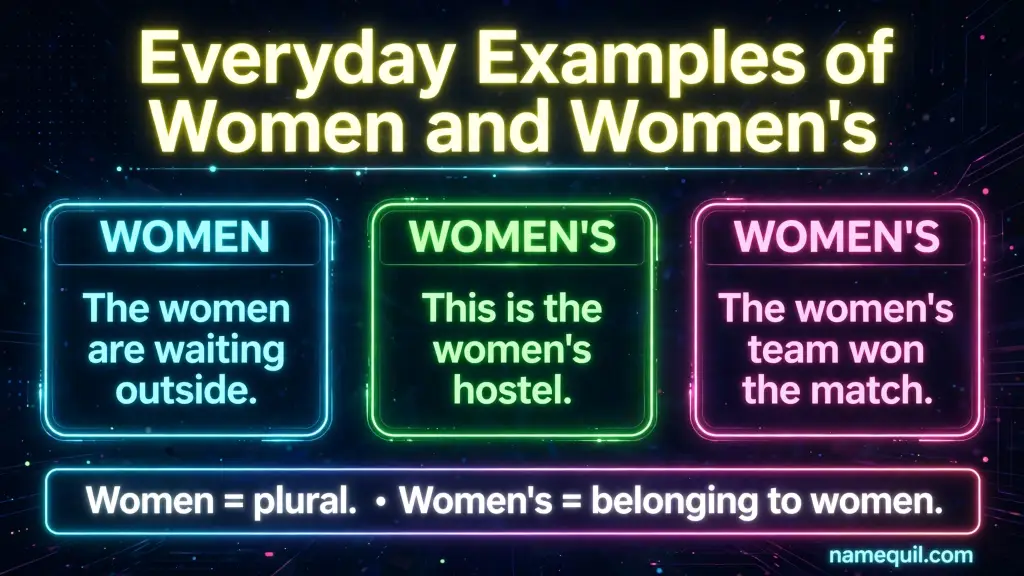
- Women: The plural form of woman. Example: Several women attended the meeting.
- Women’s: The possessive form of women. Example: The women’s meeting starts at noon.
- Womens: Not the standard spelling for the plural possessive. Use women’s in ordinary English sentences.
The apostrophe matters because it helps show the relationship between two nouns. In women’s clothing, it connects women with clothing.
What Does Women’s Mean?
Definition of Women’s
Women’s is the possessive form of the plural noun women. It expresses ownership, association, or a relationship between women and another person, thing, activity, or subject.
For example, women’s education refers to education for women or education concerning women. It does not necessarily mean that women own the education.
The possessive form can express several kinds of relationships.
1. Ownership
Use women’s when something belongs to a group of women.
Example: The women’s bags were left in the classroom.
This sentence indicates that the bags belong to the women.
2. Association
The word can also describe something connected with women.
Example: The university launched a women’s leadership program.
The program is associated with women and their leadership development.
3. Intended Audience
Sometimes, women’s identifies the people for whom a product or service is designed.
Example: The store has a large women’s clothing section.
The clothing section is intended for women.
4. Fields of Study and Public Issues
The possessive form also appears in common expressions about health, rights, education, and history.
Examples include:
- Women’s health
- Women’s rights
- Women’s history
- Women’s education
- Women’s employment
In each phrase, the apostrophe helps express a relationship between women and the topic being discussed.
The Origin of Women’s
How Did the Word Women Develop?
The word women has a long history in English. It developed from older forms related to woman, which itself comes from Old English word forms such as wīfmann. These forms combined elements associated with a woman or female person and a person or human being.
Over time, the spelling and pronunciation changed. Modern English uses woman for one adult female and women for more than one.
The Oxford English Dictionary documents the historical development and older forms of woman.
Why Is the Possessive Spelled Women’s?
Modern English uses apostrophes to mark many possessive forms.
For regular plural nouns ending in s, the possessive usually takes an apostrophe after the final s:
- Girls → girls’
- Teachers → teachers’
- Students → students’
However, women is an irregular plural. It does not end in s, so its possessive form takes apostrophe + s:
- Woman → woman’s
- Women → women’s
The same pattern applies to other irregular plurals:
- Man → man’s
- Men → men’s
- Child → child’s
- Children → children’s
- Person → person’s
- People → people’s
This is a grammatical rule, not a regional spelling preference.
British English vs American English
Is Women’s Different in British and American English?
No. Women’s is the standard possessive spelling in both British and American English. Unlike words such as colour and color, it does not have separate British and American forms.
| British English | American English | Example |
| Women’s | Women’s | Women’s clothing |
| Women’s rights | Women’s rights | Women’s rights are important. |
| Women’s health | Women’s health | The report discusses women’s health. |
| Women’s team | Women’s team | The women’s team won the match. |
| Women’s department | Women’s department | Visit the women’s department. |
Do Style Guides Allow Womens?
In standard English prose, style guides generally use apostrophes to form possessives according to grammatical rules.
However, you may encounter Womens in a website menu, database field, URL, product category, or brand name. Such uses may reflect technical limitations, search optimization choices, or a company’s chosen naming style.
These exceptions do not change the normal spelling rule.
For formal writing, follow the style guide required by your publisher, school, employer, or institution. For ordinary sentences, use women’s.
Women’s or Womens: Which Version Should You Use?
United States
Use women’s in American English.
Examples:
- Women’s clothing is on sale.
- The report examines women’s health.
- She joined the women’s basketball team.
United Kingdom
Use women’s in British English as well.
Examples:
- The women’s changing room is upstairs.
- The organization supports women’s education.
- The shop sells women’s footwear.
Canada
Canadian English also uses women’s. The apostrophe rule remains the same regardless of other differences between Canadian, American, and British spelling.
Australia
Australian English uses women’s in standard writing. Australian government guidance on apostrophes explains how apostrophes mark possession and relationships between nouns.
International Writing
For websites, blogs, educational materials, and international audiences, choose women’s. It is widely understood and grammatically standard.
Academic Writing
Use women’s when discussing women’s rights, health, history, experiences, or other related subjects.
For example: “The study explores women’s access to higher education.”
Follow your institution’s punctuation guidelines if they specify a particular style.
Business Writing
Use women’s in product descriptions, reports, emails, advertisements, and business documents.
For example: “Our new collection includes women’s jackets and accessories.”
Practical recommendation: Unless you are reproducing an official brand name or a technical label that intentionally omits punctuation, write women’s.
Common Mistakes with Womens and Women’s
Mistake 1: Leaving Out the Apostrophe
Incorrect: The company sells womens shoes.
Correct: The company sells women’s shoes.
Explanation: The phrase refers to shoes intended for women. The possessive form requires an apostrophe followed by s.
Mistake 2: Writing Womens’ Instead of Women’s
Incorrect: The organization promotes womens’ rights.
Correct: The organization promotes women’s rights.
Explanation: Although the possessive of a regular plural noun such as girls is girls’, the word women does not end in s. Therefore, use women’s.
Mistake 3: Confusing Woman’s and Women’s
Incorrect for a group: The women’s bag belongs to one woman.
This sentence is not always grammatically incorrect, but it may be unclear if you mean that the bag belongs to one specific woman.
Better for one woman: The woman’s bag is on the chair.
For a group: The women’s bags are on the chair.
Explanation: Woman’s is singular possessive, while women’s is plural possessive.
Mistake 4: Using Women When You Need a Possessive
Incorrect: The store sells women clothing.
Better: The store sells women’s clothing.
Explanation: In this sentence, women’s clothing is the conventional expression for clothing intended for women.
Some established noun modifiers do not use possessive apostrophes, so not every noun before another noun needs one. However, women’s clothing is the standard form.
Mistake 5: Treating Women’s as a Plural Noun
Incorrect: Three women’s attended the event.
Correct: Three women attended the event.
Explanation: Women is already plural. The possessive form women’s should not be used to count people.
Memory Tip
Remember this simple rule:
One woman → woman’s. More than one woman → women’s.
If you are only talking about more than one woman, use women. If you are showing a relationship or possession, use women’s.
Everyday Examples of Women and Women’s
1. Emails
Example: “Please send the women’s event schedule to all registered participants.”
Why it works: The schedule relates to an event for women.
2. Business Writing
Example: “Our company plans to expand its women’s footwear collection next year.”
Why it works: The footwear collection is intended for women.
3. News Headlines
Example: “Women’s Health Programs Receive New Funding.”
Why it works: The headline refers to programs related to women’s health.
4. Blogs
Example: “This guide explains how to choose comfortable women’s running shoes.”
Why it works: The shoes are designed or marketed for women.
5. Social Media
Example: “Explore our latest women’s fashion collection.”
Why it works: The possessive form identifies the collection’s intended audience.
6. Academic Writing
Example: “The research examines women’s participation in higher education.”
Why it works: The sentence describes a subject concerning women.
7. Daily Conversation
Example: “Where is the women’s restroom?”
Why it works: The restroom is designated for women.
8. Shopping Websites
Example: “Browse our women’s jackets, dresses, and accessories.”
Why it works: The phrase labels a product category for women.
9. Education
Example: “The university established a scholarship fund to support women’s education.”
Why it works: The scholarship fund supports education for women.
10. Community Announcements
Example: “The community center will host a women’s fitness workshop on Saturday.”
Why it works: The workshop is intended for women.
Womens vs Women’s”: Google Trends and Modern Usage
Why Do People Search for Womens or Women’s?
People commonly search for this spelling comparison because the apostrophe rule can be confusing. The word women is already plural, yet its possessive form includes another s after the apostrophe.
Common search phrases include:
- Womens or women’s
- Is womens correct?
- Women’s meaning
- Womens clothing or women’s clothing
- Womens’ or women’s
- Woman’s vs women’s
- How to spell women’s
These searches often come from students, English learners, writers, online shoppers, and website owners who want to use the correct spelling.
Regional Popularity
The spelling women’s is standard in both American and British English. There is no major regional spelling difference to explain for this word.
Exact Google Trends figures depend on the selected time period, location, and search settings. Without a specific, verified Trends comparison, it would be misleading to claim that one spelling receives a particular percentage of searches or is more popular in a certain country.
Modern Digital Usage
The apostrophe may be omitted in technical settings, such as URLs, file names, database fields, or some navigation labels. For example, a website might use a URL ending in /womens-shoes/ because URLs commonly avoid punctuation.
That does not make womens shoes the preferred spelling in ordinary text. A website can use a simplified URL while displaying the grammatically correct phrase women’s shoes on the page.
Why Correct Spelling Matters
For websites, consistent spelling improves readability and presents a professional image. Product category pages, blog posts, image captions, and page headings should normally use women’s clothing, women’s shoes, and other standard forms.
Do not add or remove apostrophes solely to target search terms. Write naturally, answer the reader’s question, and use accurate language throughout the page.
Quick Comparison Table
| Version | Meaning | Correct? | Usage | Example |
| Woman | One adult female | Yes | Singular noun | The woman is reading. |
| Woman’s | Belonging or relating to one woman | Yes | Singular possessive | The woman’s coat is blue. |
| Women | More than one woman | Yes | Plural noun | The women are waiting. |
| Women’s | Belonging or relating to women | Yes | Plural possessive | Women’s rights matter. |
| Womens | Usually an incorrect possessive spelling | No, in standard prose | Avoid in ordinary sentences | Write women’s shoes. |
| Womens’ | Incorrect for the possessive of women | No | Avoid in standard prose | Write women’s health. |
Key Takeaways
- Women’s is the standard possessive form of women.
- Women is the plural of woman.
- Woman’s refers to something belonging or relating to one woman.
- Women’s refers to something belonging or relating to women.
- Womens without an apostrophe is generally incorrect in standard English possessive phrases.
- Womens’ is also incorrect because women does not end in s.
- British, American, Canadian, and Australian English use the same standard spelling.
- Use women’s in articles, product descriptions, academic writing, and professional communication.
Frequently Asked Questions
Q1. Is womens or women’s correct?
Women’s is correct when you want to show possession or association. For example, write “women’s clothing,” “women’s health,” and “women’s rights.” The spelling womens without an apostrophe is generally incorrect in standard English in these contexts. Remember that women is already the plural of woman, so its possessive form is women’s.
Q2. Why does women’s have an apostrophe and an extra s?
The word women is an irregular plural that does not end in s. English usually forms the possessive of an irregular plural like this by adding apostrophe + s. That is why the correct form is women’s, just as children becomes children’s and men becomes men’s.
Q3. Is womens ever correct?
In ordinary English sentences, womens is not the standard spelling of the possessive form. However, it may appear in a company name, product label, website URL, or technical field that intentionally omits punctuation. Such uses are special naming or formatting choices, not the normal grammatical form. In regular prose, use women’s.
Q4. Is womens’ correct?
No. Womens’ is not the standard possessive form of women. An apostrophe alone is generally used with plural nouns that already end in s, such as girls’. Since women does not end in s, the correct possessive is women’s. Write “women’s rights,” not “womens’ rights.”
Q5. What is the difference between woman’s and women’s?
Woman’s is the singular possessive form, while women’s is the plural possessive form. For example, “The woman’s handbag is black” refers to one woman. “The women’s handbags are black” refers to handbags associated with multiple women. Choose the form based on if you mean one woman or more than one.
Q6. Should I write women clothing or women’s clothing?
In standard English, women’s clothing is the preferred phrase. It refers to clothing designed for, marketed to, or associated with women. Although some nouns can describe another noun without an apostrophe, women’s clothing is the conventional form. Use it in articles, store categories, product descriptions, and professional writing.
Q7. Is women’s correct in both British and American English?
Yes. Women’s is the standard possessive spelling in both British and American English. Unlike spelling pairs such as colour and color, this word does not change between the two varieties. The same form is also standard in Canadian and Australian English.
Q8. Is women’s shoes or womens shoes correct?
Women’s shoes is correct in standard English. The apostrophe shows the relationship between women and the shoes, usually indicating that the shoes are designed for women.
Womens shoes is a common informal or technical omission, but it is not the preferred spelling in ordinary writing. Use women’s shoes in product descriptions and articles.
Conclusion: Choose Women’s for the Possessive Form
The difference between womens and women’s comes down to a simple English grammar rule. Women’s is the correct possessive form of women, while women is the plural form of woman. The spelling womens without an apostrophe is generally incorrect when you mean something belonging to, intended for, or associated with women.
Use woman’s when referring to one woman, as in “the woman’s coat.” Use women’s when referring to women as a group, as in “women’s clothing.” If you are simply talking about multiple women, without showing possession or association, use women.
The rule applies across British, American, Canadian, and Australian English. It remains the same if you are writing a school assignment, a professional email, a blog post, or an online product description.
When editing your work, check if the noun expresses a relationship with women. If it does, women’s is usually the form you need.
Memorable takeaway: One woman, two women, one woman’s bag, and a women’s clothing store.
For more practical English grammar guides, explore related spelling and punctuation articles on Wordvexa.
You May Also Like:
- Enflamed or Inflamed: Meaning, Difference, and Examples
- Agast or Aghast: Which Spelling Is Correct?
- Faulter or Falter? The Spelling Most People Get Wrong

I’m Claire Morgan, the author behind wordvexa.com, where I write about English grammar, sentence structure, punctuation, and everyday language. My goal is to make grammar simple, clear, and practical, helping readers understand the rules and apply them with confidence in real-world writing.


1 thought on “Womens or Women’s: The Simple Grammar Fix You Need ”