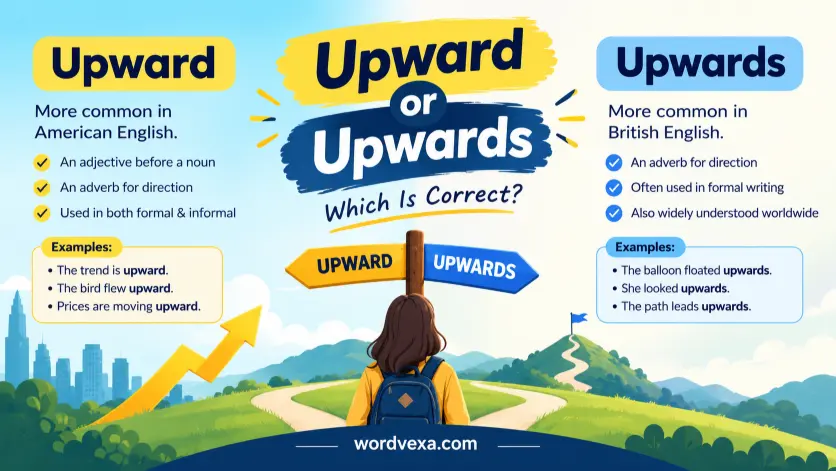
Both upward and upwards are correct English words. They often mean the same thing: moving toward a higher place, level, or position.
The main difference is that upward is more common in American English, while upwards is more common in British English. In most sentences, you can use either word without changing the meaning.
People often search for “upward or upwards” because they want to know which form is right for schoolwork, emails, articles, or formal writing. The good news is that you do not need to learn two different meanings to use these words well.
Both can describe physical movement, rising prices, growth, or progress. For example, you can say, “The balloon moved upward” or “The balloon moved upwards.”
There are a few cases where word choice depends on the sentence, writing style, and audience. This guide explains the meaning, origin, spelling differences, common mistakes, and everyday use of both words.
You will also learn which form to choose for American readers, British readers, and a global audience. By the end, you will know how to use upward and upwards with confidence.
Upward or Upwards: Quick Answer
Both spellings are correct. Use upward more often in American English and upwards more often in British English.
- Upward: The bird flew upward.
- Upwards: The bird flew upwards.
- Upward trend: The company saw an upward trend in sales.
- Move upwards: The lift moved upwards.
Both words can describe movement toward a higher point or a rise in value, level, or amount.
Quick tip: If you are writing for a US audience, upward is a safe choice. If you are writing for a UK audience, upwards is also very natural. Both forms are understood around the world.
Definition and Meaning of Upwards or Upward
What Does Upward Mean?
Upward is an adverb or adjective that describes movement, direction, or change toward a higher point or level.
In simple words, it means going up or moving higher.
Examples:
- The kite moved upward in the sky.
- The road has an upward slope.
- The business showed an upward trend.
- She looked upward at the stars.
As an adjective, upward comes before a noun to describe movement or direction.
Example: “The company reported an upward movement in profits.”
What Does Upwards Mean?
Upwards is an adverb that means toward a higher place or level. It is often used in British English.
Examples:
- The smoke drifted upwards.
- He glanced upwards.
- The water level moved upwards.
- The path leads upwards toward the hill.
In many sentences, upwards can replace upward without changing the meaning.
Are Upward and Upwards Different in Meaning?
Usually, no. Both words describe movement or change in a higher direction.
However, their grammatical roles can differ slightly in common use:
- Upward movement: Upward describes the type of movement.
- Move upwards: Upwards describes how something moves.
This is a useful pattern, but it is not a strict rule. You can also say “move upward,” and both forms are correct.
When Are These Words Used?
Both words are used in several contexts.
- Physical direction: The climber moved upward.
- Prices and numbers: Food prices are moving upwards.
- Growth and progress: The team is making upward progress.
- Looking or pointing: She looked upwards at the ceiling.
- Position or direction: The upward path was steep.
Remember that upward and upwards are not the same as up, above, or over in every sentence. Choose the word that fits the action you want to describe.
The Origin of Upward and Upwards
Where Does the Word Upward Come From?
The word upward has roots in Old English. It developed from up and -weard, an old word element that means “in the direction of.”
Over time, upward came to describe movement toward a higher place or position. It later gained wider use in expressions about growth, progress, and rising values.
For example, an upward path moves toward a higher point. An upward trend shows a rise in numbers or activity.
Where Does the Word Upwards Come From?
Upwards developed from upward with the addition of the adverb ending -s. This ending appears in several English direction words, such as towards, backwards, and forwards.
Both forms have been used in English for a long time. Their meanings are very similar, but their popularity differs across regions.
Why Do Two Forms Exist?
English has many words with more than one accepted form. Some forms became more common in British English, while others became more common in American English.
Examples include:
- Toward and towards
- Forward and forwards
- Backward and backwards
- Upward and upwards
These differences do not mean that one form is always right and the other is always wrong. In most cases, both are accepted. Regional preference and sentence structure help determine which form sounds most natural.
British English vs American English Spelling
Is Upward American or British English?
Both forms are used in British and American English. However, upward is generally more common in American English, while upwards is often preferred in British English when used as an adverb.
There is no spelling change like colour and color. Instead, the difference is mainly one of usage and regional preference.
Comparison Table
| Feature | American English | British English |
| Common adverb form | Upward | Upwards |
| Adjective before a noun | Upward trend | Upward trend |
| Movement example | Move upward | Move upwards |
| Rising prices | Prices are moving upward | Prices are moving upwards |
| Accepted spelling | Both forms | Both forms |
Examples in Both Varieties
American English:
- The plane moved upward through the clouds.
- The company reported an upward trend.
- She looked upward toward the window.
British English:
- The plane moved upwards through the clouds.
- The company reported an upward trend.
- She looked upwards towards the window.
Notice that upward trend remains natural in both varieties. The adjective form upward is widely used in both British and American English.
Which Spelling Should You Use?
For American Readers
Choose upward if you want to follow common American usage, especially in general writing and descriptions of movement.
Examples:
- The arrow points upward.
- The graph shows an upward trend.
- The temperature is moving upward.
For British and Commonwealth Readers
Upwards is a natural choice when describing movement or direction in British English. It is also used in other varieties of English, including some Commonwealth writing.
Examples:
- The child looked upwards.
- The balloon floated upwards.
- The path continued upwards.
For adjectives, upward remains common in British English too.
For International Readers
If your article is aimed at readers around the world, either form is acceptable.
For your grammar content on Wordvexa, the best approach is to:
- Choose one form as your main style.
- Use the same form consistently.
- Follow your target audience’s regional preference.
- Keep upward trend and similar adjective phrases when they fit naturally.
My recommendation: Use upward as the default for a general international or American-focused article, and explain that upwards is equally correct and often preferred in British adverbial usage.
Common Mistakes with Upward or Upwards
Mistake 1: Thinking One Word Is Incorrect
Incorrect belief: “Upwards is always wrong in American English.”
Correction: Both forms are understood and accepted. Upward is simply more common in many American contexts.
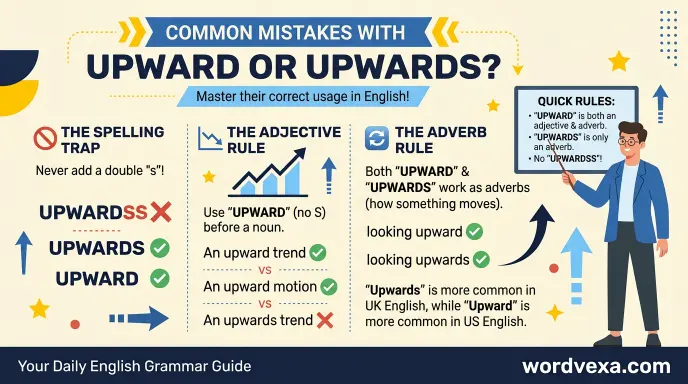
Mistake 2: Adding an Extra Ending
Incorrect: The bird flew upwardss.
Correct: The bird flew upwards.
The standard spelling has only one final s in upwards.
Mistake 3: Using Upwards as an Adjective
Less natural: The upwards movement was clear.
Better: The upward movement was clear.
Upward is the usual adjective before a noun. In contrast, upwards commonly works as an adverb.
Mistake 4: Changing Forms Without a Reason
Inconsistent: The graph moved upward, then continued upwards, then turned upward again.
Better: The graph moved upward, continued upward, and then turned downward.
Both forms can be correct, but consistent wording makes your writing easier to follow.
Mistake 5: Confusing Upward with Upwards in Every Context
There is no need to replace every instance of upward with upwards to make writing British, or every instance of upwards with upward to make writing American. Pay attention to the audience and grammatical role.
Mistake 6: Assuming Upward Always Means Physical Movement
Incorrect belief: “Upward can only describe something moving higher.”
Correction: It can also describe abstract change.
Examples:
- An upward trend in sales.
- Upward pressure on prices.
- Upward social mobility.
These expressions describe changes in value, influence, or position rather than physical movement.
Upward and Upwards in Everyday Examples
1. In Emails
Using upward:
Subject: Monthly Sales Update
Sales have shown an upward trend this month. We expect this progress to continue in the coming weeks.
Using upwards:
Subject: Project Progress
Our performance has moved upwards this quarter, and the team is working to maintain this progress.
Both are understandable. In professional writing, upward trend is a particularly natural phrase.
2. In News Reports
- The market moved upward after the announcement.
- The cost of living continued to move upwards.
- The report showed an upward trend in employment.
- The plane climbed upwards into the sky.
These examples show how the words can describe movement, economic changes, and statistical trends.
3. On Social Media
- Keep moving upward and believe in your progress.
- Small steps can take you upwards toward your goals.
- The chart shows an upward trend this week.
- Look upward and keep dreaming big.
Both words work well in captions. The choice often depends on the writer’s preferred style.
4. In Formal and Academic Writing
- The data reveal an upward trend in annual revenue.
- The temperature increased upwards throughout the test.
- The graph displays an upward movement in demand.
- The ladder extends upward along the wall.
For academic writing, prefer clear and direct expressions. For example, “The data show an upward trend” is more natural than “The data show an upwards trend” when upward is being used as an adjective.
5. In Daily Conversation
- Look upward at the sky.
- The stairs go upwards.
- The balloon floated upward.
- The prices are moving upwards.
There is no major difference in meaning in these examples.
Upward or Upwards: Google Trends and Usage Data
Which Word Is More Popular?
Upward and upwards are both established English words. Their relative popularity depends on the country, context, and grammatical use.
In general, upward is more common in American English, while upwards is often more common in British English for adverbial use. The adjective upward is widely used in both varieties.
Usage by Country and Context
| Region or context | Common preference | Example |
| United States | Upward | The plane moved upward. |
| United Kingdom | Upwards for direction | The plane moved upwards. |
| Canada | Both forms | The balloon rose upward. |
| Australia | Both forms | The child looked upwards. |
| International business | Upward in many phrases | An upward trend in sales. |
| Academic writing | Upward before nouns | Upward economic growth. |
These are general usage patterns, not exact rankings or measured percentages.
What Does Google Trends Tell Us?
Google Trends can help compare search interest for “upward” and “upwards” across countries and time periods. However, search interest does not directly measure how often people use a word in everyday speech or writing.
No verified live Google Trends figures are included here, so exact percentages or country rankings should not be assumed.
For a useful comparison, set the location to the United States or United Kingdom, select a period such as the past five years, and compare both search terms. Also remember that searches for upward may include adjective phrases such as “upward trend,” which can affect the results.
Upward vs Upwards: Side-by-Side Comparison
| Feature | Upward | Upwards |
| Meaning | Toward a higher point | Toward a higher point |
| Part of speech | Adjective and adverb | Adverb |
| American English | Very common | Also accepted |
| British English | Common, especially as an adjective | Common as an adverb |
| Before a noun | An upward slope | Usually not used this way |
| Movement | Move upward | Move upwards |
| Trend | An upward trend | Usually “an upward trend” |
| Correct spelling | Yes | Yes |
The main distinction is grammatical use: upward works as both an adjective and an adverb, while upwards is generally used as an adverb.
FAQs About Upward or Upwards
Q1. Is upward or upwards correct?
Both are correct. Upward is more common in American English, while upwards is often preferred in British English when describing movement.
Q2. Is upwards grammatically correct?
Yes. Upwards is a standard English adverb meaning toward a higher place, level, or position.
Example: “The balloon floated upwards.”
Q3. Is upward American or British?
It is used in both. It is especially common in American English and is also widely used in British English, particularly before nouns.
Example: “The company reported an upward trend.”
Q4. Do upward and upwards mean the same thing?
Yes, when used as adverbs to describe direction, they usually have the same meaning.
Example: “She looked upward” and “She looked upwards” both describe looking toward a higher point.
Q5. Should I write upward trend or upwards trend?
Use upward trend. Here, upward is an adjective that describes the noun trend. This is the standard and natural expression in both British and American English.
Q6. Is upwards formal or informal?
Upwards is suitable for both formal and informal writing. You can use it in reports, emails, essays, and everyday conversation.
Q7. Which word should English learners use?
English learners can use both forms. If you want one simple default, choose upward, especially for adjective phrases such as upward movement and upward trend. Use upwards when it fits your preferred variety of English.
Conclusion: Upwards vs Upward?
Both upward and upwards are correct English words. They usually describe movement toward a higher point, level, or position. The main difference is regional preference and grammatical use, not meaning.
Upward is particularly common in American English and is widely used in both British and American writing as an adjective. For example, “an upward trend” is the natural choice when describing rising sales, prices, or numbers. Upwards is often used in British English as an adverb, as in “The balloon floated upwards.”
When choosing between these words, think about your audience and the sentence. For American readers, upward is a safe default. For British readers, upwards is natural when describing direction. For international writing, either form works well, provided you use it clearly and consistently.
For grammar articles, school assignments, professional emails, and website content, focus on correct sentence structure rather than treating one form as wrong. Once you understand their grammatical roles, choosing between upward and upwards becomes easy.
The final rule: Both are correct. Use upward before nouns and choose either form for direction, based on your audience and style.
Discover More Articles:
- Yey or Yay: The Right Way to Express Happiness
- Drifter or Operator: Meaning, Differences, and Examples
- Form or Forum: Meaning, Spelling, and Examples

I’m Sloane Mercer, a U.S.-based English language writer focused on grammar, spelling, vocabulary, and everyday English usage. Through Wordvexa, I provide clear and practical explanations to help readers choose the right words and communicate with confidence.



2 thoughts on “Upward vs Upwards: The Simple Difference Explained”