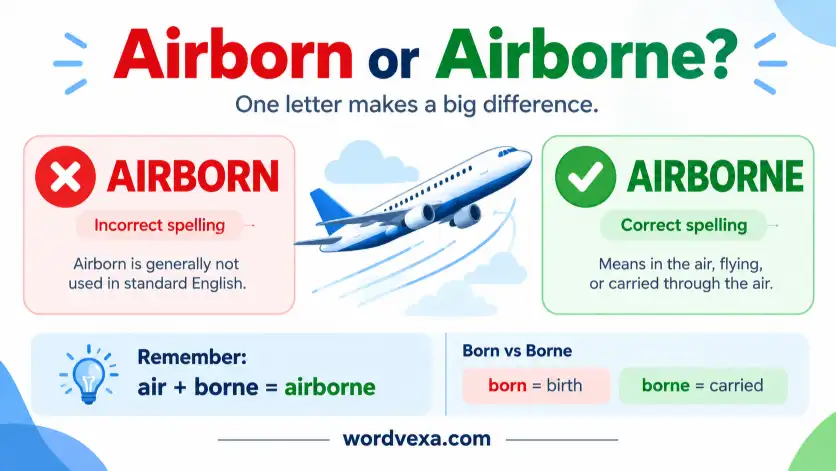
Airborn or airborne? The correct spelling is airborne. It means something that is in the air, moving through the air, or carried by air, while airborn is generally an incorrect spelling in standard English.
The difference is only one letter, but it can easily cause confusion in schoolwork, emails, articles, and professional writing.
People often search for “airborn or airborne” because the word born is very common in English. This can make airborn seem like a natural spelling. However, the correct word ends in -borne, not -born.
The word airborne is used in many contexts. You may see it in aviation, science, medicine, military writing, news reports, and everyday conversation. For example, we can say, “The plane is airborne” or “Airborne particles can travel through the air.”
In this guide, you will learn the meaning, origin, correct usage, common mistakes, regional usage, and practical examples of airborne. Let’s look at the answer more closely.
Airborn or Airborne: Quick Answer
Airborne is the correct spelling. Airborn is generally incorrect when you mean something that is in the air, carried through the air, or transported by air.
Examples:
- The airplane is airborne.
- The helicopter became airborne within minutes.
- Some particles can remain airborne for a long time.
The easiest way to remember the spelling is:
air + borne = airborne
What Does Airborne Mean?
Airborne is an adjective that describes something that is in the air, moving through the air, or carried by air.
It can describe an aircraft that has left the ground, particles floating in the atmosphere, or something transported through the air.
For example:
The plane is airborne.
This means the plane is flying and is no longer on the ground.
Another example is:
Dust became airborne when the door opened.
Here, airborne means that the dust particles were carried into the air.
Common meanings of airborne
The word can have slightly different meanings depending on context:
- In the air
- Flying
- Suspended in the air
- Carried through the air
- Transported by aircraft
Airborne in different contexts
Aviation:
The aircraft became airborne after takeoff.
Science:
The researchers studied airborne particles.
Environmental writing:
Airborne pollutants can affect air quality.
Military writing:
The airborne unit was deployed to the area.
Everyday English:
The wind sent dust airborne.
The meaning is usually easy to understand from the context.
The Origin of Airborne
The word airborne is made from two parts: air and borne.
The word air refers to the atmosphere surrounding the Earth. Borne is related to the verb bear, which can mean to carry or support.
This explains why the word is spelled airborne rather than airborn.
Born vs borne
The words born and borne are related but have different uses.
Born is mainly associated with birth:
She was born in 1998.
Borne can refer to something carried, supported, or transported:
The cost was borne by the company.
The adjective airborne follows the second idea. It refers to something that is in or carried through the air.
Similar compound words include:
- Waterborne
- Seaborne
- Landborne
These words also use -borne to express the idea of being carried or transported.
British English vs American English
There is no significant British-American spelling difference for airborne. Both British English and American English use airborne as the standard spelling.
| British English | American English | Example |
| airborne | airborne | The aircraft is airborne. |
| airborne | airborne | Airborne particles were detected. |
| airborne | airborne | The helicopter remained airborne. |
Unlike words such as colour/color or centre/center, airborne normally keeps the same spelling in both varieties of English.
Regional usage
Writers in the United States, United Kingdom, Canada, Australia, and other English-speaking regions generally use airborne.
This makes the word particularly simple for international writers. You do not normally need to change its spelling based on your target audience’s country.
Style guides
Academic institutions, publishers, businesses, newspapers, and professional organizations may have their own style preferences for wording and terminology. However, the standard spelling of this adjective remains airborne.
Which Version Should You Use?
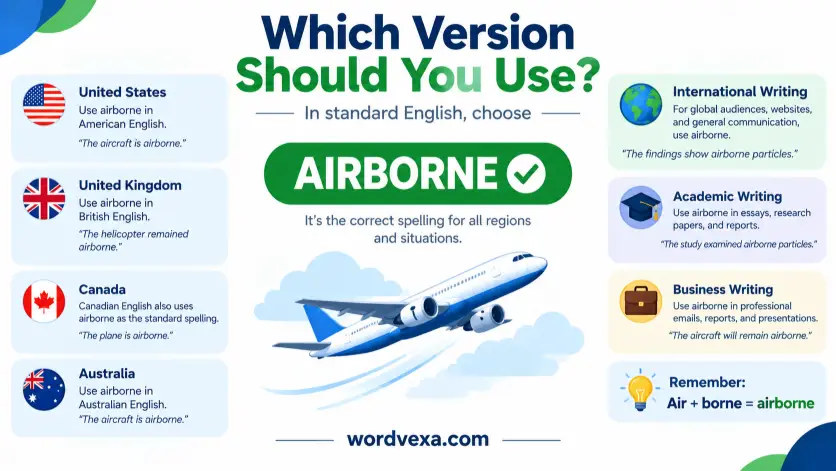
In standard English, choose airborne.
United States
Use airborne in American English.
The aircraft is now airborne.
United Kingdom
Use airborne in British English.
The helicopter remained airborne for several hours.
Canada
Canadian English also uses airborne as the standard spelling.
Australia
Use airborne in Australian English as well.
International writing
For international websites, blogs, educational resources, and general communication, airborne is the safest choice.
Academic writing
Use airborne in essays, research papers, reports, and academic assignments.
The researchers examined airborne particles in indoor environments.
Business writing
Use airborne in professional emails, reports, and business documents.
The aircraft will remain airborne until weather conditions improve.
Common Mistakes
The most common error is writing airborn instead of airborne.
| Incorrect Example | Correct Example | Explanation |
| The plane is airborn. | The plane is airborne. | The standard spelling ends in -borne. |
| Airborn particles were detected. | Airborne particles were detected. | Airborne is the established adjective. |
| The helicopter became airborn. | The helicopter became airborne. | Use airborne for something in the air. |
| The aircraft is still airborn. | The aircraft is still airborne. | The final e is part of the correct spelling. |
Why is airborn confusing?
The confusion comes from the familiar word born.
Most English learners frequently see words such as:
born, newborn, unborn
Because born is so common, it is easy to assume that airborn should also be correct.
However, airborne is formed with borne, not born.
Memory tip
Use this simple rule:
Air + borne = airborne
Think of borne as meaning carried.
Something that is carried through the air is therefore airborne.
Everyday Examples
The word airborne appears in both formal and informal communication.
Emails
The aircraft is now airborne, so we expect to arrive shortly.
Please begin the test once the drone is airborne.
Business Writing
The company is developing equipment to monitor airborne particles.
The aircraft remained airborne despite changing weather conditions.
News Headlines
Airborne Team Reaches Remote Location
Scientists Study Airborne Particles
The word is useful in headlines because it is concise and precise.
Blogs
Construction work can cause dust to become airborne.
Airborne particles may move through indoor spaces.
Social Media
Finally airborne!
The drone is airborne and ready for testing.
Academic Writing
The study examined the concentration of airborne particles.
Researchers investigated the movement of airborne pollutants.
Daily Conversation
Is the plane airborne yet?
The helicopter is already airborne.
The wind sent the leaves airborne.
Google Trends & Modern Usage
Searches for “airborn or airborne” usually reflect spelling uncertainty rather than two equally accepted spellings.
People may encounter airborn online or type it because they are unsure if the word should end in -born or -borne. The similarity in pronunciation can also contribute to the confusion.
Modern standard English uses airborne in a wide range of contexts.
The word is common in areas such as:
- Aviation
- Science
- Medicine
- Environmental studies
- Military terminology
- Journalism
- Transportation
- Academic writing
Exact search-volume statistics should not be assumed without current data. However, the general usage pattern is clear: airborne is the standard spelling for the intended adjective.
Quick Comparison Table
| Version | Meaning | Correct? | Region | Example |
| airborne | In or carried through the air | Yes | International | The plane is airborne. |
| airborn | Usually an incorrect spelling of airborne | No | Not standard | The plane is airborn. |
The important difference is the final e:
Correct: airborne
Incorrect: airborn
Airborne vs Born and Borne
Understanding born and borne makes the spelling easier to remember.
| Word | Main Meaning | Example |
| born | Related to birth | She was born in June. |
| borne | Carried or supported | The cost was borne by the company. |
| airborne | In or carried through the air | The aircraft is airborne. |
So, although born and borne look and sound similar, they should not be treated as interchangeable.
Key Takeaways
- Airborne is the correct standard spelling.
- Airborn is generally an incorrect spelling.
- Airborne means in, moving through, or carried by air.
- The word is formed from air + borne.
- Born is mainly associated with birth.
- Borne can express the idea of being carried.
- British and American English both use airborne.
- Use airborne in academic, professional, and everyday writing.
Frequently Asked Questions
Q1. Is airborn or airborne correct?
Airborne is correct. Airborn is generally a misspelling when you mean something that is in the air or carried through the air. For example, write “The plane is airborne,” not “The plane is airborn.” The standard adjective uses -borne at the end.
Q2. What does airborne mean?
Airborne means being in the air, moving through the air, or carried by air. It can describe an aircraft that is flying, particles suspended in the atmosphere, or something transported through the air. For example, “The helicopter is airborne” means that it has left the ground.
Q3. Is airborn a word?
Airborn is not the standard spelling of the adjective normally intended by this expression. In standard English, the correct form is airborne. If you are writing an essay, email, article, report, or professional document, use airborne rather than airborn.
Q4. Why is airborne spelled with an e?
Airborne contains borne, which is connected with the idea of carrying or being carried. The word combines air with borne to describe something in or carried through the air. Therefore, the standard spelling is airborne, not airborn.
Q5. Is airborne the same in British and American English?
Yes. Airborne is the standard spelling in both British and American English. Unlike words such as colour/color, it does not normally have different regional spellings. Writers in the UK, US, Canada, Australia, and international contexts can generally use airborne.
Q6. What is an example of airborne?
A simple example is “The airplane is airborne.” This means the airplane has left the ground and is flying. Another example is “Airborne particles can move through the air.” The exact meaning depends on the context in which the word is used.
Q7. What is the difference between born and borne?
Born is mainly used in connection with birth, as in “She was born in 2000.” Borne can mean carried or transported, as in “The cost was borne by the company.” The word airborne uses borne because it refers to something in or carried through the air.
Q8. Is airborne one word or two words?
Airborne is normally written as one word. The standard spelling is not air borne. For example, write “airborne particles” and “the aircraft became airborne.” The single-word form is the accepted standard adjective in ordinary English usage.
Q9. Can airborne be used for diseases?
Yes. Airborne can describe diseases, pathogens, or particles that are transmitted through the air when that description is scientifically appropriate. For example, airborne pathogen is a common term. In medical or scientific writing, the exact method of transmission should be described carefully rather than using airborne as a general label.
Q10. How can I remember the spelling of airborne?
Use the simple memory rule air + borne = airborne. Think of borne as being connected with the idea of carrying. Since something airborne is in or carried through the air, the correct ending is -borne, not -born.
Conclusion
When choosing between airborn or airborne, the correct answer is airborne. The word describes something that is in the air, flying, or carried through the air. The spelling airborn is generally incorrect and usually results from confusion between the words born and borne.
The easiest way to remember the difference is to focus on the meaning of borne. It can relate to something being carried or transported. That is why the established compound is air + borne = airborne.
There is also no major British or American spelling difference to worry about. If you are writing for readers in the United States, United Kingdom, Canada, Australia, or an international audience, airborne is the standard choice.
Use airborne in school assignments, academic writing, professional documents, emails, articles, and everyday communication. Once you remember the -borne ending, this spelling becomes easy to get right.
When something is in or carried through the air, remember: air + borne = airborne.
Read More Articles:

I’m Claire Morgan, the author behind wordvexa.com, where I write about English grammar, sentence structure, punctuation, and everyday language. My goal is to make grammar simple, clear, and practical, helping readers understand the rules and apply them with confidence in real-world writing.







